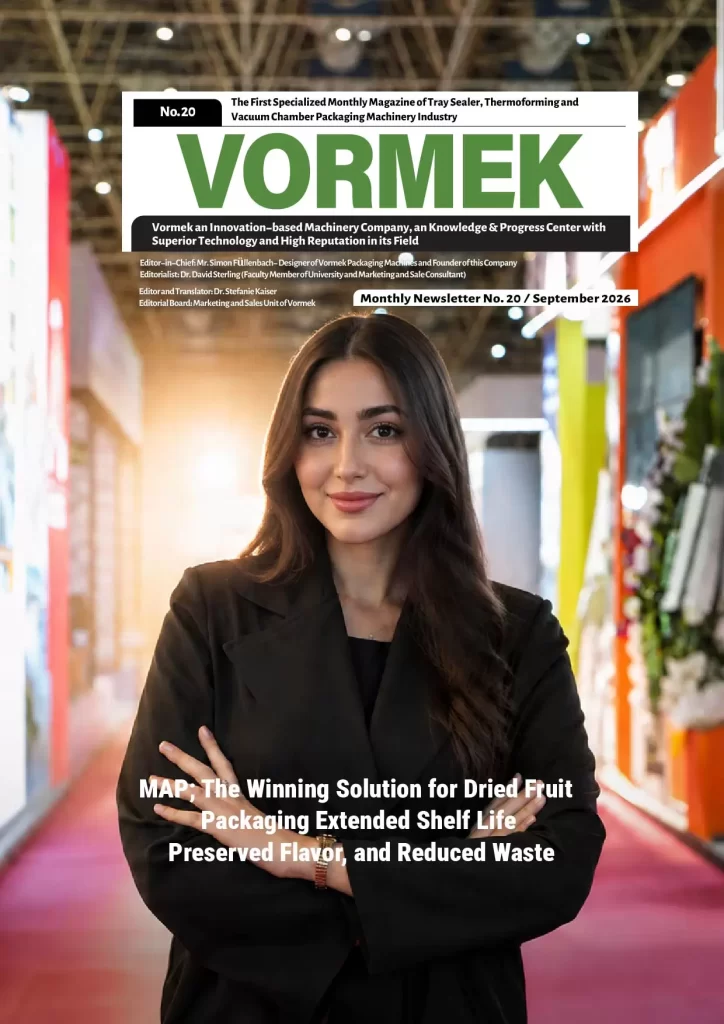
MAP Packaging for Bread: 7 Best Proven Solutions (Issue 17)
In modern commercial baking and industrial cereal processing, producers face severe challenges regarding premature staling and mold spoilage. Traditional chemical preservative additives no longer satisfy clean-label consumer expectations. Today, implementing high-precision MAP packaging for bread has emerged as the definitive industrial breakthrough for bakeries seeking extended shelf stability, zero chemical aftertaste, and expanded regional distribution networks.

Figure 1: High-barrier MAP packaging for bread using Vormek automated tray sealer machinery.
In this demanding operational landscape, industrial tray sealers and thermoforming systems play an irreplaceable role. By replacing ambient atmospheric oxygen with controlled protective gases, bakeries transform short-lived artisanal loaves, pita, sandwich bread, baguettes, and sliced toast into durable, retail-ready products suitable for competitive supermarket supply chains.
🔹 Overcoming Staling and Microbial Spoilage in Industrial Bakeries
“In commercial bakery supply chains, shelf life is not merely a technical specification—it defines the commercial viability of your distribution network. When products mold within 48 hours, delivery boundaries remain constricted. Adopting automated MAP packaging for bread breaks these limitations, enabling nationwide delivery with pristine crumb elasticity and authentic baked aroma.”
Bread and bakery products possess high water activity ($a_w$) and porous internal crumb structures, rendering them acutely susceptible to xerophilic molds such as Penicillium and Aspergillus species. Scientific research documented in ScienceDirect studies on modified atmosphere packaging confirms that elevating carbon dioxide (CO₂) concentrations above 60% effectively arrests fungal spore germination while preserving crumb moisture without crust hardening.
🔸 Seven Core Technical Advantages Explored in Issue 17
The seventeenth volume of Vormek Magazine delivers a comprehensive engineering guide dedicated specifically to the bread and cereals manufacturing sector. In this edition, we examine why adopting MAP packaging for bread outperforms traditional flow wrapping and simple bags:
- Chemical-Free Mold Suppression: Utilizing an optimized blend of carbon dioxide (CO₂) and balance nitrogen (N₂) suppresses fungal sporulation naturally, eliminating artificial calcium propionate preservatives.
- Crumb Elasticity and Moisture Retention: Gas flushing prevents moisture migration from the gluten matrix to the crust, ensuring soft texture and slowing retrogradation staling.
- Structural Anti-Crush Protection: Unlike flexible pillow bags, rigid tray sealing shields delicate pastries, artisanal croissants, flatbreads, and burger buns from transit crushing.
- Hermetic Seal Integrity under High Speeds: Industrial tray sealers with precision servo clamping eliminate micro-channels and flour dust seal contamination.
- Anti-Fog Lidding Film Compatibility: Advanced micro-coated barrier films eliminate internal condensation, guaranteeing crystal-clear product visibility in retail display cabinets.
- Extended Ambient Shelf Life: Validated operational data demonstrate shelf life extension from 3 days up to 21+ days depending on moisture content and barrier film specifications.
- Expansion into Modern Retail and Export: Meeting strict logistics timelines required by hypermarkets, hospitality chains, airline catering, and international cross-border export.
🔹 Engineering Insights on Gas Flush Calibration and Tooling
Achieving reliable barrier performance with MAP packaging for bread requires precise equipment calibration. Because bakery products contain internal trapped air within crumb cavities, standard gas flushing can fail if residual oxygen remains unevacuated. Vormek specialized tray sealers utilize rapid pulsed-vacuum technology combined with synchronized gas injection to reach residual oxygen thresholds below 0.8% without collapsing soft dough structures.
🔹 Actionable ROI for Commercial Bakery Facilities
By integrating automated tray sealers with existing bread slicing, cooling, and automated loading lines, plant operators substantially decrease labor overhead while boosting daily output. High-speed quick-change tooling allows bakeries to switch between multi-pack rolls, par-baked loaves, and specialty gluten-free items with minimal production downtime.
🔹 Who Benefits Most from This Issue?
Whether you oversee an industrial commercial bakery, operate centralized commissary kitchens, or produce par-baked artisan loaves, the insights in this edition provide immediate operational clarity. Implementing proven MAP packaging for bread directly lowers daily return rates, reduces waste disposal expenses, and dramatically expands your brand’s retail profitability.
Download Vormek Magazine Issue 17 (PDF)
Access the complete digital publication with comprehensive technical schematics, MAP gas mixture charts, and real-world industrial case studies.
To explore our complete range of specialized equipment, visit our overview of industrial tray sealer packaging machines or consult directly with our packaging technical team.
Wishing you sustained freshness and commercial expansion in every loaf.
Editor-in-Chief, Vormek Magazine