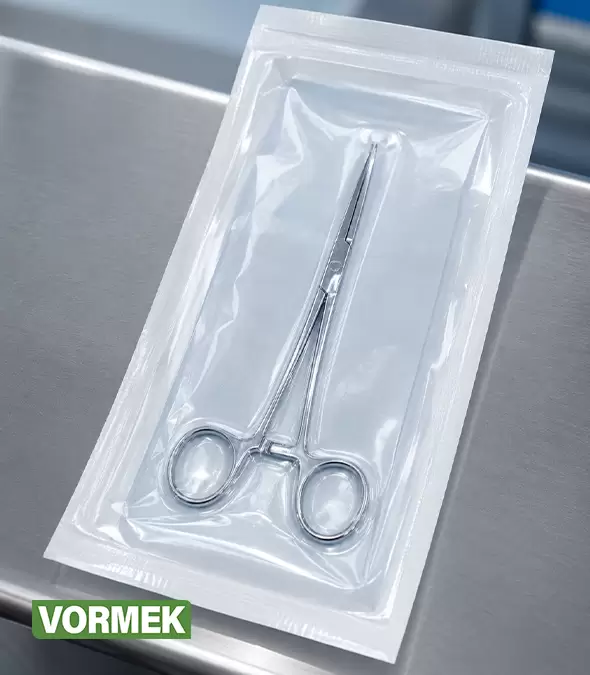
Medical packaging plays a critical role in protecting healthcare products from contamination, maintaining sterility, and ensuring patient safety. Unlike conventional industrial packaging, medical packaging is considered part of the overall medical device system because its performance directly affects product integrity throughout storage, transportation, and clinical use.
From surgical instruments and diagnostic kits to implantable devices and laboratory consumables, every product must remain protected until the moment it is opened by healthcare professionals. Even a microscopic defect in a package seal may compromise sterility and render an otherwise perfect product unusable.
To meet these demanding requirements, manufacturers require packaging equipment capable of producing repeatable, validated, and high-quality seals while complying with international medical standards.
Vormek develops industrial packaging machines designed to support manufacturers of medical devices, pharmaceutical accessories, laboratory products, and sterile healthcare components. By combining advanced automation, hygienic engineering, and precise sealing technology, Vormek helps manufacturers improve packaging quality while reducing production risks and operational costs.
Medical & Sterile Packaging Solutions
Medical packaging is much more than placing a product inside a protective container. A complete packaging solution must protect the product throughout its entire lifecycle—from production and sterilization to warehousing, transportation, hospital storage, and final clinical use.
An effective medical packaging system should achieve several objectives simultaneously:
- Maintain sterility after sterilization
- Protect products from mechanical damage
- Prevent microbial contamination
- Resist moisture and environmental exposure
- Ensure easy aseptic opening
- Support product traceability
- Meet international regulatory requirements
- Deliver consistent package quality across every production batch
Achieving these goals requires both high-performance packaging materials and precision packaging machinery.
Why Medical Packaging Requires Specialized Equipment
Packaging requirements in healthcare are significantly more demanding than in most industrial sectors. While cosmetic imperfections may be acceptable in consumer packaging, medical packaging leaves virtually no room for error.
Packaging equipment must deliver highly repeatable sealing conditions, including accurate control of temperature, pressure, and sealing time. Even slight process variations may reduce seal strength or compromise the sterile barrier.
Modern medical packaging equipment is therefore designed with:
- Programmable sealing recipes
- PLC-controlled process monitoring
- Servo-driven motion systems
- Hygienic stainless-steel construction
- Digital production records
- High process repeatability
These features enable manufacturers to maintain consistent packaging quality while simplifying validation and quality assurance procedures.
Products Commonly Packaged in the Medical Industry
Medical packaging machines are used across numerous healthcare applications.
Typical products include:
- Surgical instrument sets
- Orthopedic implants
- Dental kits
- Disposable syringes
- Catheters
- IV components
- Diagnostic test kits
- Laboratory consumables
- Surgical gloves
- Sterile drapes
- Medical tubing
- Wound care products
- Pharmaceutical accessories
- Disposable plastic devices
- Procedure packs
Each product requires a packaging solution tailored to its size, geometry, sterilization method, and handling requirements.
Packaging Materials Used for Sterile Medical Products
Selecting the correct packaging material is as important as selecting the packaging machine. Medical packaging materials must protect products while remaining compatible with sterilization processes.
Medical-Grade Paper
Medical paper is widely used for products sterilized using ethylene oxide or steam. It provides excellent microbial barrier performance while allowing sterilizing gases to penetrate the package.
Typical applications include:
- Surgical instruments
- Disposable medical devices
- Hospital procedure packs
Tyvek®
Tyvek® has become one of the most widely used medical packaging materials due to its exceptional microbial barrier properties, puncture resistance, and compatibility with multiple sterilization methods.
It is commonly used for:
- Implantable devices
- Catheters
- Orthopedic products
- High-value sterile medical devices
PETG Trays
Rigid PETG trays provide outstanding dimensional stability, transparency, and product presentation while protecting delicate medical components during transportation.
Typical products include:
- Surgical kits
- Implant trays
- Dental procedure kits
- Diagnostic products
High-Barrier Medical Films
Medical packaging frequently uses multilayer barrier films manufactured from combinations of:
- PET
- PE
- PA
- EVOH
- Medical laminates
These materials provide protection against oxygen, moisture, and mechanical damage while supporting reliable heat sealing.
Sterile Barrier Systems
One of the most important concepts in healthcare packaging is the Sterile Barrier System (SBS).
The sterile barrier system is designed to prevent microorganisms from entering the package after sterilization while allowing healthcare professionals to open the package aseptically.
A reliable sterile barrier system should provide:
| Requirement | Purpose |
|---|---|
| Seal integrity | Prevent microbial ingress |
| Mechanical strength | Protect during transportation |
| Sterilization compatibility | Maintain performance after sterilization |
| Peelability | Allow safe aseptic opening |
| Barrier protection | Resist moisture and contamination |
The packaging machine is a key contributor to the performance of the sterile barrier system because sealing quality determines whether sterility can be maintained throughout the product’s shelf life.
Sterilization Methods and Packaging Compatibility
Medical packaging must remain stable after exposure to various sterilization processes.
The most common sterilization methods include:
| Sterilization Method | Typical Packaging Requirement |
|---|---|
| Ethylene Oxide (EtO) | Gas-permeable packaging materials |
| Gamma Irradiation | Radiation-resistant films |
| Electron Beam | Stable multilayer materials |
| Steam Sterilization | Heat-resistant packaging |
| Hydrogen Peroxide Plasma | Low-moisture compatible materials |
Packaging equipment must produce consistent seals regardless of the sterilization process selected.
Critical Packaging Parameters
Reliable medical packaging depends on accurate control of several process variables.
Key packaging parameters include:
- Sealing temperature
- Sealing pressure
- Dwell time
- Vacuum level
- Film tension
- Tool alignment
- Tray positioning
- Cycle consistency
Advanced packaging systems continuously monitor these variables to reduce process variation and improve package quality.
Why Seal Integrity Is Critical
Seal integrity is one of the most important quality indicators in sterile packaging.
Poor sealing may result in:
- Microbial contamination
- Moisture ingress
- Product rejection
- Sterility loss
- Regulatory non-compliance
- Increased production waste
Common sealing defects include:
- Channel leaks
- Incomplete seals
- Wrinkled seals
- Burned seals
- Uneven seal width
- Weak peel strength
Modern tray sealing systems minimize these risks through precise control of temperature, pressure, and sealing time.
Packaging Challenges in Medical & Sterile Processing
Manufacturers of medical devices face unique packaging challenges that extend beyond simply sealing a package. Every packaging process must consistently deliver validated performance while protecting sterile products throughout transportation, storage, and clinical use.
Some of the most common challenges include:
- Maintaining seal consistency across long production runs
- Preventing contamination during packaging
- Selecting compatible packaging materials
- Meeting cleanroom requirements
- Supporting multiple sterilization methods
- Reducing operator-related variation
- Achieving full traceability
- Complying with international medical packaging standards
Addressing these challenges requires packaging equipment designed specifically for regulated medical manufacturing environments.
Packaging Challenges in Medical & Sterile Processing
Medical device manufacturers operate in one of the world’s most highly regulated production environments. Unlike conventional packaging operations, every stage of the packaging process must be controlled, documented, validated, and repeatable. The packaging machine is not simply a production asset—it is an integral part of the quality assurance system.
A successful medical packaging process must consistently protect the sterile barrier while maintaining production efficiency and minimizing the risk of non-conforming products.
The following challenges are among the most significant in modern medical manufacturing.
Maintaining Sterility Throughout the Supply Chain
Sterility is established during the sterilization process, but it is preserved by the packaging.
Once a medical product leaves the sterilizer, its packaging becomes the primary barrier against microorganisms, dust, moisture, and physical damage. The package must maintain its integrity during transportation, warehouse storage, distribution, and handling until it is opened by healthcare professionals.
Even microscopic seal defects can compromise the sterile barrier and result in product rejection.
To minimize this risk, packaging equipment must provide:
- Stable sealing pressure
- Accurate sealing temperature
- Repeatable dwell time
- Uniform seal width
- Consistent cycle performance
Compliance with International Standards
Medical packaging must comply with strict international regulations to ensure product safety and quality.
Among these, ISO 11607 is recognized as the primary standard for packaging terminally sterilized medical devices.
Rather than focusing only on the finished package, ISO 11607 emphasizes validation of the entire packaging process, including equipment, materials, sealing parameters, and performance testing.
Key requirements include:
| ISO 11607 Requirement | Purpose |
|---|---|
| Packaging material qualification | Verify material suitability |
| Process validation | Demonstrate repeatable production |
| Seal integrity verification | Maintain sterile barrier |
| Equipment qualification | Confirm machine capability |
| Package performance testing | Ensure durability during distribution |
| Documentation | Support audits and regulatory compliance |
Packaging systems equipped with programmable recipes and digital process monitoring make compliance significantly easier.
Equipment Qualification (IQ, OQ, and PQ)
Validation begins long before production starts.
Medical packaging equipment is generally qualified through three internationally recognized stages.
Installation Qualification (IQ)
Installation Qualification confirms that the equipment has been installed correctly and meets all manufacturer specifications.
Typical activities include:
- Electrical verification
- Pneumatic system inspection
- Utility confirmation
- Safety checks
- Calibration review
- Software installation verification
Operational Qualification (OQ)
Operational Qualification verifies that the machine consistently performs within predetermined operating limits.
Typical parameters include:
- Sealing temperature accuracy
- Pressure consistency
- Vacuum stability
- Alarm functionality
- PLC performance
- HMI operation
- Cycle repeatability
Performance Qualification (PQ)
Performance Qualification demonstrates that the packaging system consistently produces acceptable packages during normal production conditions.
Common PQ evaluations include:
- Long production runs
- Visual package inspection
- Seal strength testing
- Seal integrity verification
- Production consistency
- Material compatibility
Cleanroom Packaging
Many medical products are packaged inside controlled cleanroom environments to reduce the risk of particulate and microbial contamination.
Packaging equipment intended for cleanroom installation should feature:
- Stainless-steel construction
- Smooth hygienic surfaces
- Minimal particle generation
- Easy cleaning
- Enclosed mechanical components
- Corrosion-resistant materials
- Hygienic machine design
These features simplify sanitation procedures while supporting GMP and cleanroom requirements.
Packaging Material Compatibility
Medical packaging machines must accommodate a wide range of packaging materials, each requiring different sealing conditions.
Common medical packaging materials include:
- Tyvek®
- Medical-grade paper
- PETG trays
- PET films
- Medical PE
- Multilayer laminates
- High-barrier films
Because each material responds differently to heat and pressure, modern packaging machines allow operators to store multiple validated sealing recipes for quick and reliable product changeovers.
Seal Integrity Testing
Producing a seal is only the beginning. Manufacturers must verify that every seal maintains the sterile barrier throughout the product’s intended shelf life.
Common seal integrity testing methods include:
- Dye penetration testing
- Bubble leak testing
- Vacuum decay testing
- High-voltage leak detection
- Microbial challenge testing
These methods help identify leaks that may not be visible during routine inspection.
Seal Strength Testing
Medical packages must remain securely sealed during transportation while allowing healthcare professionals to open them safely and aseptically.
Seal strength testing evaluates:
- Peel force
- Seal uniformity
- Failure mode
- Seal width
- Peel consistency
Consistent sealing parameters are essential for achieving reliable test results and reducing production variability.
Digital Traceability
Modern healthcare manufacturing requires complete traceability throughout the packaging process.
Advanced packaging equipment can automatically record:
- Batch number
- Operator identification
- Production date and time
- Sealing temperature
- Sealing pressure
- Vacuum level
- Machine alarms
- Cycle count
- Production recipes
These digital records simplify audits, facilitate root-cause analysis, and support regulatory inspections.
Automation Reduces Human Error
Manual packaging operations increase the likelihood of inconsistent sealing, incorrect product placement, and documentation errors.
Automation improves both quality and productivity by reducing operator intervention.
Typical automation features include:
- Automatic tray feeding
- Servo positioning
- Barcode verification
- Vision inspection systems
- Automatic reject units
- Conveyor integration
- Recipe management
- Production monitoring
Automation also enhances repeatability, which is a critical requirement in regulated medical manufacturing.
Common Packaging Problems and Corrective Actions
The following table summarizes typical packaging defects encountered in medical production and practical solutions.
| Packaging Issue | Possible Cause | Recommended Action |
|---|---|---|
| Weak seal | Low sealing temperature | Optimize sealing profile |
| Burned seal | Excessive temperature | Reduce sealing temperature |
| Wrinkled film | Improper film tension | Adjust film feed system |
| Channel leak | Contamination in seal area | Improve product positioning and cleaning |
| Inconsistent peel force | Material variation | Validate material specifications |
| Tray deformation | Excessive sealing pressure | Adjust pressure settings |
| Vacuum loss | Worn sealing components | Inspect and replace tooling |
| Poor package appearance | Tool misalignment | Recalibrate sealing head |
Reducing Packaging Risks
An effective risk management strategy helps prevent defects before they occur.
Best practices include:
- Validating sealing parameters
- Performing routine equipment calibration
- Monitoring process consistency
- Training operators regularly
- Conducting preventive maintenance
- Inspecting packaging materials before production
- Recording critical process data
- Reviewing quality trends continuously
By integrating these practices into daily operations, manufacturers can improve product quality, reduce waste, and maintain compliance with international medical packaging standards.
Transition to Equipment Selection
Once packaging risks are controlled and validation requirements are established, selecting the appropriate packaging technology becomes the next critical step. The choice between tray sealing, thermoforming, vacuum packaging, or high-speed automation depends on the product type, production capacity, sterilization method, and long-term manufacturing objectives.
In the next section, we will explore the Recommended Vormek Machines for medical and sterile packaging, compare different packaging technologies, and provide practical guidance for selecting the most suitable solution for each application.
Recommended Vormek Machines
Choosing the right packaging equipment is essential for ensuring product safety, regulatory compliance, and long-term manufacturing efficiency. The ideal solution depends on several factors, including product dimensions, packaging material, sterilization method, production volume, and the level of automation required.
Vormek offers a complete range of packaging systems designed to meet the diverse needs of medical device manufacturers, pharmaceutical suppliers, laboratory equipment producers, and healthcare packaging companies.
Automatic Tray Sealers
Automatic Tray Sealers are the preferred solution for medical products packaged in rigid trays. They provide highly repeatable sealing performance while supporting high production efficiency and excellent package presentation.
These systems are suitable for manufacturers seeking consistent seal integrity with minimal operator intervention.
Typical Applications
- Surgical instrument trays
- Orthopedic implant kits
- Dental procedure kits
- Diagnostic testing kits
- Laboratory reagent trays
- Disposable medical devices
- Sterile medical accessories
- Medical procedure sets
Key Features
- PLC-controlled sealing parameters
- Servo-driven positioning
- Automatic tray indexing
- Digital recipe storage
- High seal repeatability
- Stainless-steel hygienic construction
- Fast product changeover
- Optional barcode and vision inspection integration
Because medical manufacturers often package multiple product sizes, programmable recipes allow rapid changeovers while maintaining validated sealing conditions.
High-Speed Tray Sealers
Large-scale medical manufacturers require packaging systems capable of continuous production without sacrificing quality.
High-Speed Tray Sealers are designed for high-output facilities that package thousands of units per shift.
Suitable Products
- Disposable syringes
- Diagnostic kits
- Laboratory consumables
- Pharmaceutical accessories
- Medical test components
- Hospital supply products
Advantages
- High production capacity
- Continuous automatic operation
- Stable sealing performance
- Automatic tray feeding
- Conveyor integration
- Vision inspection compatibility
- Automatic reject systems
- Low production downtime
These systems maximize Overall Equipment Effectiveness (OEE) while reducing labor requirements and improving process consistency.
Vacuum Chamber Packaging Machines
Vacuum packaging remains one of the most reliable solutions for protecting medical products from contamination, dust, and excessive package movement during transportation.
By removing air from the package before sealing, Vacuum Chamber machines create compact and secure packages that are easier to transport and store.
Recommended Applications
- Surgical instruments
- Medical tubing
- Catheter sets
- Procedure kits
- Sterile garments
- Disposable accessories
- Medical textiles
- Laboratory equipment
Main Benefits
- Reduced package volume
- Enhanced product protection
- Improved transportation efficiency
- Lower storage space requirements
- Better protection against moisture
- Professional package appearance
Vacuum packaging is particularly effective for products that require long-term storage before sterilization or distribution.
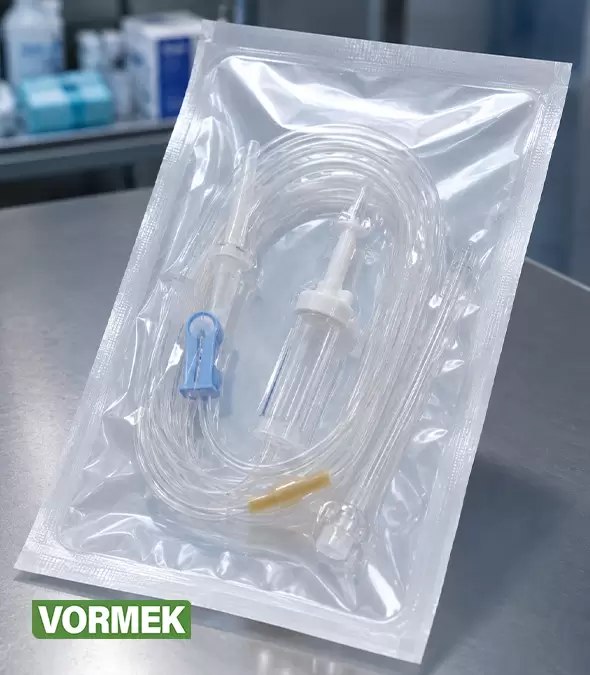
Thermoforming Packaging Machines
Thermoforming technology combines package forming, product loading, vacuum or gas flushing (when required), and sealing into one continuous production process.
Instead of using preformed trays, the machine creates custom cavities directly from medical-grade film, reducing material waste while increasing production speed.
Typical Medical Applications
- Disposable syringes
- IV components
- Catheters
- Diagnostic cartridges
- Medical filters
- Surgical blades
- Orthopedic implants
- Laboratory accessories
Benefits
- High production speed
- Excellent material utilization
- Flexible package design
- Consistent cavity dimensions
- Reduced packaging waste
- Reliable seal quality
- Easy automation integration
Thermoforming is especially suitable for manufacturers producing large volumes of standardized medical devices.
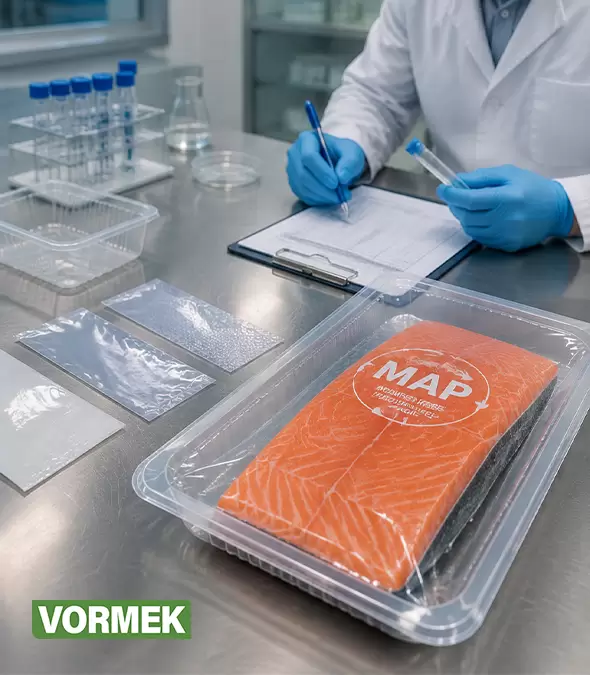
Modified Atmosphere Packaging (MAP)
Although MAP technology is primarily associated with food packaging, certain healthcare and laboratory products may benefit from modified atmosphere packaging.
Controlled gas environments can help protect moisture-sensitive products and reduce oxidation where applicable.
Potential applications include:
- Diagnostic reagents
- Biological research products
- Laboratory chemicals
- Moisture-sensitive medical components
- Specialized pharmaceutical accessories
The suitability of MAP depends on product characteristics and regulatory requirements and should always be validated during package development.
Which Machine Is Right for Your Product?
Selecting the appropriate packaging technology depends on the product’s characteristics and production requirements.
| Product Type | Recommended Machine | Packaging Format |
|---|---|---|
| Surgical instruments | Automatic Tray Sealer | PETG tray + Tyvek® lid |
| Orthopedic implants | Automatic Tray Sealer | Rigid sterile tray |
| Dental kits | Automatic Tray Sealer | Medical tray |
| Disposable syringes | Thermoforming Machine | Formed flexible package |
| Catheters | Thermoforming Machine | Flexible sterile pack |
| Diagnostic kits | Tray Sealer | Medical tray |
| Laboratory consumables | High-Speed Tray Sealer | Multi-cavity tray |
| Medical tubing | Vacuum Chamber | Vacuum pouch |
| Surgical gowns | Vacuum Chamber | Flexible sterile pouch |
| Procedure sets | Tray Sealer | Sterile tray |
Why Choose Vormek Medical Packaging Machines?
Medical manufacturers require more than reliable machinery—they need packaging systems that support validation, repeatability, hygiene, and future production growth.
Vormek equipment is engineered around these priorities.
Precision Process Control
Accurate process control is fundamental to medical packaging.
Vormek machines continuously regulate:
- Sealing temperature
- Sealing pressure
- Dwell time
- Vacuum level
- Cycle timing
- Alarm monitoring
- Recipe management
This minimizes process variation and helps maintain consistent package quality.
Hygienic Machine Design
Medical production environments demand equipment that is easy to clean and compatible with cleanroom operation.
Vormek machines feature:
- Stainless-steel construction
- Smooth hygienic surfaces
- Corrosion-resistant components
- Easy-access maintenance areas
- Minimal contamination points
- Washdown-friendly design
These features simplify sanitation while supporting GMP and clean manufacturing practices.
Flexible Production
Medical manufacturers frequently produce products of different sizes and configurations.
Quick-change tooling and programmable recipes enable fast product changeovers without compromising validated process parameters.
This flexibility reduces downtime and improves production efficiency.
Lower Total Cost of Ownership
Beyond the initial investment, packaging equipment should deliver long-term operational value.
Vormek systems help reduce costs through:
- Lower material waste
- Reduced package rejection
- Improved equipment uptime
- Lower maintenance requirements
- Faster changeovers
- Higher production efficiency
- Reduced operator dependency
Over the equipment’s lifecycle, these improvements contribute to a lower Total Cost of Ownership (TCO).
Related Technical Guides
Manufacturers evaluating medical packaging equipment may also benefit from the following technical resources:
- ISO 11607 Compliance Guide
- Tray Sealing vs. Thermoforming for Medical Devices
- Medical Packaging Material Selection
- Understanding Sterile Barrier Systems
- Seal Integrity Testing Methods
- Best Practices for Cleanroom Packaging
- Packaging Validation: IQ, OQ & PQ Explained
- Leak Testing for Sterile Medical Packaging
- Common Medical Packaging Defects and Solutions
- Designing an Efficient Medical Packaging Line
These guides help engineering, production, and quality teams improve packaging performance while supporting regulatory compliance.
Get a Custom Quote
Every medical manufacturing facility has unique packaging requirements. Product dimensions, packaging materials, sterilization methods, cleanroom classifications, production capacity, and automation goals all influence the selection of the most appropriate packaging solution.
Rather than offering a standard machine configuration, Vormek works with manufacturers to design packaging systems tailored to their production process. This approach helps ensure regulatory compliance, maximize production efficiency, and support future business growth.
When requesting a quotation, manufacturers should provide the following information:
- Product dimensions and weight
- Type of medical product
- Packaging material specifications
- Sterilization method
- Required production capacity
- Tray or pouch dimensions
- Cleanroom classification
- Desired automation level
- Utility availability
- Future expansion plans
Providing these details enables the engineering team to recommend the most suitable packaging solution while minimizing implementation time.
Choosing the Right Medical Packaging Machine
Selecting packaging equipment should be based on long-term operational performance rather than initial purchase price alone.
The following checklist can help manufacturers compare different packaging solutions.
| Selection Criteria | Why It Matters |
|---|---|
| Product type | Determines the appropriate packaging technology |
| Production capacity | Defines the required automation level |
| Packaging material | Influences sealing parameters |
| Sterilization method | Determines material compatibility |
| Validation capability | Supports regulatory compliance |
| Cleanroom compatibility | Reduces contamination risk |
| Changeover flexibility | Improves manufacturing efficiency |
| Technical support | Minimizes production downtime |
| Future scalability | Supports business expansion |
| Total Cost of Ownership (TCO) | Measures long-term investment value |
A well-planned investment reduces maintenance costs, minimizes production interruptions, and delivers consistent packaging quality throughout the equipment’s service life.
Summary Table
The following table summarizes the recommended Vormek packaging solutions for common medical applications.
| Medical Product | Recommended Machine | Packaging Format | Primary Benefit |
|---|---|---|---|
| Surgical instruments | Automatic Tray Sealer | PETG tray + Tyvek® | Sterile barrier protection |
| Orthopedic implants | Automatic Tray Sealer | Rigid tray | Excellent seal integrity |
| Dental kits | Automatic Tray Sealer | Medical tray | Organized presentation |
| Disposable syringes | Thermoforming Machine | Formed package | High production speed |
| Catheters | Thermoforming Machine | Flexible sterile pack | Product protection |
| IV components | Thermoforming Machine | Medical film | Material efficiency |
| Diagnostic kits | Tray Sealer | Medical tray | Reliable sealing |
| Laboratory consumables | High-Speed Tray Sealer | Multi-cavity tray | Maximum productivity |
| Medical tubing | Vacuum Chamber | Vacuum pouch | Reduced package volume |
| Surgical gowns | Vacuum Chamber | Flexible pouch | Easier storage and transport |
| Procedure packs | Automatic Tray Sealer | Sterile tray | Professional appearance |
| Medical accessories | Vacuum Chamber | Vacuum package | Improved handling and storage |
Frequently Asked Questions (FAQ)
1. What is the most important requirement for medical packaging?
The primary objective is to maintain a sterile barrier that protects the product from contamination until it is opened for clinical use.
2. Which packaging machine is best for surgical instruments?
Automatic Tray Sealers are generally the preferred solution because they provide consistent sealing quality, excellent package presentation, and compatibility with rigid sterile trays.
3. What is the difference between a Tray Sealer and a Thermoforming Machine?
A Tray Sealer seals preformed trays, making it ideal for flexible production and multiple product formats. A Thermoforming Machine forms the package directly from rollstock film, making it more suitable for high-volume production with standardized package dimensions.
4. Can Vacuum Chamber machines be used for medical devices?
Yes. Vacuum Chamber systems are widely used for packaging surgical instruments, medical textiles, tubing, and procedure kits where compact packaging and product protection are required.
5. Which sterilization methods are commonly used for medical products?
The most common methods include:
- Ethylene Oxide (EtO)
- Gamma Irradiation
- Electron Beam
- Steam Sterilization
- Hydrogen Peroxide Plasma
Packaging materials and sealing parameters must always be validated for the selected sterilization method.
6. Why is seal integrity critical?
Seal integrity ensures that microorganisms cannot enter the package after sterilization. A defective seal may compromise sterility, resulting in product rejection and potential patient safety risks.
7. What is ISO 11607?
ISO 11607 is the international standard that specifies the requirements for packaging terminally sterilized medical devices, including material selection, package performance, sealing process validation, and equipment qualification.
8. Can Vormek packaging systems operate in cleanrooms?
Yes. Vormek machines are designed with hygienic stainless-steel construction, smooth surfaces, and cleanroom-compatible engineering principles to support controlled manufacturing environments.
9. What materials are commonly used in sterile medical packaging?
Typical materials include:
- Tyvek®
- Medical-grade paper
- PETG trays
- PET film
- Medical PE film
- Multilayer barrier laminates
The appropriate material depends on the product type, sterilization method, and shelf-life requirements.
10. Why should manufacturers choose Vormek?
Vormek combines precision engineering, intelligent automation, hygienic machine design, and reliable process control to help medical manufacturers achieve consistent packaging quality, support regulatory compliance, and improve long-term production efficiency.
Conclusion
Medical packaging is an essential component of healthcare manufacturing. It not only protects products during storage and transportation but also safeguards patient safety by preserving sterility until the point of use. As regulations become more stringent and product complexity increases, manufacturers require packaging systems that deliver consistent sealing quality, validated processes, and reliable long-term performance.
Whether packaging surgical instruments, diagnostic kits, orthopedic implants, laboratory consumables, or disposable medical devices, selecting the right packaging technology is fundamental to maintaining product integrity and meeting international standards.
With a portfolio that includes Automatic Tray Sealers, High-Speed Tray Sealers, Thermoforming Machines, Vacuum Chamber Systems, and customized automation solutions, Vormek provides flexible packaging technologies tailored to the evolving needs of the medical and sterile manufacturing industry.
Investing in the right packaging equipment helps manufacturers reduce operational risks, improve process efficiency, simplify validation, and strengthen confidence among healthcare providers, distributors, and regulatory authorities.