Introduction
Seafood and fish packaging is entering a period in which material science, food safety, automation, sustainability, and digital traceability are becoming increasingly interconnected.
For seafood processors, the question in 2026 is no longer simply whether a package can protect fish until it reaches the retailer. Modern packaging systems are increasingly expected to control oxygen exposure, maintain seal integrity in wet production environments, support higher line speeds, reduce material consumption, generate traceability data, and accommodate packaging structures that may change as recyclability requirements evolve.
These pressures are particularly significant for fish and seafood because the products themselves are challenging to package. Fresh fish is highly perishable. Moisture, purge, oils, bones, irregular product geometry, temperature variation, and microbial activity can all influence packaging performance. A packaging concept that works well for a dry food product may therefore perform very differently with salmon fillets, shrimp, shellfish, smoked fish, or portioned white fish.
At the same time, regulatory and commercial pressures are changing. The European Union’s Packaging and Packaging Waste Regulation (PPWR) is pushing packaging strategies toward greater recyclability and resource efficiency. Digital traceability is becoming increasingly important throughout food supply chains, while processors continue to face pressure to increase throughput without proportionally increasing labor.
Together, these forces are shaping four major seafood & fish packaging trends in 2026:
- greater emphasis on recyclable and resource-efficient packaging materials;
- increased automation in response to labor and productivity pressures;
- smarter inspection, production data, and traceability;
- more strategic purchasing of packaging machinery based on long-term flexibility rather than current output alone.
For seafood manufacturers planning their next investment, understanding these trends can help prevent a machine purchased today from becoming a production constraint several years from now.
Seafood Packaging Trends 2026: What Is Changing?
The most important development in seafood packaging is not a single technology.
It is convergence.
Packaging materials, machinery, inspection systems, production data, traceability, hygiene, and sustainability can no longer be treated as completely separate decisions.
A seafood processor moving from a conventional multilayer film toward a recyclable structure, for example, may discover that the new film behaves differently during sealing. That change can influence sealing temperature, dwell time, seal pressure, line speed, and ultimately package integrity.
Increasing line speed creates another chain reaction.
Higher throughput may expose limitations in manual tray loading, product positioning, inspection, coding, or case packing. Once operators become the bottleneck, installing a faster sealing machine alone does not necessarily increase total factory output.
The same principle applies to traceability. Adding a QR code or production code is useful only when the information behind it can be reliably associated with the correct product, batch, production time, and process conditions.
This systems-based approach is one of the defining themes of seafood packaging in 2026.
| Packaging Trend | Primary Driver | Potential Benefit | Key Technical Challenge |
|---|---|---|---|
| Recyclable materials | Regulation & sustainability | Lower material impact | Sealability and barrier performance |
| Mono-material films | Design for recycling | Improved recyclability potential | Maintaining required barrier properties |
| Packaging automation | Labor & throughput | Higher output consistency | Line integration |
| Vision inspection | Quality assurance | Earlier defect detection | Validation in wet environments |
| Digital traceability | Food safety & compliance | Faster product identification | Data integration |
| Flexible machinery | Changing SKUs & films | Longer equipment relevance | Higher initial engineering requirement |
For processors, the implication is clear: the best seafood packaging solution is increasingly the one that balances package performance, machine capability, food safety, flexibility, sustainability, and total operating cost.
Sustainability & Recyclable Seafood Packaging Materials
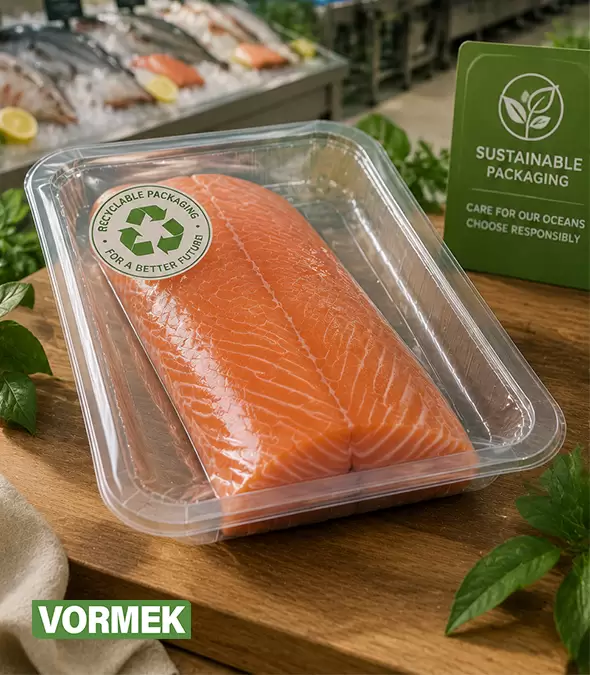
Sustainability remains one of the strongest forces influencing food packaging development in 2026.
The direction is clear: packaging producers and food manufacturers are under increasing pressure to reduce unnecessary material use and improve recyclability while maintaining the protective functions required by highly perishable foods.
Seafood makes this transition particularly demanding.
Why Sustainable Seafood Packaging Is Technically Difficult
The environmental footprint of packaging cannot be evaluated only by asking how much plastic is used.
Packaging also protects food.
If a lighter or more recyclable package results in increased leakage, shorter shelf life, higher oxidation, or more product rejection, the reduction in packaging material may be offset by greater food waste.
This matters especially for seafood because temperature control, package integrity, barrier performance, and cold-chain management all contribute to maintaining product quality.
The engineering objective is therefore not simply:
Use less packaging.
It is:
Use the minimum packaging resources necessary to maintain the required level of product protection, safety, shelf life, and distribution performance.
That distinction is critical.
Mono-Material Films Are Becoming More Important
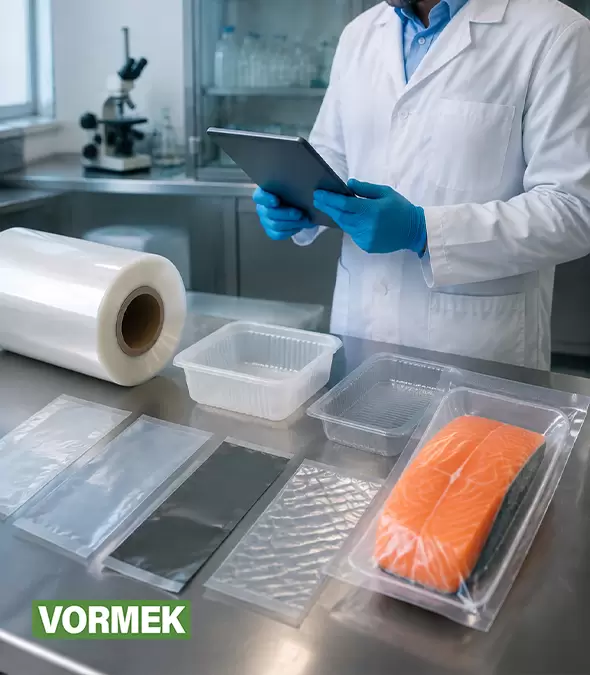
Traditional high-barrier packaging structures often combine several polymers because each layer provides a different function.
One layer may provide mechanical strength. Another may provide an oxygen barrier. Another creates the sealing surface.
This approach can produce excellent technical performance but may complicate recycling when different materials cannot easily be separated.
Consequently, packaging development is increasingly focused on mono-material and recycling-compatible structures, particularly polyethylene- and polypropylene-based solutions where technically appropriate.
However, “mono-material” does not automatically mean “drop-in replacement.”
A new film structure may have different:
- seal initiation temperatures;
- hot-tack properties;
- shrink behavior;
- stiffness;
- puncture resistance;
- oxygen transmission rates (OTR);
- water-vapor transmission rates (WVTR);
- anti-fog performance;
- machinability.
These differences become highly relevant on seafood packaging lines.
A film that seals successfully on a dry product may produce inconsistent results when the tray flange is contaminated by water, oil, marinade, or product particles.
Seal Window Is Becoming a Machine-Purchasing Consideration
As sustainable films evolve, packaging equipment needs sufficient process control to accommodate them.
A useful concept is the seal window: the range of temperature, pressure, and dwell-time conditions within which an acceptable hermetic seal can be produced.
A narrow process window leaves less tolerance for production variation.
Modern tray-sealing equipment should therefore provide accurate and repeatable control of critical sealing parameters rather than relying on crude adjustments.
When evaluating a Smart Sealer for seafood applications, processors should look beyond nominal packs per minute and determine whether the machine provides sufficient control for different films, tray materials, product temperatures, packaging recipes, and sealing conditions.
This becomes increasingly important as processors move between conventional and recyclable packaging structures.
Material Reduction Without Losing Packaging Performance
Downgauging is another significant strategy.
Reducing film thickness can lower material consumption per package, but only when mechanical and sealing performance remain acceptable.
For seafood, excessive downgauging can increase:
- puncture risk from bones or shells;
- film deformation;
- seal distortion;
- handling damage;
- package failures during distribution.
Sustainable packaging development therefore increasingly requires trials on the actual packaging machine using the actual seafood product.
Film specifications alone are rarely enough.
PPWR Makes Long-Term Packaging Strategy More Important
The EU Packaging and Packaging Waste Regulation adds another reason for manufacturers selling into European markets to think beyond their existing packaging structure.
Rather than treating sustainability as a marketing project, processors increasingly need to consider packaging design, material composition, recyclability, documentation, and future compliance together.
For equipment buyers, this creates an important strategic question:
Can a machine purchased in 2026 handle the packaging materials the business may need in 2028, 2030, and beyond?
That question may ultimately matter more than achieving the lowest possible purchase price today.
Seafood Packaging Automation and Labor Shortages
The second major trend is automation.
Automation in seafood processing is not new, but its business case is changing.
Processors increasingly want packaging lines that can produce more consistent output with fewer repetitive manual interventions.
This does not necessarily mean removing every operator from the line.
It means automating tasks where manual variation creates bottlenecks, inconsistency, hygiene risks, or unnecessary labor dependence.
Where Manual Seafood Packaging Lines Lose Productivity
Consider a tray-sealing line.
The tray sealer itself may theoretically process a high number of packages per minute, but actual output can be constrained by:
- manual tray placement;
- inconsistent product loading;
- tray spacing;
- film changes;
- manual coding;
- visual inspection;
- product rejection;
- accumulation at discharge;
- secondary packaging.
This creates an important distinction between machine speed and line output.
A machine capable of 30 packs per minute provides little benefit if upstream operations consistently supply only 18 correctly prepared packs per minute.
Processors should therefore evaluate saleable packages per shift, not simply the maximum theoretical speed displayed on a machine specification sheet.
From Stand-Alone Machines to Integrated Seafood Packaging Lines
The direction of automation is increasingly toward connected modules.
Depending on product type and production volume, an automated seafood packaging line may incorporate:
Product loading → tray transport → tray sealing/MAP → inspection → coding → rejection → weighing → labeling → accumulation → secondary packaging
Not every factory needs every stage automated.
The correct automation level depends on labor availability, product variation, throughput, hygiene requirements, available floor space, and return on investment.
For manufacturers evaluating their overall Seafood & Fish packaging solution, the important question is therefore not simply which sealing machine to purchase, but how that machine fits into the complete production flow.
Automation Improves Process Repeatability
One of automation’s most valuable benefits in seafood packaging is consistency.
Manual processes naturally introduce variation.
Operators may position trays differently, inspect seals differently, or respond differently to production disturbances.
Automation can reduce this variability by creating repeatable machine cycles and standardized product handling.
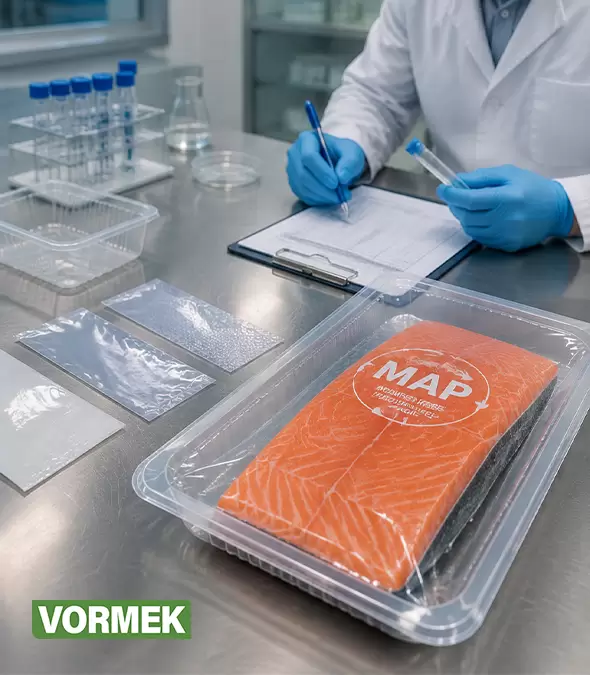
For Modified Atmosphere Packaging (MAP), repeatability becomes particularly important because package performance depends on several interacting variables:
- vacuum level;
- gas composition;
- residual oxygen;
- gas-to-product ratio;
- seal integrity;
- package headspace;
- product temperature;
- film permeability.
Automation does not eliminate the need for process validation, but it can make validated conditions easier to reproduce consistently.
Changeover Flexibility Is Becoming More Valuable
Seafood processors rarely run one product indefinitely.
A plant may package salmon portions in the morning, white fish fillets later in the day, and shrimp in another tray format for a different retailer.
SKU proliferation therefore changes the economics of automation.
A high-speed machine with slow, complicated changeovers can lose significant productive time between batches.
For this reason, processors increasingly value:
- recipe storage;
- tool-change efficiency;
- adjustable transport systems;
- HMI-based parameter management;
- rapid film replacement;
- accessible tooling;
- modular line layouts.
Overall Equipment Effectiveness is determined by more than maximum speed:
OEE = Availability × Performance × Quality
A slightly slower machine that changes formats quickly and produces fewer rejected packages may generate more saleable output over an entire shift than a faster machine suffering frequent interruptions.
Smart Inspection and Seafood Traceability Technology
The third major trend is the movement from basic packaging automation toward intelligent seafood packaging lines.
In traditional systems, quality control is heavily dependent on operator observation.
Operators check whether film is positioned correctly, labels are present, seals look acceptable, and packages appear complete.
Human inspection remains valuable, but it becomes increasingly difficult to apply consistently as line speed increases.
This is where machine vision, sensors, digital records, and automated rejection systems become increasingly relevant.
Machine Vision for Seafood Packaging Quality Control
Modern vision systems can potentially inspect characteristics such as:
- label presence;
- label position;
- printed code quality;
- tray orientation;
- film alignment;
- package appearance;
- missing components;
- selected visible seal defects.
The objective is not merely to find defective packages.
A more valuable system can help identify patterns.
Suppose a vision system detects increasing numbers of packages with film misalignment.
Instead of waiting until operators notice a significant problem, production personnel can investigate earlier.
The issue may involve:
- film tracking;
- tray positioning;
- tooling contamination;
- mechanical wear;
- incorrect setup;
- inconsistent incoming materials.
Inspection data can therefore become process-improvement data.
Seal Inspection Is Particularly Important for Seafood
Seafood packaging creates difficult sealing conditions.
Water, oil, blood, marinade, ice residue, and product fragments can enter the sealing area.
Even small amounts of contamination may compromise seal quality.
For MAP products, this can be particularly serious because a microscopic leak may gradually change the internal atmosphere and undermine the conditions established during packaging.
Processors should therefore evaluate whether their machine or production line can integrate with:
- vision inspection;
- leak detection;
- checkweighers;
- metal detection;
- gas analysis;
- automated reject stations.
The important word is integrate.
Purchasing inspection devices independently without considering communication and mechanical integration can create unnecessary complexity later.
Seafood Traceability Is Moving Closer to the Packaging Line
Traceability has traditionally been considered an ERP, warehouse, or labeling function.
That boundary is disappearing.
Packaging is the point at which a physical food product is often converted into an identifiable commercial unit.
The packaging line can therefore become an important data-generation point.
Depending on the system, production records may connect a package or batch with:
- product ID;
- production date;
- batch or lot number;
- packaging machine;
- packaging recipe;
- operator;
- label code;
- timestamp;
- destination.
This information can support faster investigations and more targeted recalls.
Why Seafood Processors Need Stronger Traceability
Seafood supply chains can be complex.
Products may move through harvesting, processing, freezing, thawing, portioning, repacking, distribution, and retail operations.
Maintaining reliable identification throughout these stages can improve both food-safety management and commercial transparency.
In the United States, the FDA Food Traceability Rule establishes recordkeeping requirements around Critical Tracking Events (CTEs) and associated Key Data Elements (KDEs) for covered foods.
For processors purchasing machinery today, this broader movement toward structured traceability makes connectivity increasingly relevant.
A packaging machine capable of communicating production information with upstream or downstream systems may offer greater long-term value than a completely isolated machine.
QR Codes, RFID, and Digital Identification
QR codes are already practical for connecting physical packages with digital information.
RFID and NFC offer additional possibilities where automated identification or richer supply-chain interaction justifies the cost.
However, smart packaging should not be adopted simply because the technology exists.
The first question should always be:
What problem are we trying to solve?
If the goal is recall management, lot-level identification may be sufficient.
If the goal is unit-level authentication or supply-chain tracking, more advanced identification may make sense.
Technology should follow the traceability objective—not the other way around.
What Seafood Packaging Trends Mean for Your Next Machine Purchase
The most important implication of these trends is that seafood packaging equipment should increasingly be evaluated as a long-term production platform, not simply as a sealing machine.
A purchasing decision based exclusively on today’s product can become expensive when packaging requirements change.
1. Test Current and Future Packaging Materials
Ask whether the machine can process more than the film currently being used.
Evaluate:
- recyclable structures;
- mono-material films;
- different film thicknesses;
- anti-fog films;
- high-barrier structures;
- alternative tray materials.
Whenever possible, conduct real packaging trials using the intended product, tray, film, and production conditions.
2. Evaluate Real Output, Not Brochure Speed
Ask for performance under conditions that resemble actual production.
A realistic trial should consider:
- actual tray dimensions;
- actual seafood product;
- MAP cycle where applicable;
- required residual oxygen;
- loading constraints;
- film type;
- changeover frequency.
Nominal cycle speed and commercially usable output are not the same thing.
3. Check Automation Expansion Capability
A processor may begin with manual loading but later require automatic denesting, labeling, inspection, or robotic handling.
Machines designed for integration can make that expansion easier.
Before purchasing, investigate communication interfaces, conveyor integration, available space, line controls, and synchronization options.
4. Prioritize Hygienic Engineering
No technology trend overrides hygiene.
Seafood packaging machinery operates in a demanding environment where water, salt, organic residues, and cleaning chemicals can accelerate deterioration if equipment is poorly designed.
Look for:
- food-contact-compatible materials;
- corrosion-resistant construction;
- accessible cleaning zones;
- minimized product traps;
- protected electrical components;
- drainage-conscious design;
- removable components where appropriate.
The ability to clean effectively affects both food safety and equipment uptime.
5. Consider Machine Data and Connectivity
Even if a factory does not currently use advanced production analytics, buyers should consider whether the machine can support future connectivity.
Useful capabilities may include:
- recipe storage;
- alarm history;
- production counters;
- batch information;
- remote diagnostics;
- inspection-system communication;
- production data export.
A machine purchased in 2026 may remain in production for many years. Data requirements are likely to evolve during that lifetime.
6. Calculate Total Cost of Ownership
Purchase price is only one component of machine cost.
A more complete comparison is:
TCO = Purchase Price + Labor + Energy + Packaging Material + Maintenance + Downtime + Rejects + Changeover Losses
For seafood processors, material waste and rejected product can be particularly expensive.
A machine that costs more initially but produces more consistent seals, reduces film waste, changes formats faster, and requires fewer repetitive manual operations may ultimately deliver a lower cost per accepted package.
For this reason, processors comparing technologies should evaluate the complete requirements of a Seafood & Fish packaging line rather than selecting equipment solely from quoted cycle speed.
2026 Seafood Packaging Machine Buying Checklist
Before approving your next seafood packaging equipment investment, ask:
| Question | Why It Matters |
|---|---|
| Can it run current and emerging recyclable films? | Protects against material changes |
| Can sealing parameters be controlled precisely? | Supports consistent seal integrity |
| Can the machine perform MAP if required? | Expands packaging options |
| How quickly can formats be changed? | Reduces downtime |
| Can inspection systems be integrated? | Supports automated QC |
| Can production data be recorded or exported? | Supports traceability |
| Is the design suitable for wet cleaning? | Critical for seafood hygiene |
| Can automation modules be added later? | Protects future capacity |
| What is real output with our product? | Prevents unrealistic ROI assumptions |
| What is total cost per accepted pack? | Provides a better investment comparison |
The strongest equipment decision is rarely the machine with the longest specification sheet.
It is the machine that matches the processor’s product, production volume, hygiene regime, packaging method, future material strategy, and automation roadmap.
Conclusion: The Future of Seafood & Fish Packaging in 2026
The leading seafood & fish packaging trends in 2026 point toward an industry that is becoming more sustainable, automated, measurable, and connected.
Recyclable and mono-material packaging structures are increasing the importance of precise sealing control. Automation is shifting attention from individual high-speed machines toward balanced production lines. Smart inspection is giving processors more opportunities to identify defects before they become large batches of waste. Traceability is moving closer to the packaging line itself.
For seafood processors, these developments change how equipment should be purchased.
The right question is no longer:
“How fast is this machine?”
It is:
“Can this packaging platform produce safe, consistent, traceable packages using the materials and production requirements we expect over the next several years?”
Processors that evaluate equipment from this perspective can make investments that remain useful as regulations, packaging materials, labor conditions, customer requirements, and production volumes evolve.
In 2026, future-ready seafood packaging is not defined by one machine feature.
It is defined by flexibility, process control, hygiene, automation readiness, material compatibility, and data capability working together.
Frequently Asked Questions About Seafood & Fish Packaging Trends in 2026
What are the biggest seafood packaging trends in 2026?
The biggest trends include recyclable and mono-material packaging, material reduction, increased packaging automation, machine-vision inspection, improved digital traceability, and growing demand for flexible machinery capable of handling changing films, products, and formats.
What sustainable packaging materials are trending for seafood in 2026?
Mono-material and recycling-compatible PE- and PP-based structures are receiving increasing attention where their barrier, mechanical, and sealing properties meet the requirements of the seafood product. Material selection should be based on shelf life, product characteristics, packaging method, and distribution conditions rather than recyclability alone.
Are mono-material films suitable for fish and seafood packaging?
They can be, but suitability depends on the product, required shelf life, oxygen and moisture barrier requirements, sealing conditions, distribution environment, and packaging method. Commercial conversion should follow machine and product trials.
Why is automation becoming more important in seafood packaging?
Automation can reduce dependence on repetitive manual operations while improving throughput consistency, process repeatability, hygiene, and quality control. Its value is particularly high when manual operations have become the bottleneck of an otherwise high-capacity packaging line.
How is AI being used in seafood packaging?
One of the most practical applications is machine vision. Camera-based systems combined with image-processing or AI models can inspect selected package characteristics, detect certain defects, verify codes or labels, identify patterns, and trigger automatic rejection of non-conforming packages.
What role does traceability play in seafood packaging?
The packaging line can connect physical products with batch and production information. Better traceability can support food-safety investigations, recalls, inventory control, regulatory recordkeeping, and supply-chain transparency.
Should seafood processors buy machines specifically for recyclable films?
Rather than purchasing equipment for one specific film, processors should prioritize machinery with sufficient temperature, pressure, dwell-time, film-handling, and recipe-control flexibility to accommodate multiple qualified structures. Compatibility should always be confirmed through trials.
What should seafood processors look for when buying packaging machinery in 2026?
Key considerations include hygienic design, real production capacity, film compatibility, MAP capability where required, changeover time, automation readiness, inspection integration, data connectivity, serviceability, and total cost of ownership.
Is maximum packaging machine speed still important?
Yes, but maximum cycle speed alone can be misleading. Sustainable output also depends on upstream loading, downstream handling, changeovers, downtime, rejection rates, and product-specific cycle requirements. Saleable packs per shift is often a more useful performance metric.
How can seafood packaging equipment support future traceability requirements?
Equipment can support traceability through production records, batch information, recipe storage, coding-system integration, timestamps, inspection data, and communication with upstream or downstream production systems.
What packaging technology is most future-proof for seafood?
There is no universally future-proof packaging technology. The strongest long-term solution is generally a flexible platform that supports multiple packaging formats and materials, precise process control, hygienic operation, automation integration, inspection systems, and production-data connectivity.