Introduction: Sustainable Seafood Packaging Without Compromising Shelf Life
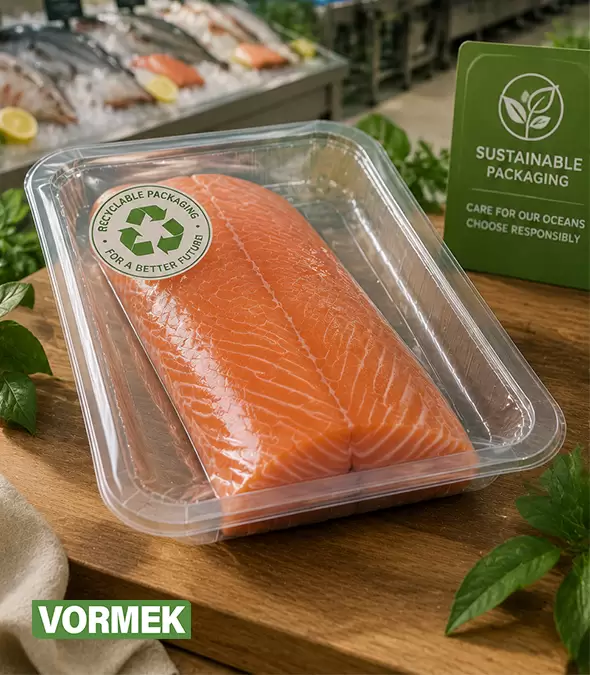
Sustainable seafood packaging must achieve two objectives that can sometimes conflict: reducing packaging impact while protecting highly perishable fish and seafood throughout processing, storage and distribution.
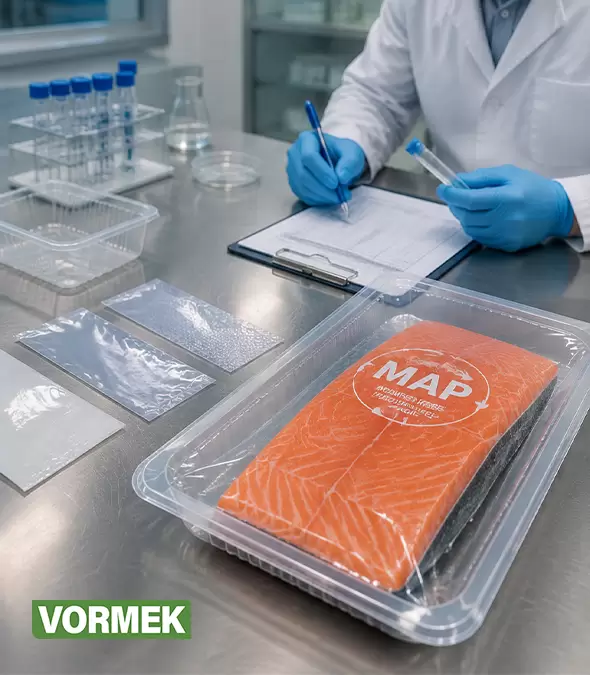
Fresh fish, shellfish, smoked seafood and frozen products can require reliable oxygen and moisture barriers, strong seals, puncture resistance and good performance under refrigerated or frozen conditions. Modified atmosphere packaging (MAP) introduces additional requirements because film permeability and seal integrity can influence the atmosphere surrounding the product.
For this reason, replacing a conventional multilayer film with a recyclable alternative is rarely a simple material substitution.
Promising options include mono-material PE and PP films, recyclable high-barrier structures, recyclable trays, downgauged films and lightweight rigid packaging. Their suitability depends on the seafood product, required shelf life, packaging atmosphere, cold chain and packaging equipment.
This guide examines how seafood processors can improve packaging sustainability without unnecessarily sacrificing product protection, shelf life or line efficiency.
For processors reviewing packaging technologies across different fish and seafood applications, the Seafood & Fish industry landing page provides a broader overview of relevant packaging solutions.
Why Sustainability Pressure Is Growing in Seafood Packaging
Sustainability is becoming a technical and commercial packaging requirement. Regulations, retailer targets, extended producer responsibility programmes and corporate plastic-reduction commitments are encouraging seafood processors to reduce material use and improve packaging recyclability.
The challenge is that many conventional seafood packages use multilayer structures specifically engineered for performance. Different layers may provide oxygen barrier, moisture resistance, mechanical strength, puncture resistance and heat-sealing functionality.
These structures can protect seafood effectively, but combinations of incompatible polymers may be difficult to process through conventional mechanical recycling systems.
As a result, packaging development is increasingly moving towards design-for-recycling, where material selection considers both product protection and end-of-life processing.
Recyclability Is Becoming a Purchasing Requirement
Retailers and food manufacturers increasingly include recyclability and material reduction within packaging specifications.
For seafood processors, this means packaging decisions may need to satisfy both technical requirements and customer sustainability targets.
However, the term recyclable packaging requires careful interpretation.
Actual recyclability can depend on:
- polymer composition;
- barrier layers and coatings;
- labels and adhesives;
- inks;
- local collection systems;
- sorting technology;
- recycling infrastructure;
- contamination after use.
A package designed for recycling is therefore not necessarily recycled in every market. Sustainability claims should be assessed against the relevant recycling guidelines and infrastructure in the intended destination market.
Seafood Shelf Life Must Remain Part of the Sustainability Equation
Reducing plastic use is beneficial only if the new package continues to protect the seafood effectively.
Fresh seafood is highly perishable. Insufficient barrier performance, package leakage or poor temperature control can accelerate quality deterioration and increase food waste.
A sustainable packaging transition should therefore be evaluated as a product–package–process system.
Ideally, a new package should:
- reduce material or improve recyclability;
- maintain the required commercial shelf life;
- provide reliable seal integrity;
- withstand the intended cold chain;
- maintain acceptable packaging-line efficiency.
This is particularly important for MAP seafood packaging, where gas composition, film permeability, package headspace and seal integrity interact throughout storage.
A material with improved recyclability but insufficient barrier performance may not be a better environmental solution if it causes significantly higher product losses.
Reducing Material Can Be as Important as Changing Material
Sustainable packaging does not always require switching polymer families.
Downgauging—reducing film or tray thickness while maintaining functionality—can lower plastic consumption per package and may also reduce material costs.
However, seafood can be mechanically demanding. Fish bones, shells and sharp frozen products can create puncture risks, while lightweight trays may deform during processing or distribution.
The objective should therefore be to use the minimum amount of packaging material necessary to protect the product reliably, rather than simply selecting the thinnest available film or tray.
Key Sustainability Criteria for Seafood Packaging
A packaging material should be evaluated across its complete functional life.
| Criterion | Key Question |
|---|---|
| Recyclability | Is the complete structure compatible with an appropriate recycling stream? |
| Material efficiency | Can film or tray weight be reduced safely? |
| Oxygen barrier | Is the OTR suitable for the required shelf life? |
| Moisture barrier | Is WVTR appropriate for the product and storage conditions? |
| Seal integrity | Can reliable seals be maintained during distribution? |
| Mechanical strength | Can the package resist puncture and handling damage? |
| Food waste | Could the material change increase spoilage or leakage? |
| Machine compatibility | Can it run consistently at the required output? |
| Cold-chain performance | Will the pack remain functional under chilled or frozen conditions? |
This broader assessment prevents sustainability from being reduced to plastic weight or recyclability alone.
Mono-Material & Recyclable Film Options for Seafood Packaging
One of the main strategies for improving seafood packaging recyclability is simplifying material structures.
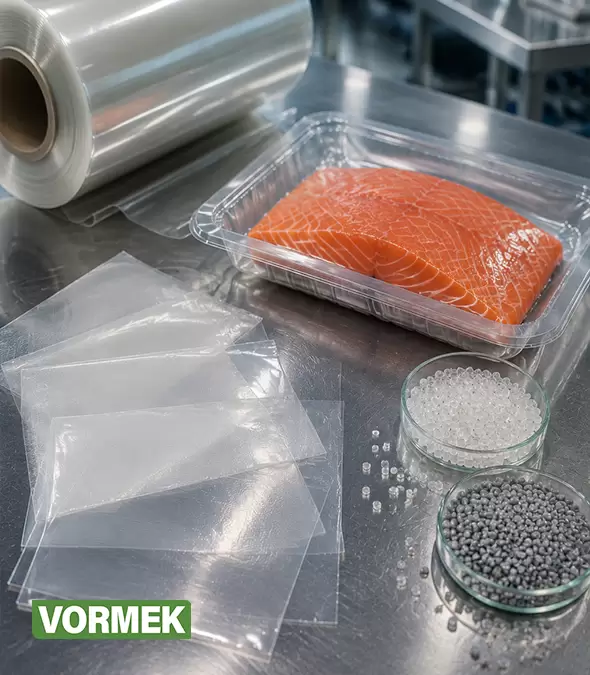
Traditional barrier films may combine different polymer families to obtain specific mechanical, barrier and sealing properties. Mono-material structures instead attempt to achieve these functions while remaining predominantly within a single polymer family.
For fish and seafood packaging, polyethylene (PE) and polypropylene (PP) are among the most relevant material families.
What Is Mono-Material Seafood Packaging?
In commercial packaging, “mono-material” does not necessarily mean that every component consists exclusively of one polymer.
It generally describes a structure predominantly based on one polymer family, with specialised layers, coatings or additives incorporated where necessary.
The aim is to improve compatibility with recycling processes while maintaining essential packaging functions such as:
- oxygen and moisture protection;
- heat sealability;
- puncture resistance;
- flexibility or rigidity;
- low-temperature performance;
- anti-fog behaviour;
- controlled peelability.
The term mono-material should therefore not replace technical evaluation. A recyclable structure must still meet the functional requirements of the seafood product.
PE-Based Recyclable Films for Seafood
Polyethylene-based structures can combine different PE grades to provide flexibility, toughness and sealability while remaining predominantly within the polyethylene family.
Depending on their construction and barrier properties, PE-based films may be considered for applications such as:
- vacuum-packed seafood;
- flexible fish packaging;
- pouches;
- selected lidding applications.
PE can also provide useful toughness at low temperatures, making properly engineered structures relevant to chilled or frozen distribution.
The main challenge is balancing oxygen barrier, stiffness, puncture resistance and machinability.
Processors should therefore compare measured technical specifications rather than selecting a film solely because it is marketed as mono-material.
PP-Based Films and Recyclable Seafood Trays
Polypropylene is particularly relevant to tray-sealed seafood.
A PP tray combined with an appropriately designed PP-compatible lidding structure can simplify the package’s material strategy while providing the rigidity required for retail presentation.
Important performance characteristics include:
- seal initiation temperature;
- sealing window;
- hot-tack performance;
- peel strength;
- film shrinkage;
- anti-fog properties;
- oxygen transmission;
- contamination tolerance.
For MAP applications, tray rigidity must also be considered. Excessively lightweight trays can deform during evacuation, potentially affecting seal alignment and package appearance.
The tray and lidding film should therefore be evaluated as a complete packaging system.
Recyclable High-Barrier Films for Seafood
Barrier performance is one of the most important considerations when replacing conventional seafood packaging.
Modern recyclable structures can incorporate specialised barrier technologies while remaining predominantly within a compatible polymer family. This can help narrow the performance gap between recyclable films and traditional multilayer structures.
Two specifications deserve particular attention:
OTR – Oxygen Transmission Rate: the amount of oxygen that passes through a packaging material under specified test conditions.
WVTR – Water Vapour Transmission Rate: the rate at which water vapour passes through the material under specified conditions.
Neither value should be considered in isolation.
The required barrier depends on factors including seafood type, packaging atmosphere, storage temperature, headspace volume and target shelf life.
Downgauged Films and Lightweight Trays
Reducing film or tray thickness can lower material consumption without completely changing the packaging format.
Potential advantages include:
- less material per package;
- reduced packaging weight;
- lower material consumption per production run;
- potentially more packages per film roll.
The reduced structure must still provide sufficient tensile strength, puncture resistance, seal performance and tray rigidity.
Whole fish, crustaceans and products with sharp bones or shells may require greater mechanical protection than boneless fillets.
For this reason, downgauging should be validated under actual production and distribution conditions rather than assessed solely from material thickness.
Sustainable Seafood Packaging Materials: Quick Comparison
| Packaging Option | Sustainability Advantage | Main Technical Consideration | Potential Application |
|---|---|---|---|
| PE mono-material film | Improved design for recycling | Barrier and stiffness | Vacuum/flexible packs |
| PP-based film | Simplified polymer strategy | Seal-window optimisation | Tray sealing |
| PP tray + compatible lid | Potentially simplified pack structure | Rigidity during MAP | Fresh/chilled seafood |
| Recyclable high-barrier film | Combines barrier with recyclability goals | Application-specific OTR/WVTR | MAP seafood |
| Downgauged film | Lower material consumption | Puncture resistance | Suitable low-risk products |
| Lightweight tray | Reduced plastic per pack | Mechanical stability | Tray-sealed seafood |
There is no universally best sustainable packaging material for fish and seafood.
The correct structure should be selected according to shelf-life requirements, barrier performance, packaging atmosphere, mechanical risk, machine compatibility and the recycling system of the intended market.
Recyclable vs Traditional Barrier Films for Seafood: Key Trade-Offs
Switching from conventional multilayer packaging to recyclable or mono-material films is rarely a direct substitution. Traditional barrier structures often combine different polymers because each layer performs a specific function, such as oxygen protection, moisture resistance, puncture strength or heat sealing.
Recyclable alternatives aim to deliver sufficient performance using a simpler material structure. The key question is therefore not whether a recyclable film matches every property of a conventional high-barrier film, but whether it provides the level of protection actually required by the seafood product.
Oxygen Barrier and Seafood Shelf Life
Oxygen transmission is a critical consideration for many chilled seafood products, particularly those packed under modified atmosphere.
The relevant specification is Oxygen Transmission Rate (OTR). Lower OTR values generally indicate stronger resistance to oxygen transmission under the stated test conditions.
However, the required oxygen barrier varies according to:
- seafood species and product format;
- fat content and oxidation sensitivity;
- packaging atmosphere;
- package headspace;
- storage temperature;
- distribution time;
- required commercial shelf life.
A product intended for short refrigerated distribution may not require the same barrier as seafood moving through a longer supply chain.
For MAP products, film permeability also contributes to how the headspace atmosphere changes during storage. A recyclable film with different permeability from the existing structure may therefore affect package performance even when the initial gas mixture remains unchanged.
For this reason, a significant material change should be supported by product-specific shelf-life validation.
Moisture Barrier and Product Quality
Water Vapour Transmission Rate (WVTR) describes the movement of water vapour through a packaging material under defined conditions.
For seafood, unsuitable moisture performance can contribute to quality problems such as surface dehydration or undesirable changes in package appearance.
Moisture protection is particularly important in frozen seafood packaging, where inadequate protection can contribute to dehydration and freezer burn during prolonged storage.
The required WVTR should therefore be considered alongside product characteristics, storage temperature and intended shelf life.
Seal Integrity: A Critical Performance Factor
High barrier performance provides limited value if the package leaks.
Seafood creates challenging sealing conditions because water, oil, marinades, protein residues or small product particles can contaminate the tray flange or sealing interface.
When introducing a recyclable film, processors should assess:
- seal initiation temperature;
- optimum sealing range;
- dwell time requirements;
- sealing pressure;
- hot-tack performance;
- tray compatibility;
- tolerance to expected seal-area contamination.
The new material may require a different machine recipe from the conventional film.
Simply applying the previous temperature and dwell settings can lead to weak seals, excessive film shrinkage or inconsistent peeling.
Puncture Resistance and Mechanical Performance
Seafood packages may experience significant mechanical stress during filling, sealing, stacking, transport and retail handling.
Whole fish, crustaceans, shells and sharp bones can create concentrated puncture risks. Frozen products can also behave differently from chilled products because both the food and packaging materials are exposed to lower temperatures.
When evaluating a sustainable film, processors should consider:
- puncture resistance;
- tensile strength;
- tear resistance;
- elongation;
- flex-crack resistance;
- low-temperature toughness.
Downgauging should be approached particularly carefully in these applications.
Saving material per package provides little benefit if the change increases leaks, damaged packs or product waste.
MAP Performance with Recyclable Films
Modified atmosphere packaging places additional demands on sustainable materials.
The package must maintain an appropriate atmosphere throughout the intended storage period. This performance depends on several interacting variables:
film permeability + seal integrity + package headspace + gas composition + storage temperature
Changing the film can therefore alter MAP performance even if the packaging machine and initial gas recipe remain unchanged.
After introducing a new recyclable structure, processors may need to evaluate:
- residual oxygen after packaging;
- headspace gas composition during storage;
- package leakage;
- seal strength;
- pack appearance;
- drip development;
- sensory quality;
- microbiological performance;
- validated shelf life.
Gas composition and shelf life should always be validated for the specific seafood product and process conditions.
Clarity and Anti-Fog Performance
Fresh seafood is often purchased partly on visual appearance, making transparency and condensation control commercially important.
A sustainable film should therefore be assessed not only immediately after packaging but also after refrigerated storage.
Changes in film structure can affect:
- optical clarity;
- haze;
- condensation behaviour;
- anti-fog performance;
- retail presentation.
This is especially important for clear tray-sealed seafood, where condensation on the lidding film can obscure the product.
A technically sustainable material that substantially reduces shelf appeal may not be commercially successful.
Cost per Pack Matters More Than Film Price Alone
Comparing sustainable and conventional materials only by price per kilogram can be misleading.
A thinner recyclable film may cost more per kilogram but use less material per package. Conversely, a lower-priced material can become expensive if it causes more rejects, slower line speeds or frequent operator intervention.
A more useful metric is:
Total packaging cost per acceptable finished pack
This considers material consumption alongside production efficiency and waste.
| Performance Factor | Traditional Multilayer Film | Recyclable/Mono-Material Film |
|---|---|---|
| Oxygen barrier | Often very high | Application-dependent |
| Moisture barrier | Well established | Can be highly effective |
| Recycling compatibility | May be limited | Potentially improved |
| Seal window | Usually established | May require optimisation |
| Puncture resistance | Often strong | Must be validated |
| MAP suitability | Widely established | Application testing required |
| Machine settings | Usually known | May require new recipes |
| Shelf-life data | Often established | Revalidation recommended |
| Material structure | Often more complex | Generally simplified |
How to Evaluate the Performance Trade-Off
The objective should not be to maximise every film property. It should be to establish the minimum functional requirements necessary to protect the product reliably.
A practical decision sequence is:
Product requirements → Target shelf life → Barrier requirements → Mechanical performance → Sealability → Machine compatibility → Recyclability
This approach can reveal opportunities that are missed when films are compared only by technical datasheets.
For example, an existing multilayer structure may provide substantially more oxygen barrier than a particular seafood product actually requires. In that case, a recyclable alternative with a moderately higher OTR may still provide sufficient shelf-life performance.
The opposite is also possible. A highly sensitive product with an extended refrigerated distribution period may require barrier performance that cannot be reduced without affecting product quality.
The best sustainable packaging structure is therefore not necessarily the one with the highest barrier specification or the strongest recyclability claim. It is the one that provides sufficient protection with the lowest practical material and environmental burden throughout the required product life.
Equipment Compatibility with Sustainable Seafood Packaging Films
Selecting a recyclable or mono-material film is only part of a successful sustainability transition. The material must also run consistently on the packaging equipment at the required production speed.
Sustainable films can behave differently from conventional multilayer structures in terms of stiffness, friction, heat response, elongation and sealing characteristics. Even films with similar thicknesses may require different machine settings.
For this reason, equipment compatibility should be validated before a sustainable seafood packaging material enters commercial production.
Why Recyclable Films May Need Different Sealing Settings
Heat-sealing behaviour depends on the composition and seal layer of the film. A recyclable structure may therefore have a different processing window from the material it replaces.
Important variables include:
- seal initiation temperature;
- optimum sealing temperature;
- dwell time;
- sealing pressure;
- hot-tack performance;
- film shrinkage;
- web tension;
- cutting behaviour.
Using the existing machine recipe without validation can produce weak seals, excessive shrinkage or inconsistent peel performance.
The objective should be to establish a stable sealing window, rather than simply finding one temperature at which the package appears acceptable.
Temperature, Dwell Time and Pressure
Three parameters are particularly important in tray sealing:
Temperature + Dwell Time + Pressure
These variables interact.
For example, increasing temperature may improve bonding up to a point, but excessive heat can distort the film or tray. Similarly, insufficient dwell time may prevent a reliable seal even when the sealing temperature appears correct.
Trials should begin within the material supplier’s recommended processing range and then determine settings that provide consistent performance under normal production variation.
This is especially important for seafood because moisture, oil, protein residue or marinade can occasionally reach the sealing area.
A robust process must therefore perform under realistic plant conditions rather than only with perfectly clean laboratory samples.
Tray and Lidding Film Compatibility
A recyclable tray and recyclable lidding film are not automatically compatible.
For tray-sealed seafood, the film’s sealing layer must interact correctly with the tray flange. The complete tray-and-film system should be evaluated for:
- seal strength;
- peel characteristics;
- contamination tolerance;
- heat resistance;
- dimensional stability;
- film shrinkage;
- tray deformation.
This becomes particularly important with lightweight trays.
During MAP packaging, evacuation can create mechanical stress before the package is gas flushed and sealed. A tray with insufficient rigidity may deform, affecting appearance or the sealing interface.
Material reduction should therefore be balanced against the mechanical demands of the packaging process.
Film Handling and Web Control
Downgauged and mono-material films may behave differently as they move through a packaging machine.
Changes in stiffness or friction can influence:
- film tracking;
- web tension;
- wrinkling;
- registration;
- cutting accuracy;
- roll handling.
Printed films require particularly accurate web control because poor registration can affect both graphics and cutting position.
Equipment intended to operate with evolving sustainable packaging materials should provide sufficient control over film movement and sealing parameters.
For processors evaluating tray-sealing equipment for different seafood applications, the Smart Sealer product page can be used as an internal reference for relevant packaging capabilities.
Machine flexibility is increasingly valuable because sustainable film technology is still evolving. Equipment capable of accommodating different material structures and process recipes can make future packaging transitions easier.
MAP Compatibility with Sustainable Films
For modified atmosphere seafood packaging, successful material conversion requires more than achieving a visually acceptable seal.
Film permeability, tray rigidity and package integrity can all influence MAP performance.
After changing the tray or film, processors should consider verifying:
- tray deformation during evacuation;
- residual oxygen after sealing;
- headspace gas composition;
- package leakage;
- seal integrity;
- film tension;
- package appearance during storage.
A new material may also require reassessment of the packaging process if its permeability differs substantially from the existing film.
The important distinction is:
Machinability does not equal validated package performance.
A film may run successfully through a tray sealer while still failing to provide the required shelf life or atmosphere retention.
How to Test Sustainable Films on a Seafood Packaging Line
A structured trial can reduce the risks associated with material conversion.
1. Establish the Existing Packaging Baseline
Before changing materials, document the current package performance.
Useful baseline information includes:
- tray and film specifications;
- sealing temperature;
- dwell time;
- sealing pressure;
- line speed;
- reject rate;
- seal performance;
- MAP results where applicable;
- validated shelf life.
This provides a reference for evaluating the sustainable alternative.
2. Run Controlled Machine Trials
Test the new film across an appropriate range of sealing parameters.
Inspect packages for:
- incomplete seals;
- wrinkles;
- excessive shrinkage;
- tray deformation;
- poor cutting;
- inconsistent peeling;
- film-tracking problems.
Package appearance alone should not determine approval. Seal performance must also be verified.
3. Test Under Realistic Processing Conditions
Seafood packaging lines are not perfectly dry environments.
Trials should therefore represent expected production conditions within the facility’s validated food-safety and quality procedures.
This is particularly important when assessing seal robustness, because moisture or product residue near the sealing area can expose weaknesses that may not appear during ideal laboratory trials.
4. Validate Packaging Performance During Storage
Machine trials confirm that a material can be processed. Shelf-life trials determine whether it can protect the product.
Depending on the seafood product and quality programme, validation may include:
- leak testing;
- seal-strength assessment;
- headspace gas analysis;
- condensation and anti-fog evaluation;
- drip assessment;
- sensory evaluation;
- microbiological testing.
Tests should represent the intended refrigerated or frozen storage conditions.
5. Complete an Extended Production Trial
A short trial may not reveal problems that emerge during continuous operation.
An extended production run can identify:
- film tracking drift;
- roll-to-roll variation;
- changes in throughput;
- increased reject rates;
- cutting problems;
- frequent operator adjustments.
Commercial conversion should ideally occur only after both package performance and production stability have been demonstrated.
How to Switch to Sustainable Seafood Packaging
Moving towards recyclable seafood packaging should be treated as an engineering project rather than simply a material purchase.
A practical conversion process follows seven steps:
- Define product requirements.
Establish target shelf life, storage temperature, packaging atmosphere and distribution conditions. - Define packaging performance.
Determine required oxygen barrier, moisture barrier, puncture resistance, rigidity and seal performance. - Shortlist recyclable alternatives.
Evaluate suitable mono-material, recyclable high-barrier or downgauged structures with packaging suppliers. - Confirm machine compatibility.
Review tray dimensions, film characteristics and recommended processing ranges. - Optimise the packaging process.
Establish appropriate sealing temperature, dwell time, pressure and film-handling settings. - Validate shelf life and production performance.
Confirm that the package protects the seafood while maintaining acceptable throughput and reject rates. - Verify recyclability claims.
Assess the complete packaging structure against applicable design-for-recycling guidance and infrastructure in the intended market.
Material, Machine, Product and Cold Chain Must Work Together
Sustainable seafood packaging is ultimately a system involving four interconnected elements:
Material + Machine + Product + Cold Chain
Optimising one element while ignoring the others can create unintended consequences.
A thinner tray may reduce plastic consumption but deform during MAP evacuation. A recyclable film may improve end-of-life compatibility but require different sealing parameters. A lower-barrier structure may reduce material complexity but fail to support the required shelf life.
The most effective transition therefore balances recyclability, material efficiency, food protection and production reliability.
As packaging regulations and material technologies continue to develop, equipment flexibility will also become increasingly important. Seafood processors that can test and adopt new film and tray structures without major line modifications will be better positioned to respond to future sustainability requirements.
Conclusion: Choosing Sustainable Packaging for Seafood & Fish
Sustainable seafood packaging must balance recyclability, material efficiency, product protection and production performance.
Mono-material PE and PP films, recyclable high-barrier structures, downgauged films and lightweight trays can all reduce packaging impact. However, no material should be selected on recyclability claims alone.
Seafood processors should evaluate OTR, WVTR, puncture resistance, seal integrity, tray rigidity, cold-chain performance and compatibility with MAP where applicable. Any significant material change should also be validated under realistic production and storage conditions.
Packaging equipment plays an equally important role. Recyclable films may require different sealing temperatures, dwell times, pressures or web-control settings. Flexible equipment capable of accommodating changing film and tray specifications can therefore support longer-term sustainability strategies.
For further information on packaging technologies for different seafood products, visit the Seafood & Fish industry landing page. Processors evaluating tray-sealing solutions can also explore the Smart Sealer product page.
Ultimately, the best sustainable packaging for seafood is not necessarily the package that uses the least plastic. It is the solution that uses material efficiently while maintaining the safety, quality and intended shelf life of the food it protects.
Frequently Asked Questions About Sustainable Seafood Packaging
What is the most sustainable packaging for seafood?
There is no single best option for every seafood product. Depending on the application, sustainable options can include mono-material PE or PP films, recyclable trays, recyclable high-barrier structures and downgauged packaging. Selection should consider shelf life, barrier requirements, cold-chain conditions, packaging equipment and local recycling infrastructure.
Are mono-material films suitable for fish packaging?
Yes, provided their barrier, mechanical and sealing properties meet the requirements of the product. Mono-material PE and PP structures can improve design for recycling, but processors should validate OTR, WVTR, puncture resistance, seal integrity and shelf-life performance before commercial use.
Can recyclable packaging maintain fresh fish shelf life?
Yes, if the packaging provides sufficient barrier and seal performance for the specific product. Shelf life also depends on product quality, hygiene, storage temperature and packaging atmosphere. Recyclable films should therefore undergo product-specific shelf-life validation rather than being approved solely from material specifications.
Can recyclable films be used for MAP seafood packaging?
Some recyclable high-barrier films are suitable for modified atmosphere packaging. Their suitability depends on gas permeability, seal integrity and the required storage period. When changing film structures, processors should evaluate residual oxygen, headspace gas composition, leakage and product quality throughout the intended shelf life.
What is the difference between mono-material and recyclable packaging?
Mono-material packaging is predominantly based on one polymer family, such as PE or PP, to improve compatibility with recycling processes. Recyclability is broader and depends on the complete package as well as local collection, sorting and recycling infrastructure.
Can seafood packaging use less plastic through downgauging?
Yes. Reducing film or tray thickness can lower plastic consumption per package without changing the complete packaging format. However, the downgauged structure must retain adequate puncture resistance, seal strength and rigidity. Testing is particularly important for products with bones, shells or sharp edges.
Do recyclable films require different tray sealer settings?
They can. Recyclable films may have different heat-sealing and mechanical characteristics from conventional multilayer films. Temperature, dwell time, pressure and web-control settings may therefore need optimisation to achieve consistent seals and production performance.
How should recyclable seafood packaging be tested?
Start by benchmarking the existing package. The recyclable alternative should then undergo machine trials, seal testing and storage validation. Depending on the application, testing may also include headspace gas analysis, leak testing, anti-fog evaluation, sensory assessment and microbiological shelf-life studies.
Is recyclable packaging always more sustainable?
Not necessarily. Recyclability is only one part of packaging sustainability. If a recyclable structure increases spoilage, leakage, rejects or food waste, its overall environmental benefit may be reduced. Material efficiency, product protection, manufacturing performance and end-of-life infrastructure should be considered together.
What should seafood processors check before changing packaging films?
Before switching, processors should review material composition, thickness, OTR, WVTR, sealing range, puncture resistance, tray compatibility and applicable recycling guidance. The new structure should then be tested on the actual packaging line and validated against the required product shelf life.