Automatic vs Semi-Automatic Tray Sealers for Meat Processing Plants
Introduction
In modern meat processing plants, packaging technology has become a strategic factor in maintaining product quality, extending shelf life, improving operational efficiency, and meeting the strict requirements of retail and export markets.
For red meat processors, selecting the right tray sealing solution is not simply a machinery investment. It directly influences production capacity, labor efficiency, packaging consistency, food safety performance, and long-term profitability.
Among available packaging technologies, automatic and semi-automatic tray sealers are two widely used solutions for fresh meat, chilled products, and Modified Atmosphere Packaging (MAP) applications.
Both systems can deliver reliable sealing performance, but their advantages become clear in different production environments.
A semi-automatic tray sealer is typically selected by processors that require flexibility, lower initial investment, and the ability to manage multiple product formats. These systems are suitable for companies producing different meat cuts, premium products, seasonal items, or variable daily volumes.
In contrast, automatic tray sealers are designed for industrial meat processing facilities where high throughput, consistent packaging quality, reduced labor dependency, and integration with complete production lines are essential.
The correct choice depends on several critical factors:
- Daily production volume
- Number of product variations
- Labor availability and operating costs
- Required packaging speed
- MAP requirements
- Future production growth
- Integration with existing processing equipment
A properly selected tray sealing system enables meat processors to achieve:
- Longer product shelf life
- Improved package integrity
- Reduced packaging waste
- Higher production consistency
- Better operational control
This guide provides a detailed comparison of automatic vs semi-automatic tray sealers for meat processing plants, helping manufacturers identify the most suitable solution based on technical requirements, production goals, and business strategy.
Why Tray Sealer Selection Matters in Meat Processing
Fresh meat is one of the most demanding applications in the food packaging industry.
Unlike dry products, meat products are highly sensitive to:
- Oxygen exposure
- Microbial growth
- Temperature variations
- Handling conditions
- Packaging failures
The packaging system plays a critical role in protecting product quality from the processing line until final consumption.
A professional meat tray sealing system must provide reliable control over several important parameters:
| Packaging Factor | Impact on Meat Quality |
|---|---|
| Seal integrity | Prevents leakage, contamination, and package failure |
| MAP gas control | Supports shelf-life extension and product stability |
| Film compatibility | Protects appearance and package performance |
| Sealing accuracy | Reduces rejected packs and material waste |
| Hygienic machine design | Supports food safety requirements |
For fresh red meat, packaging quality directly affects consumer perception because customers evaluate freshness through:
- Product appearance
- Meat color stability
- Package cleanliness
- Seal reliability
A high-performance tray sealer ensures that each package receives:
- Accurate sealing pressure
- Stable sealing temperature
- Controlled cycle time
- Reliable film cutting
- Consistent gas exchange during MAP applications
These requirements become increasingly important when products are supplied to:
- Supermarkets
- Retail chains
- Foodservice companies
- Export markets
Understanding Automatic and Semi-Automatic Tray Sealing Technology
A tray sealer applies a flexible barrier film over a preformed tray containing the meat product.
Depending on the application, the machine can operate with:
- Standard heat sealing
- Vacuum packaging
- Modified Atmosphere Packaging (MAP)
In MAP applications, the machine modifies the internal atmosphere of the package by replacing normal air with a controlled gas mixture.
For red meat products, gas selection depends on:
- Meat type
- Storage temperature
- Distribution conditions
- Required shelf life
Common gases used in meat MAP applications include:
Oxygen (O₂)
Oxygen is commonly used in fresh red meat packaging because it helps maintain the bright red appearance that consumers associate with freshness.
Carbon Dioxide (CO₂)
Carbon dioxide contributes to microbial growth control and supports improved shelf-life performance.
Nitrogen (N₂)
Nitrogen is an inert gas used to balance the atmosphere and reduce package collapse caused by CO₂ absorption.
The difference between automatic and semi-automatic tray sealers is mainly related to the level of process automation.
A semi-automatic system requires an operator to manually place filled trays into the sealing station.
An automatic tray sealer integrates multiple processes, including:
- Automatic tray feeding
- Tray positioning
- Gas injection
- Film handling
- Sealing
- Film cutting
- Product discharge
This difference creates significant variations in:
- Production capacity
- Labor requirements
- Packaging consistency
- Investment strategy
Key Technical Factors When Choosing a Tray Sealer for Meat Products
Before selecting an automatic or semi-automatic tray sealing system, meat processors should evaluate several technical factors.
Seal Integrity
A reliable seal is essential for preventing leakage, contamination, and loss of product quality.
Important parameters include:
- Sealing temperature control
- Pressure consistency
- Film compatibility
- Tray material quality
A weak or inconsistent seal can reduce shelf life and create product rejection issues.
MAP Accuracy
For fresh meat applications, accurate gas management is critical.
The tray sealer must provide:
- Stable gas injection
- Correct cycle timing
- Proper sealing conditions
- Repeatable package atmosphere
Consistent MAP performance helps maintain product quality throughout distribution.
Tray and Film Compatibility
Meat processors may use different packaging materials, including:
- PP trays
- PET trays
- Barrier trays
- High-performance sealing films
The selected tray sealer should match the required packaging materials and production requirements.
Hygiene Design
Meat processing environments require equipment designed for frequent cleaning and sanitation.
Important features include:
- Stainless steel construction
- Easy access to sealing components
- Reduced contamination risk
- Simple maintenance procedures
Production Flexibility
The ideal machine depends on whether the processor prioritizes:
- High volume production
- Multiple product formats
- Fast changeovers
- Maximum automation
Understanding these requirements is the foundation for selecting the correct packaging technology.
Semi-Automatic vs Automatic Tray Sealers: Detailed Comparison for Meat Processing Plants
Selecting between a semi-automatic and automatic tray sealer requires a clear understanding of production requirements, operational priorities, and long-term business objectives.
Both technologies can provide reliable packaging performance, but they are designed for different production environments.
A semi-automatic tray sealer focuses on flexibility and cost efficiency, while an automatic tray sealer focuses on productivity, consistency, and industrial-scale performance.
Semi-Automatic Tray Sealers for Meat Packaging
Semi-automatic tray sealers are widely used by small and medium-sized meat processors that need professional packaging quality without investing immediately in a fully automated production line.
In these systems, operators manually place filled trays into the sealing station, and the machine automatically completes the sealing cycle.
Depending on the configuration, semi-automatic tray sealers can support:
- Heat sealing
- MAP packaging
- Vacuum and gas applications
- Different tray sizes
- Multiple product formats
- Quick mold changes
Main Advantages of Semi-Automatic Tray Sealers
Lower Initial Investment
One of the biggest advantages of semi-automatic systems is the lower entry cost compared with fully automatic packaging lines.
This makes them suitable for companies that:
- Are upgrading from manual packaging
- Have moderate production volumes
- Need professional packaging quality
- Want controlled investment growth
For many developing meat processors, a semi-automatic tray sealer provides an effective balance between performance and investment.
High Product Flexibility
Meat processors often handle multiple products, including:
- Beef portions
- Lamb cuts
- Marinated meat
- Ready-to-cook products
- Premium retail packs
Semi-automatic systems provide flexibility because operators can quickly adapt production between different products and packaging formats.
This is especially valuable for companies where product variety is more important than maximum production speed.
Simple Operation and Maintenance
Semi-automatic tray sealers generally require less complex operation compared with fully automated systems.
Benefits include:
- Easier operator training
- Faster production setup
- Simple maintenance procedures
- Lower technical complexity
However, semi-automatic systems also have some limitations:
- Production speed depends on operator performance
- Labor requirements remain higher
- Output consistency may vary
- Expansion capacity can become limited as demand increases
Automatic Tray Sealers for Industrial Meat Production
Automatic tray sealers are designed for industrial meat processing plants where production efficiency, repeatability, and automation are essential.
Unlike semi-automatic systems, automatic tray sealers reduce manual intervention by integrating multiple packaging operations into a continuous process.
Typical automatic systems may include:
- Automatic tray denesting
- Conveyor feeding
- Tray positioning
- MAP gas injection
- Film feeding
- Precision sealing
- Film cutting
- Pack discharge
- Integration with labeling and inspection systems
These capabilities make automatic tray sealers suitable for:
- Large meat processing plants
- Supermarket suppliers
- Export-oriented producers
- Central production facilities
Main Advantages of Automatic Tray Sealers
Higher Production Capacity
The primary advantage of automation is maintaining stable production output.
In industrial meat processing, packaging speed must match upstream processes such as:
- Cutting
- Portioning
- Weighing
- Filling
- Inspection
A packaging system with insufficient capacity can become a production bottleneck.
Automatic tray sealers provide:
- Higher trays per hour
- Continuous operation
- Stable cycle times
- Reduced production interruptions
Improved Packaging Consistency
Consistency is one of the most important requirements in retail meat packaging.
Automatic systems precisely control:
- Sealing temperature
- Sealing pressure
- Film positioning
- Gas injection volume
- Cycle timing
This reduces variation between packages and improves:
- Product appearance
- Shelf-life reliability
- Customer satisfaction
- Retail acceptance
Reduced Labor Dependency
Manual tray loading is one of the most repetitive activities in meat packaging.
Automation helps processors reduce dependency on repetitive labor tasks and improve workforce efficiency.
Benefits include:
- Lower labor pressure
- More predictable production
- Reduced operator fatigue
- Easier multi-shift operation
Automatic vs Semi-Automatic Tray Sealer Comparison Table
| Feature | Semi-Automatic Tray Sealer | Automatic Tray Sealer |
|---|---|---|
| Operator involvement | High | Low |
| Initial investment | Lower | Higher |
| Production capacity | Low to medium | Medium to high |
| Labor requirement | Higher | Lower |
| Product flexibility | Excellent | Very good |
| Packaging consistency | Operator dependent | Highly controlled |
| MAP capability | Available | Advanced |
| Changeover flexibility | Excellent | Good |
| Production scalability | Limited | Excellent |
| Integration capability | Limited | Advanced |
Production Volume Considerations for Meat Packaging Lines
Production volume is one of the most important factors when selecting tray sealing technology.
Choosing equipment based only on current production can create limitations when the business grows.
Processors should evaluate:
- Daily tray output
- Number of production shifts
- Product demand growth
- Customer requirements
- Future expansion plans
Semi-Automatic Production Applications
Semi-automatic tray sealers are usually suitable for companies with:
- Variable production volumes
- Multiple product categories
- Frequent product changes
- Moderate packaging requirements
Typical applications include:
- Local meat processors
- Specialty meat producers
- Premium brands
- New product development
The flexibility of manual loading allows operators to quickly adapt to changing production requirements.
Automatic Production Applications
Automatic tray sealers are preferred when companies require:
- High production volume
- Continuous operation
- Stable output
- Reduced manual handling
- Integration with complete production lines
Typical users include:
- Industrial meat processors
- Retail suppliers
- Export companies
- Large distribution facilities
For example, a processor producing thousands of MAP meat trays per day can benefit from automation because the machine maintains consistent performance throughout long production shifts.
Production Capacity Comparison
Actual output depends on tray size, product characteristics, machine configuration, and automation level.
The following ranges provide general guidance:
| Packaging System | Typical Production Range | Suitable Application |
|---|---|---|
| Manual sealing | Low volume | Small producers |
| Semi-automatic tray sealer | 300–1,200 trays/hour | Medium processors |
| Automatic tray sealer | 1,000–3,000+ trays/hour | Industrial processors |
| Fully integrated packaging lines | 3,000+ trays/hour | Large-scale production |
The final capacity depends on:
- Number of sealing lanes
- Tray dimensions
- MAP cycle requirements
- Film handling system
- Production workflow
Labor Cost Comparison Between Automatic and Semi-Automatic Systems
Labor efficiency has become a major factor in packaging investment decisions.
Although semi-automatic tray sealers require lower initial investment, they depend more heavily on operators.
Over time, labor expenses can become a significant part of total operating costs.
Automatic tray sealers require greater initial investment but can reduce repetitive manual operations.
Labor Requirement Analysis
| Factor | Semi-Automatic System | Automatic System |
|---|---|---|
| Tray loading | Manual | Automatic |
| Operator involvement | High | Low |
| Physical workload | Higher | Lower |
| Production dependency on workers | High | Low |
| Long-term scalability | Limited | Excellent |
How Automation Reduces Meat Packaging Labor Costs
In meat processing environments, repetitive packaging operations can create several challenges:
- Increased labor expenses
- Operator fatigue
- Production inconsistency
- Difficulty maintaining output during workforce shortages
Automatic tray sealing technology replaces repetitive manual activities with controlled mechanical processes.
A typical automated workflow includes:
- Automatic tray supply
- Tray positioning
- MAP gas injection
- Film sealing
- Film cutting
- Pack discharge
By reducing manual steps, processors can improve productivity while maintaining consistent packaging quality.
ROI Timeline: When Does an Automatic Tray Sealer Pay Back?
For meat processors, investing in an automatic tray sealer should be evaluated as a long-term production strategy rather than only an equipment purchase.
The real value of automation is created through improved productivity, reduced operating costs, higher packaging consistency, and the ability to support future business growth.
The return on investment (ROI) of an automatic tray sealer depends on several measurable factors:
- Reduction in labor requirements
- Increase in production capacity
- Lower packaging waste
- Fewer sealing failures
- Improved product consistency
- Ability to accept larger retail and export contracts
A common mistake is comparing only the purchase price of semi-automatic and automatic systems.
A more accurate evaluation requires considering the total cost of ownership (TCO), including:
- Labor expenses
- Production efficiency
- Maintenance requirements
- Packaging losses
- Long-term scalability
Automatic Tray Sealer ROI Factors in Meat Processing
1. Labor Cost Reduction
Labor is one of the most visible economic benefits of automation.
As production volumes increase, manual tray loading requires additional operators to maintain output.
An automatic tray sealing system helps processors:
- Reduce repetitive manual operations
- Optimize workforce allocation
- Improve production stability
- Maintain output during labor shortages
The economic advantage becomes more significant for companies operating:
- Multiple production shifts
- High-volume production lines
- Continuous packaging operations
2. Increased Production Capacity
Automation allows companies to increase output without increasing labor proportionally.
For growing meat processors, this creates opportunities to:
- Supply larger retailers
- Enter export markets
- Increase daily production volume
- Improve production planning
A packaging system with higher capacity can become a competitive advantage when customers require reliable delivery schedules.
3. Reduced Packaging Waste and Product Loss
Packaging failures can create significant costs in meat processing.
Common problems include:
- Poor seal quality
- Film waste
- Package leakage
- Product rejection
Automatic tray sealers improve process control by maintaining stable operating conditions.
This helps reduce:
- Material waste
- Production interruptions
- Customer complaints
- Product losses
Typical ROI Timeline for Industrial Meat Packaging
The payback period depends on operational conditions and machine utilization.
| Factor | Effect on ROI |
|---|---|
| Higher production volume | Faster payback |
| Multiple working shifts | Faster payback |
| Higher labor costs | Faster payback |
| Increased retail demand | Faster payback |
| Low machine utilization | Slower payback |
For many industrial meat processors, automatic tray sealing investments are evaluated within approximately 12–36 months, depending on production conditions and business objectives.
Real-World Meat Packaging Application Scenario
To understand the difference between semi-automatic and automatic tray sealing systems, consider a growing meat processor supplying chilled retail products.
The company initially produces a moderate number of MAP meat trays per day using a semi-automatic tray sealer.
At this stage, the semi-automatic system provides:
- Lower initial investment
- Flexible product handling
- Easy product changeovers
However, as demand increases and the company begins supplying larger customers, several challenges may appear:
- More operators are required
- Packaging speed becomes limited
- Production planning becomes more difficult
- Maintaining consistent output becomes challenging
By upgrading to an automatic tray sealing system, the processor can achieve:
- Higher production capacity
- More consistent MAP performance
- Reduced manual handling
- Improved production scheduling
This example demonstrates an important principle:
The best packaging solution is not always the machine with the lowest purchase price, but the system that provides the highest operational value throughout its lifetime.
Hygiene Requirements for Meat Tray Sealing Machines
Meat processing environments require strict hygiene control due to the sensitivity of fresh products.
A tray sealing machine must be designed for:
- Food safety compliance
- Easy sanitation
- Reduced contamination risk
- Reliable daily operation
Stainless Steel Construction
Professional meat packaging equipment typically uses food-grade stainless steel construction because it provides:
- Corrosion resistance
- Easy cleaning
- Long service life
- Compatibility with food production environments
Smooth stainless-steel surfaces help reduce residue accumulation and simplify sanitation procedures.
Reduced Product Handling
Every additional manual interaction with a meat product can increase contamination risk.
Automation reduces unnecessary handling by transferring more operations from manual processes to controlled mechanical systems.
Benefits include:
- Improved hygiene consistency
- Reduced contamination opportunities
- Better production control
Easy Cleaning and Maintenance Design
Downtime is a major concern in meat processing plants.
A well-designed tray sealer should provide:
- Easy access to sealing components
- Simple cleaning procedures
- Quick inspection points
- Efficient preventive maintenance
These features help processors maintain production schedules while meeting hygiene requirements.
MAP Performance in Fresh Meat Tray Sealing
Modified Atmosphere Packaging (MAP) is one of the most important technologies used in modern meat packaging.
MAP modifies the atmosphere inside the tray by replacing normal air with a controlled gas mixture.
The objectives are:
- Extending shelf life
- Maintaining product appearance
- Reducing microbial growth
- Improving distribution capability
For fresh red meat, packaging atmosphere plays a major role in maintaining product acceptance.
Gas Selection Considerations for Meat MAP Packaging
Oxygen (O₂)
Oxygen is commonly used in fresh red meat applications because it supports the bright red color associated with freshness.
Carbon Dioxide (CO₂)
Carbon dioxide helps slow microbial growth and contributes to improved shelf-life performance.
Nitrogen (N₂)
Nitrogen is an inert gas used to balance the atmosphere and reduce package collapse caused by carbon dioxide absorption.
The final gas composition depends on:
- Meat type
- Storage temperature
- Distribution conditions
- Desired shelf life
Why Automatic Tray Sealers Provide Better MAP Control
In high-volume meat production, MAP consistency is essential.
Automatic systems provide improved control over:
- Tray positioning
- Gas injection timing
- Sealing pressure
- Film placement
- Cycle synchronization
This reduces variation between packages and improves reliability throughout the supply chain.
For processors supplying supermarkets and export markets, consistent MAP performance is critical because every package must maintain the same quality standards.
Product Changeover and Flexibility in Meat Tray Sealing Machines
While automation provides productivity advantages, flexibility remains an important consideration.
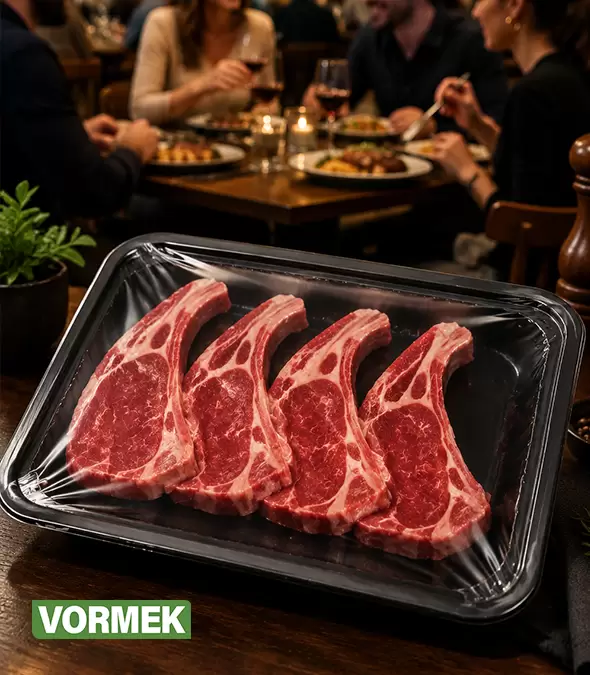
Meat processors often handle different products, including:
- Beef portions
- Lamb cuts
- Marinated products
- Ready-to-cook meals
- Seasonal products
The ideal packaging system depends on balancing:
- Production volume
- Product variety
- Changeover frequency
- Investment strategy
When Semi-Automatic Systems Are More Suitable
Semi-automatic tray sealers are preferred when:
- Products change frequently
- Production volumes vary
- Customized packaging is required
- Investment flexibility is important
They provide excellent adaptability for companies managing multiple product categories.
When Automatic Systems Are More Suitable
Automatic tray sealers are preferred when:
- Production is standardized
- Volume is high
- Labor optimization is important
- Continuous operation is required
Modern automatic systems can also include quick-change tooling and programmable settings to reduce changeover time.
Which Vormek Model Fits Your Meat Packaging Line?
Selecting the right tray sealing machine depends on several operational factors:
- Production volume
- Level of automation required
- Product variety
- Labor availability
- Future expansion plans
Vormek provides different tray sealing solutions designed for different levels of meat processing operations, from flexible semi-automatic applications to advanced industrial packaging lines.
The correct machine selection should be based on the processor’s current production requirements while also considering future growth opportunities.
Gosealer: Flexible Tray Sealing Solution for Meat Processors
The Gosealer tray sealing solution is designed for meat processors that require reliable packaging performance combined with operational flexibility.
It is suitable for companies that need:
- Professional tray sealing quality
- Flexible production capability
- Support for MAP applications
- Efficient product changeover
- Easy operation and maintenance
Gosealer is an appropriate choice for medium-scale meat processors that handle different products and require a balance between investment efficiency and packaging performance.
Typical applications may include:
- Fresh meat portions
- Chilled meat products
- Marinated products
- Retail-ready meat packs
For processors that are growing their production but still require flexibility, Gosealer provides a practical pathway toward more efficient packaging operations.
Pack Meister: Advanced Automation for Industrial Meat Production
The Pack Meister tray sealing solution is designed for industrial meat processors that require higher productivity, reduced manual intervention, and consistent packaging performance.
It is suitable for operations requiring:
- Higher production output
- Stable packaging quality
- Reduced labor dependency
- Integration with production lines
- Continuous industrial operation
For large meat processing facilities supplying retail chains or export markets, automation becomes essential because packaging performance must remain stable throughout long production shifts.
Pack Meister supports processors that need to improve:
- Production efficiency
- Packaging consistency
- Operational scalability
- Long-term manufacturing performance
Gosealer vs Pack Meister: Which Solution Fits Your Operation?
| Requirement | Recommended Solution |
|---|---|
| Flexible production | Gosealer |
| Medium production volume | Gosealer |
| Multiple product variations | Gosealer |
| Growing production demand | Gosealer / Pack Meister |
| High-volume meat packaging | Pack Meister |
| Reduced labor dependency | Pack Meister |
| Export-oriented production | Pack Meister |
| Industrial automation | Pack Meister |
The final selection should always be based on production analysis, packaging requirements, and future business objectives.
Which Tray Sealer Should You Choose? Decision Guide
Choosing between an automatic and semi-automatic tray sealer requires evaluating the complete production environment.
Choose a Semi-Automatic Tray Sealer When:
A semi-automatic system is usually the better option when:
- Production volume is moderate
- Product variety is high
- Frequent changeovers are required
- Initial investment needs to be controlled
- Flexibility is more important than maximum speed
This solution allows processors to maintain professional packaging quality while adapting quickly to different products.
Choose an Automatic Tray Sealer When:
An automatic system is usually the better option when:
- Production volume is high
- Products are standardized
- Labor optimization is important
- Continuous operation is required
- Integration with other equipment is planned
Automation provides stronger performance for processors supplying:
- Supermarkets
- Large retailers
- Export markets
- Industrial distribution networks
Quick Selection Matrix for Meat Processors
| Production Situation | Recommended Solution |
|---|---|
| Small to medium production | Semi-automatic tray sealer |
| Multiple products and frequent changes | Semi-automatic tray sealer |
| Growing production requirements | Advanced semi-automatic or automatic |
| Retail supermarket supply | Automatic tray sealer |
| Export meat production | Automatic tray sealer |
| Multi-shift operation | Automatic tray sealer |
| Complete packaging line integration | Automatic tray sealer |
Frequently Asked Questions (FAQ)
What is the main difference between an automatic and semi-automatic tray sealer?
The main difference is the level of automation.
A semi-automatic tray sealer requires an operator to manually place trays into the sealing station, while an automatic tray sealer performs processes such as tray feeding, positioning, gas injection, sealing, and discharge automatically.
Semi-automatic systems provide flexibility and lower initial investment, while automatic systems provide higher productivity, consistency, and scalability.
Which tray sealer is best for fresh meat packaging?
The best tray sealer depends on production requirements.
Semi-automatic tray sealers are suitable for processors that require flexibility, moderate production volumes, and multiple product formats.
Automatic tray sealers are better suited for industrial meat plants requiring high output, consistent MAP packaging, and reduced labor dependency.
Can semi-automatic tray sealers use MAP technology?
Yes.
Semi-automatic tray sealers can support MAP applications depending on the machine configuration.
They can provide controlled gas flushing or vacuum and gas processes to improve shelf-life performance.
For high-volume MAP meat production, automatic systems generally provide greater consistency because all packaging parameters are controlled within a continuous process.
How long does an automatic tray sealer take to recover its investment?
The ROI period depends on:
- Production volume
- Labor costs
- Operating hours
- Machine utilization
- Business growth
For many industrial meat processors, automatic tray sealing investments are evaluated within approximately 12–36 months.
Higher production volumes and multi-shift operation usually improve the return on investment.
Does automation improve meat packaging quality?
Yes.
Automatic tray sealers improve packaging consistency by controlling:
- Sealing temperature
- Sealing pressure
- Film positioning
- Gas injection accuracy
- Cycle timing
This reduces packaging variation and helps maintain reliable product quality.
What factors should meat processors consider before buying a tray sealer?
Before investing in a tray sealing machine, processors should evaluate:
- Daily production requirements
- Product variety
- Required shelf life
- MAP requirements
- Available labor resources
- Future production growth
Selecting the correct machine based on these factors prevents unnecessary investment and ensures long-term operational efficiency.
Is an automatic tray sealer worth the investment for small meat companies?
For companies with low production volumes, a semi-automatic solution may provide better investment efficiency.
However, businesses expecting rapid growth, larger retail contracts, or increased production demand should evaluate automation because it can provide stronger long-term value.
How does MAP packaging extend fresh meat shelf life?
MAP packaging modifies the internal atmosphere of the package by replacing normal air with selected gas mixtures.
Depending on the application, gases such as oxygen, carbon dioxide, and nitrogen can help:
- Maintain meat color
- Control microbial growth
- Reduce oxidation
- Improve storage stability
The correct gas composition depends on product type, storage temperature, and distribution conditions.
Conclusion: Selecting the Right Tray Sealer for Meat Processing Plants
The decision between an automatic and semi-automatic tray sealer should be based on production strategy, not only the initial equipment price.
Semi-automatic tray sealers remain an effective solution for meat processors that require:
- Flexible production
- Lower initial investment
- Multiple product handling capability
Automatic tray sealers are the preferred solution for industrial meat processors that require:
- Higher production capacity
- Reduced labor dependency
- Consistent packaging performance
- Advanced MAP control
- Long-term scalability
The most successful packaging investment is the one that matches both current operational requirements and future business objectives.
By carefully evaluating production volume, labor costs, product requirements, and growth plans, meat processors can select a tray sealing system that delivers sustainable performance and measurable value.
Request a Meat Packaging Line Consultation
Choosing the right tray sealer requires a detailed understanding of your product, production volume, packaging goals, and future expansion plans.
Vormek engineers can help meat processors evaluate the most suitable tray sealing solution, from flexible semi-automatic systems to advanced automatic packaging lines.
A correctly selected packaging system can improve efficiency, protect product quality, and create long-term value for meat processing operations.