Introduction: Seafood & Fish Packaging Machine Costs in 2026
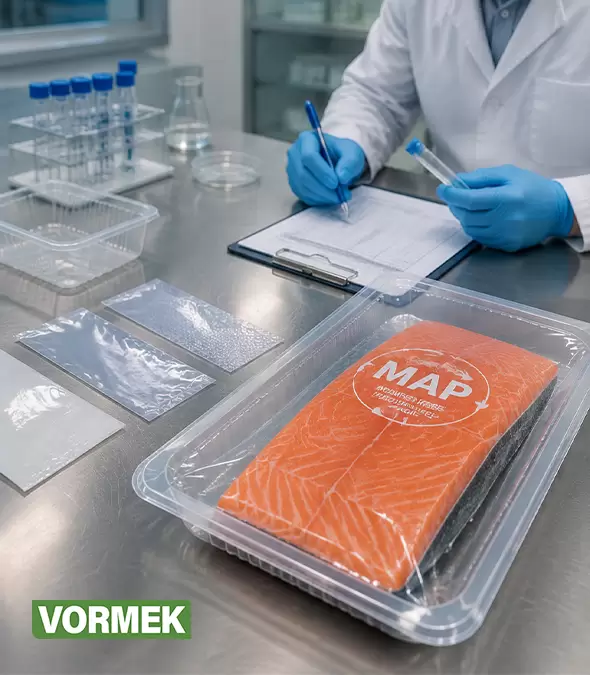
Seafood and fish packaging equipment can range from under $20,000 for basic tray sealing systems to more than $250,000 for highly automated MAP lines. Industrial thermoforming systems can cost even more, depending on capacity, configuration and integration requirements.
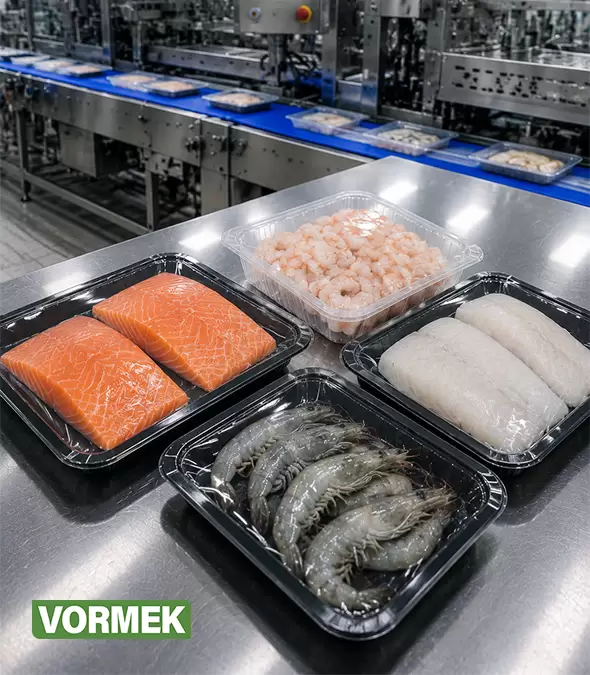
For seafood processors, however, purchase price is only one part of the investment. Fresh fish, fillets, shellfish and other chilled seafood products are highly perishable, so seal integrity, hygienic design, packaging atmosphere and process consistency can directly influence product quality, waste and operating costs.
A realistic equipment budget should therefore consider three cost categories:
- Capital costs: machine, tooling, installation and auxiliary equipment.
- Operating costs: film, trays, MAP gas, labour, utilities and maintenance.
- Lifecycle costs: spare parts, downtime, additional tooling and future upgrades.
This 2026 guide explains the factors that affect seafood packaging machine prices, compares semi-automatic and automatic equipment, identifies hidden costs and shows how to prepare an accurate request for quotation.
Pricing note: All price ranges in this guide are indicative budgeting estimates. Actual quotations vary according to manufacturer, country of origin, machine specification, capacity, tooling and project requirements.
Factors That Affect Seafood & Fish Packaging Machine Price
There is no standard price for a seafood packaging machine. A processor sealing 1,000 trays per shift requires a very different system from a factory producing 15,000 MAP packs per shift.
The following factors have the greatest impact on equipment cost.
1. Packaging Method: Seal-Only, MAP, Vacuum or Skin
Packaging technology is a major price driver.
A basic tray sealer primarily applies and heat-seals lidding film. Modified Atmosphere Packaging (MAP) requires additional systems to modify the atmosphere inside the package before sealing.
Depending on machine design, this can include:
- vacuum pumps;
- gas injection and control;
- MAP-compatible tooling;
- valves and pneumatic components;
- pressure or vacuum monitoring.
Vacuum skin packaging can require additional film-heating, vacuum and tooling capabilities.
Processors should therefore define the packaging method before comparing prices. Two machines described as seafood tray sealers can have substantially different costs when one performs basic sealing and the other provides controlled MAP processing.
2. Production Capacity
Higher throughput generally requires larger tooling, faster handling systems, greater vacuum capacity or increased automation.
Instead of asking for a “high-speed machine”, processors should specify:
- packs per minute or hour;
- packs per shift;
- operating hours per day;
- expected future volume.
A small processor may achieve its target with a semi-automatic system, while a high-volume plant may require automatic tray feeding and multi-cavity tooling.
Oversizing should also be avoided. Unused capacity increases capital cost without necessarily improving profitability.
3. Tooling, Tray Size and Number of Formats
Tray dimensions determine tooling size, sealing area and film requirements.
Manufacturers typically need the tray length, width, depth, flange dimensions, material and maximum product height before designing the tooling.
Capacity also depends on the number of trays sealed per cycle:
| Tooling Configuration | Capacity Level | Typical Application |
|---|---|---|
| 1 tray/cycle | Low | Small-batch production |
| 2 trays/cycle | Low–Medium | Growing processors |
| 4 trays/cycle | Medium–High | Industrial production |
| Multi-cavity | High | Automated high-volume lines |
Processors packaging several tray formats may require multiple tooling sets. This increases initial cost and makes changeover time an important operational consideration.
4. Hygienic Design
Seafood plants are challenging environments because equipment may be exposed to water, salt, proteins and frequent sanitation.
Important design considerations include:
- appropriate stainless-steel construction;
- corrosion-resistant components;
- accessible cleaning areas;
- hygienic conveyor design;
- protected electrical systems;
- effective drainage.
Hygienic engineering can increase purchase price, but poor sanitation design may create greater lifecycle costs through longer cleaning times, corrosion, maintenance and food-safety risks.
5. Vacuum and MAP Capacity
For vacuum and MAP systems, pump capacity must match package volume, tooling configuration and required cycle time.
A useful engineering principle is:
More cavities + larger package headspace + shorter cycle time = greater vacuum demand
An undersized system may restrict production, while an oversized system can increase capital and energy costs unnecessarily.
MAP applications may also require gas-control components, depending on the required process and atmosphere accuracy.
6. Automation Level
Automation is one of the largest variables affecting equipment price.
A semi-automatic system may rely on operators for tray loading and unloading. An automatic line can include:
- tray denesting;
- conveyors;
- filling;
- MAP and sealing;
- coding and labelling;
- checkweighing;
- inspection;
- automatic discharge.
Each module increases capital expenditure but can reduce labour requirements and manual handling.
The relevant financial question is not simply how much automation costs, but how much labour, downtime or production inefficiency it can remove over the machine’s operating life.
7. Controls and Printed Film Registration
PLC controls, touch-screen HMIs, servo drives and sensors can improve process repeatability.
They may control sealing temperature, vacuum level, gas injection, film indexing, recipes and alarms.
Printed lidding film can also require photocell registration and accurate film positioning.
These features add cost but may reduce setup errors, operator dependency and film waste.
8. Line Integration
A standalone tray sealer normally costs less than an integrated seafood packaging line.
Integration may involve weighing equipment, fillers, conveyors, printers, labellers, checkweighers or inspection systems. Mechanical interfaces, line speeds and control signals must be coordinated.
Buyers should therefore determine whether a quotation covers only the machine or also includes integration, installation and commissioning.
What Should You Define Before Comparing Machine Prices?
Before comparing equipment through a Seafood & Fish industry landing page or evaluating a system on the Smart Sealer product page, processors should define six fundamentals:
Product → Package → Packaging Method → Target Shelf Life → Capacity → Automation Level
Once these variables are clear, manufacturers can recommend an appropriate configuration and provide a more meaningful quotation.
The next step is to compare the actual economics of semi-automatic and automatic seafood packaging equipment.
Semi-Automatic vs Automatic Seafood Packaging Machine Cost Range
Choosing between semi-automatic and automatic seafood packaging equipment is primarily an economic decision. Semi-automatic systems require less capital, while automatic machines generally offer higher throughput, lower operator dependency and greater integration potential.
For 2026 budgeting, the following ranges provide a practical starting point.
2026 Seafood & Fish Packaging Equipment Price Ranges
| Equipment Type | Indicative 2026 Price Range* | Typical Application |
|---|---|---|
| Basic Tray Sealer | $8,000–$20,000 | Small-scale seal-only production |
| Semi-Automatic Tray Sealer | $20,000–$50,000 | Small to medium processors |
| Semi-Automatic MAP Tray Sealer | $30,000–$70,000 | Chilled fish and seafood |
| Automatic Tray Sealer | $60,000–$150,000+ | Medium to high-volume production |
| Automatic MAP Packaging Line | $100,000–$250,000+ | Industrial seafood processing |
| Thermoforming System | $120,000–$350,000+ | High-volume integrated production |
*These are indicative budgeting ranges, not fixed quotations. Actual prices depend on manufacturer, country of origin, tooling, capacity, automation and auxiliary equipment.
How Much Does a Semi-Automatic Seafood Packaging Machine Cost?
A semi-automatic tray sealer typically costs approximately $20,000–$50,000, while MAP-capable configurations may range from $30,000–$70,000.
These systems are often suitable for processors with moderate production volumes, multiple SKUs or frequent format changes. Operators typically load trays manually, while the machine controls film handling and sealing and, where specified, vacuum and gas flushing.
Semi-automatic equipment is generally most economical when:
- production volume is low to moderate;
- batches are relatively short;
- manual loading is acceptable;
- capital expenditure is limited;
- product formats change frequently.
The main limitation is labour dependency. As production volume increases, manual loading and unloading can become a bottleneck and increase operating cost per pack.
How Much Does an Automatic Fish Packaging Machine Cost?
Automatic tray sealers generally fall within approximately $60,000–$150,000+, while complete automatic MAP systems may reach $100,000–$250,000+.
The higher investment reflects additional capabilities such as automatic tray handling, continuous conveyors, multi-cavity tooling, higher-capacity vacuum systems and integration with other production equipment.
Automatic systems are particularly relevant when:
- daily production volumes are high;
- multiple shifts are operated;
- labour availability is limited;
- consistent cycle times are important;
- upstream or downstream integration is required.
The correct choice therefore depends on utilisation. A high-speed automatic machine operating far below capacity may deliver a poor return, while an undersized semi-automatic system can become expensive when additional labour and operating hours are required.
Semi-Automatic vs Automatic Seafood Packaging Equipment
| Cost Factor | Semi-Automatic | Automatic |
|---|---|---|
| Initial Investment | Lower | Higher |
| Labour Requirement | Higher | Lower |
| Throughput | Low–Medium | Medium–High |
| Operator Dependency | Higher | Lower |
| Integration Potential | Moderate | High |
| Production Consistency | Good | Very High |
| Expansion Potential | Moderate | High |
| Best Fit | Flexible/shorter runs | Continuous industrial production |
This is why purchase price alone is a weak basis for equipment selection.
A processor should compare the investment against expected production volume, labour requirements, utilisation and future growth.
Calculate Seafood Packaging Cost per Pack
A more meaningful financial metric is cost per acceptable pack.
At its simplest:
Equipment Cost per Pack = Equipment Investment ÷ Total Acceptable Packs Produced
For example, if a $100,000 packaging system produces 10 million acceptable packs during the evaluated ownership period:
$100,000 ÷ 10,000,000 = $0.01 per pack
For a more realistic comparison:
Total Cost per Pack = (Machine + Tooling + Labour + Film + Trays + Gas + Energy + Maintenance + Downtime) ÷ Acceptable Packs Produced
The term acceptable packs matters. Seal failures, damaged trays, film-registration errors and other rejects reduce saleable output and increase the real unit cost.
For seafood processors, rejected packs may also mean product losses, making poor packaging performance considerably more expensive than wasted film alone.
When Does Automation Pay for Itself?
A simple payback calculation can help determine whether additional automation is financially justified:
Payback Period = Additional Automation Investment ÷ Annual Operating Cost Savings
Suppose an automatic system requires $80,000 more investment than a semi-automatic alternative but reduces annual labour and operating costs by $32,000:
$80,000 ÷ $32,000 = 2.5 years
The additional automation would theoretically recover its incremental investment in approximately 2.5 years.
For a complete investment analysis, processors should also consider financing, maintenance, depreciation, production growth and expected machine utilisation.
Production Volume vs Automation Level
The economic relationship can be represented conceptually:
| Production Volume | Semi-Automatic Suitability | Automatic Suitability |
|---|---|---|
| Low | High | Low |
| Medium | High | Medium–High |
| High | Low–Medium | High |
| Very High | Low | Very High |
This is not a fixed rule. A processor with expensive or scarce labour may justify automation at a lower production volume, while another facility with frequent short batches may continue to benefit from semi-automatic equipment.
The objective is to identify the system that achieves the required production capacity at the lowest sustainable total cost—not simply the machine with the lowest quotation.
Hidden Costs to Budget For When Buying Seafood Packaging Equipment
The machine price is only part of the total investment. Tooling, packaging materials, utilities, maintenance and downtime can significantly affect the true cost of a seafood packaging operation.
These expenses should be included when calculating total cost of ownership.
Tooling and Mould Costs
Different tray sizes may require separate tooling sets. MAP tooling can also be more complex because vacuum and gas channels must be incorporated into the design.
Before purchasing equipment, confirm:
- tooling cost for each format;
- changeover time;
- replacement component costs;
- availability of future tooling.
For processors handling multiple seafood SKUs, tooling can represent a significant additional capital expense.
Film and Tray Costs
Film and trays are recurring costs and may exceed the original machine investment over the equipment’s operating life.
Seafood lidding films may require properties such as oxygen barrier, moisture resistance, anti-fog performance, puncture resistance, optical clarity and reliable sealability.
Film width also affects material efficiency. Excessive trim may appear insignificant per package but can create substantial annual waste at high production volumes.
Tray quality is equally important. Poor dimensional consistency, damaged flanges or incompatible materials can increase seal failures and rejects.
For this reason, the machine, tray and film should be validated as one packaging system.
MAP Gas and Utility Costs
MAP applications introduce recurring gas costs.
Consumption depends on tray headspace, gas composition, production volume, residual oxygen target and machine efficiency.
A simple estimate is:
Annual Gas Cost = Gas Consumption per Pack × Annual Pack Volume × Gas Unit Cost
Utilities should also be included in the budget. Depending on configuration, seafood packaging equipment may require electricity, compressed air, cooling water and vacuum systems.
Before installation, confirm whether the existing factory infrastructure can support these requirements. Compressor, electrical or cooling-system upgrades can add unexpected project costs.
Maintenance, Spare Parts and Downtime
Preventive maintenance should be budgeted from the first year.
Typical service items may include sealing components, gaskets, cutting parts, pneumatic seals, sensors and vacuum pump consumables.
Spare-parts availability is particularly important for seafood processors because packaging downtime can affect highly perishable inventory.
Downtime cost can be considered as:
Downtime Cost = Lost Production + Idle Labour + Product Loss + Recovery Costs
Supplier response time, remote diagnostics, local service capability and recommended spare-parts packages therefore have measurable economic value.
Cleaning and Changeover Costs
Seafood production requires rigorous sanitation. Equipment with difficult-to-access surfaces may require more cleaning labour and longer production stops.
Format changes can create similar losses. Replacing tooling, changing film, loading new recipes and validating seal quality all consume production time.
Processors running multiple tray formats should therefore consider hygienic accessibility, quick-change tooling and recipe storage when comparing equipment.
A higher initial investment can sometimes be justified by shorter sanitation and changeover times over several years of production.
How to Get an Accurate Quote for Seafood & Fish Packaging Equipment
An accurate quotation requires more than asking, “How much does a fish packaging machine cost?”
Manufacturers need a clear production specification. The following information allows suppliers to select suitable tooling, vacuum capacity, automation and machine size.
1. Define the Product and Packaging Method
Specify the exact seafood product: fresh fillets, whole fish, shrimp, shellfish, smoked fish, marinated seafood, frozen products or another format.
Also identify the required packaging process:
- seal-only;
- vacuum;
- Modified Atmosphere Packaging;
- vacuum skin packaging.
Product characteristics such as free liquid, sharp bones, irregular height or marinades can affect packaging requirements.
If a target shelf life has already been established, include it in the project brief.
2. Provide Tray and Film Specifications
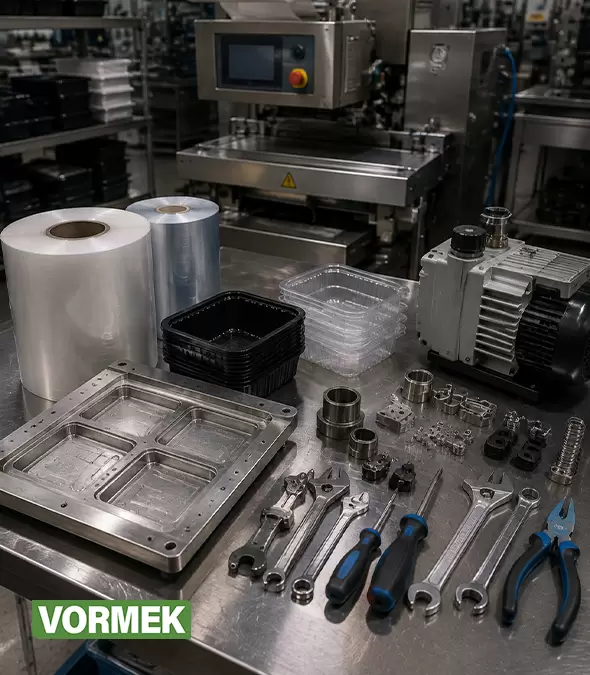
For each tray format, provide:
- length, width and depth;
- flange dimensions;
- tray material;
- product weight and maximum height.
Technical drawings or physical samples are preferable where available.
Film information should include material structure, thickness, roll width and whether printed-film registration is required.
This information is essential for accurate tooling design and film-handling specifications.
3. State the Required Output
Capacity should be expressed numerically.
For example:
6,000 acceptable packs per 8-hour shift
is much more useful than requesting a “high-speed” machine.
Include the number of shifts, production days and expected future growth. This helps prevent both undersizing and unnecessary oversizing.
4. Define the Automation Scope
Identify which processes should be automated.
These may include tray denesting, filling, conveyor transfer, MAP, sealing, coding, labelling, checkweighing and inspection.
If labour reduction is a primary objective, provide current staffing and production information. Automation can then be evaluated against measurable operating savings.
5. Provide Factory and Utility Information
Suppliers should understand the actual installation environment, including:
- available floor space;
- line direction;
- electrical supply;
- compressed-air availability;
- MAP gas supply;
- cleaning procedures;
- washdown requirements.
For seafood applications, sanitation and corrosion resistance should be discussed explicitly rather than assumed.
6. Request a Complete Cost Breakdown
A useful quotation should clearly identify what is included.
| Cost Category | What to Confirm |
|---|---|
| Base Machine | Standard configuration |
| Tooling | Number and cost of mould sets |
| MAP/Vacuum | Pumps and gas-control equipment |
| Automation | Denesters, conveyors and auxiliary modules |
| Installation | Installation and commissioning |
| Training | Operator and maintenance training |
| Spare Parts | Recommended initial package |
| Warranty | Duration and coverage |
| Service | Remote and on-site support |
| Delivery | Freight, lead time and delivery terms |
This prevents an apparently inexpensive quotation from becoming significantly more expensive once essential components are added.
7. Request a Packaging Trial Where Possible
Before final equipment approval, performance should ideally be assessed using the intended product, tray and film.
Useful parameters include:
- achievable cycle time;
- packs per minute;
- seal integrity;
- residual oxygen for MAP;
- film and gas consumption;
- reject rate;
- changeover time.
Nominal cycle speed alone can be misleading.
Actual output should be evaluated as:
Actual Output = Cycles per Minute × Acceptable Packs per Cycle
Production efficiency and rejects should then be considered to determine realistic saleable output.
Seafood Packaging Machine RFQ Checklist
Before requesting a final quotation, prepare:
- Product: seafood type and condition
- Package: tray dimensions, material and product weight
- Process: seal-only, vacuum, MAP or skin
- Film: structure, width and printed/unprinted format
- Capacity: required packs per hour or shift
- Automation: semi-automatic or automatic
- Formats: number of trays and SKUs
- Utilities: electricity, compressed air and gas
- Environment: sanitation and washdown requirements
- Growth: expected future production capacity
Providing these details allows suppliers to quote against the actual application rather than a generic machine specification, making both technical and financial comparisons significantly more reliable.
Frequently Asked Questions About Seafood & Fish Packaging Machine Costs
How much does a seafood packaging machine cost in 2026?
Seafood packaging equipment can range from approximately $8,000–$20,000 for basic tray sealers to more than $250,000 for highly automated MAP lines. Industrial thermoforming systems may range from approximately $120,000–$350,000+, depending on capacity, tooling and configuration.
These figures should be used for preliminary budgeting only. Final prices vary by manufacturer, automation level, hygienic design and project scope.
How much does a fish tray sealing machine cost?
A semi-automatic fish tray sealer typically requires a budget of approximately $20,000–$50,000. MAP-capable semi-automatic systems may range from $30,000–$70,000, while automatic tray sealers can cost approximately $60,000–$150,000+.
Tooling, vacuum systems, conveyors and installation may be priced separately, so buyers should compare complete project costs rather than base-machine prices.
Is a MAP seafood packaging machine more expensive?
Generally, yes. MAP systems may require vacuum pumps, gas control, specialised tooling, additional valves and more advanced controls.
Whether this additional investment is justified depends on the seafood product, target shelf life, production volume and validated packaging process.
Is a semi-automatic or automatic seafood packaging machine better?
Neither option is universally better.
Semi-automatic equipment usually provides a lower initial investment and greater flexibility for moderate production volumes and short batches. Automatic systems are generally better suited to high-volume production where labour reduction, consistent throughput and line integration are priorities.
The most appropriate choice is the system that provides the required output and package quality at the lowest sustainable total cost per acceptable pack.
What hidden costs should I budget for?
In addition to the machine, processors should budget for tooling, trays, film, MAP gas, freight, installation, training, utilities, spare parts and preventive maintenance.
Downtime, sanitation and format changeovers should also be considered because they reduce productive operating time.
How can I reduce seafood packaging cost per pack?
Cost per pack can be reduced by matching machine capacity to actual demand, minimising film waste, optimising tooling layouts, reducing rejects, improving gas efficiency and shortening cleaning and changeover times.
Automation can also reduce unit cost when labour savings and additional throughput justify the higher capital investment.
What information is needed for an accurate machine quote?
Suppliers should receive the seafood product type, tray dimensions and material, packaging method, film specification, required output, number of formats, automation requirements and available factory utilities.
Providing physical tray and film samples can further improve tooling and process accuracy.
Should I buy extra capacity for future production growth?
Some additional capacity is advisable when significant growth is expected, but excessive oversizing can increase capital cost unnecessarily.
Processors should estimate realistic production requirements over the next three to five years and select equipment with sufficient headroom for expected growth.
Conclusion: How to Choose the Right Seafood Packaging Equipment for Your Budget
Seafood and fish packaging equipment prices vary widely in 2026. Basic sealing equipment may cost under $20,000, while industrial automatic MAP and thermoforming systems can require six-figure investments.
The lowest purchase price, however, does not necessarily produce the lowest packaging cost.
A meaningful equipment comparison should consider:
Machine + Tooling + Materials + Labour + Utilities + Maintenance + Downtime
Processors should also evaluate throughput, seal consistency, hygienic design, changeover time, service availability and future capacity.
Before requesting a quotation, define six fundamentals:
Product → Package → Packaging Method → Target Shelf Life → Capacity → Automation
Smaller processors and businesses producing frequent short batches may achieve better economics with flexible semi-automatic equipment. High-volume plants operating long or multiple shifts may benefit more from automatic tray handling, MAP and integrated production systems.
Processors researching suitable technologies can use the Seafood & Fish industry landing page to compare packaging approaches for different seafood applications and review the Smart Sealer product page when evaluating tray sealing and MAP configurations.
Ultimately, the best seafood packaging machine is not simply the one with the lowest quotation. It is the system that can reliably produce the required number of acceptable packs, at the required quality and food-safety standard, while delivering a sustainable cost per pack throughout its operating life.