Introduction
Choosing the right packaging machine is a critical investment for any red meat processor. The selected system influences much more than line speed. It affects product safety, shelf life, color stability, drip control, labor requirements, packaging waste, retail appearance, and the overall profitability of the production line.
Fresh red meat is a highly perishable food product. After processing, biochemical and microbiological changes continue inside the muscle tissue. Myoglobin reactions influence visible meat color, while lipid oxidation, moisture loss, temperature abuse, and microbial growth gradually reduce quality.
For this reason, red meat packaging should not be treated as a simple sealing operation. The packaging machine must work as part of a complete system that includes:
- The meat product
- Tray geometry
- Lidding film
- Packaging atmosphere
- Sealing parameters
- Cold-chain conditions
- Distribution time
- Retail requirements
A machine may offer an impressive nominal speed but still perform poorly if it cannot maintain stable sealing pressure, accurate film positioning, consistent vacuum levels, or repeatable gas flushing. Similarly, a technically advanced machine may be an unnecessary investment for a processor with low daily production and frequent product changes.
The right choice is therefore not always the fastest, largest, or least expensive machine. It is the machine that matches the processor’s actual production volume, product portfolio, packaging format, hygiene requirements, labor conditions, and expected growth.
This guide provides a practical framework for evaluating red meat packaging equipment. It explains how to compare production capacity, packaging technology, film compatibility, automation level, total cost of ownership, return on investment, and after-sales support.
Whether your facility packages beef steaks, minced beef, burger patties, lamb chops, bone-in cuts, premium aged meat, or export primals, the selection process should begin with a clear definition of production requirements.
Why the Right Red Meat Packaging Machine Matters
Packaging performance directly affects the quality of meat throughout refrigerated storage and distribution. Poor package integrity can allow oxygen ingress, gas loss, moisture leakage, or microbial contamination. These failures may shorten shelf life, accelerate discoloration, increase product returns, and damage retailer confidence.
For fresh red meat, the packaging system must help control several important quality mechanisms:
- Myoglobin oxidation: Excessive oxidation can convert desirable red oxymyoglobin into brown metmyoglobin.
- Lipid oxidation: Oxygen exposure can generate off-flavors and reduce sensory quality.
- Microbial growth: Spoilage organisms may grow rapidly when temperature and atmosphere are not properly controlled.
- Drip loss: Poor moisture management reduces saleable weight and affects retail presentation.
- Seal integrity: Weak, contaminated, or incomplete seals compromise package performance.
A properly specified machine improves repeatability by controlling sealing temperature, sealing time, pressure, vacuum, gas flushing, film advance, and cutting accuracy.
| Operational objective | Packaging-machine contribution |
|---|---|
| Extend refrigerated shelf life | Stable vacuum, MAP control, and high-integrity sealing |
| Maintain meat color | Compatible atmosphere and barrier packaging |
| Reduce rejected packs | Consistent sealing and film positioning |
| Improve food safety | Hygienic construction and reduced handling |
| Lower labor costs | Appropriate automation level |
| Minimize packaging waste | Accurate film transport and recipe control |
| Support business growth | Modular tooling and scalable line design |
The purchasing decision should therefore be based on total production performance rather than purchase price alone.
How Much Production Capacity Does Your Red Meat Packaging Line Need?
Production volume is the first technical factor to evaluate. A machine that is too small becomes a bottleneck, while an oversized system may increase capital cost, floor-space requirements, and maintenance complexity without generating sufficient return.
Processors should calculate capacity using real operating conditions rather than relying only on average daily output.
Important inputs include:
- Packs per hour
- Packs per shift
- Number of shifts per day
- Tray dimensions
- Trays per sealing cycle
- MAP or vacuum cycle duration
- Product-change frequency
- Cleaning and changeover time
- Seasonal production peaks
- Expected growth over three to five years
A useful starting principle is to specify enough spare capacity to handle short-term growth and peak demand. In many operations, selecting a machine with approximately 20–30% capacity above current average demand provides useful flexibility without excessive oversizing.
Compare Packs per Minute, Not Only Cycles per Minute
Packaging-machine speed is commonly advertised in cycles per minute. However, cycle speed alone does not show actual line output because each mold may seal a different number of trays.
| Machine type | Typical cycles per minute | Trays per cycle | Approximate packs per minute |
|---|---|---|---|
| Semi-automatic tray sealer | 4–6 | 1 | 4–6 |
| Rotary tray sealer | 6–8 | 2 | 12–16 |
| Automatic tray sealer | 6–9 | 4 | 24–36 |
| High-speed multi-lane system | 8–10 | 6–8 | 48–80 |
These figures are illustrative. Actual output depends on tray size, mold configuration, vacuum time, gas-exchange requirements, sealing temperature, loading efficiency, and downstream equipment.
For this reason, buyers should request production trials using their own tray, film, and product whenever possible.
Consider Effective Output and OEE
Nominal speed does not equal real production output. A faster machine may deliver less usable production if it suffers from frequent stoppages, slow changeovers, film-tracking problems, or high reject rates.
Overall Equipment Effectiveness, or OEE, evaluates three factors:
- Availability: How often the machine is ready to operate
- Performance: How closely it runs to its target speed
- Quality: How many finished packs meet specifications
A machine producing 35 packs per minute with stable uptime may create more saleable output than a machine rated at 45 packs per minute but affected by frequent stops and seal rejects.
Production-Capacity Selection Table
| Production level | Typical packs per shift | Suitable starting solution |
|---|---|---|
| Artisan butcher or pilot line | 200–800 | Semi-automatic tray sealer |
| Small meat processor | 800–3,000 | Rotary or advanced semi-automatic system |
| Medium processor | 3,000–8,000 | Automatic tray sealer |
| Large retail supplier | 8,000–20,000 | High-speed automatic tray sealer |
| Industrial multi-shift facility | More than 20,000 | Integrated multi-lane packaging line |
These ranges should not be used as fixed purchasing rules. A processor packaging large bone-in cuts may require longer cycles than a processor sealing shallow minced-meat trays. Product mix and packaging technology must therefore be assessed alongside volume.
Production-Capacity Decision Flow
Calculate average packs per shift
              │
              ▼
Identify peak and seasonal demand
              │
              ▼
Add cleaning and changeover losses
              │
              ▼
Calculate required packs per hour
              │
              ▼
Allow capacity for future growth
              │
              ▼
Compare actual output under MAP or vacuum conditions
              │
              ▼
Select the appropriate machine class
How to Match a Packaging Machine to Your Red Meat Product and Packaging Materials
Selecting the correct production capacity is only the first step. The next—and often more critical—decision is ensuring that the packaging machine is compatible with the characteristics of the meat product, packaging atmosphere, tray, and lidding film.
Fresh red meat behaves differently from poultry, seafood, or processed foods. Factors such as myoglobin chemistry, fat content, bone structure, moisture release, microbial activity, and intended shelf life all influence packaging performance. Consequently, the packaging machine should be selected as part of a complete packaging system rather than as an individual piece of equipment.
Choose the Right Packaging Technology for Your Product
Different products require different packaging technologies depending on their distribution channel, expected shelf life, and retail presentation.
Modified Atmosphere Packaging (MAP)
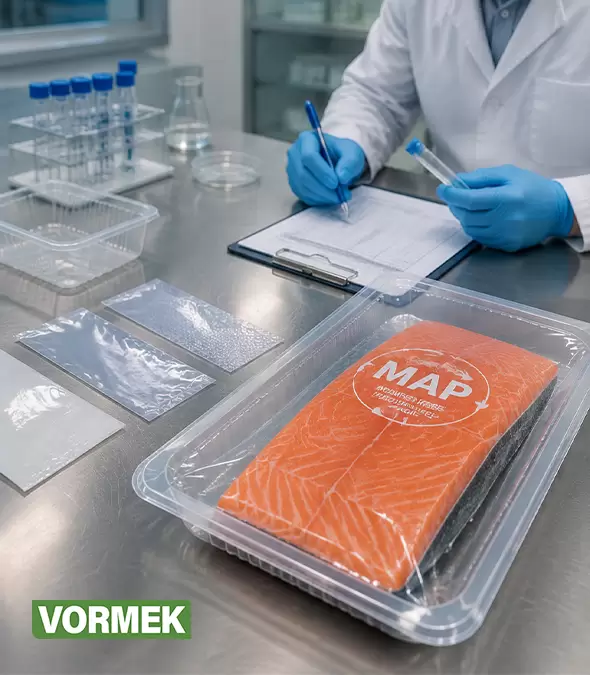
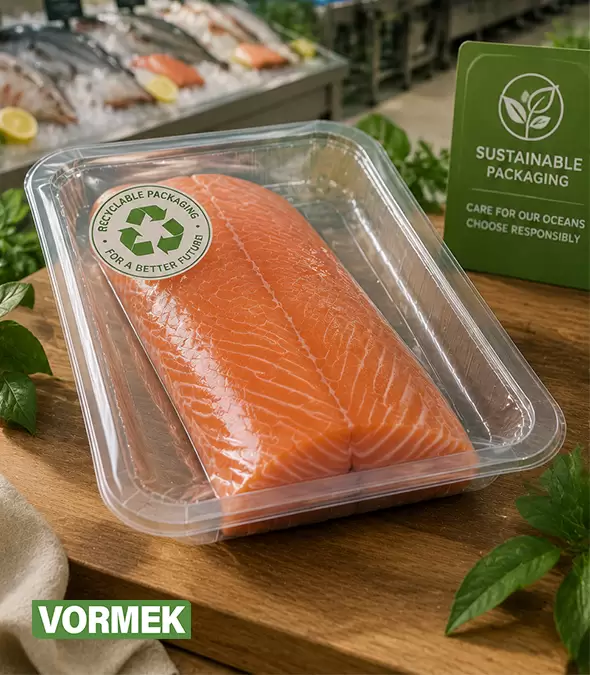
MAP is the most widely used solution for fresh retail beef and lamb because it replaces ambient air with a controlled gas mixture that slows spoilage while preserving an attractive appearance.
For fresh red meat, oxygen has a unique role. High oxygen concentrations promote the formation of oxymyoglobin, the bright red pigment associated with freshness by consumers. Carbon dioxide suppresses the growth of aerobic spoilage microorganisms such as Pseudomonas spp., helping extend refrigerated shelf life.
A typical gas mixture for fresh beef is:
| Gas | Typical Range | Function |
|---|---|---|
| Oxygen (O₂) | 70–80% | Maintains bright red color |
| Carbon dioxide (CO₂) | 20–30% | Inhibits spoilage bacteria |
| Nitrogen (N₂) | Optional | Prevents package collapse |
The packaging machine should maintain stable vacuum levels and accurate gas replacement while minimizing residual oxygen after sealing.
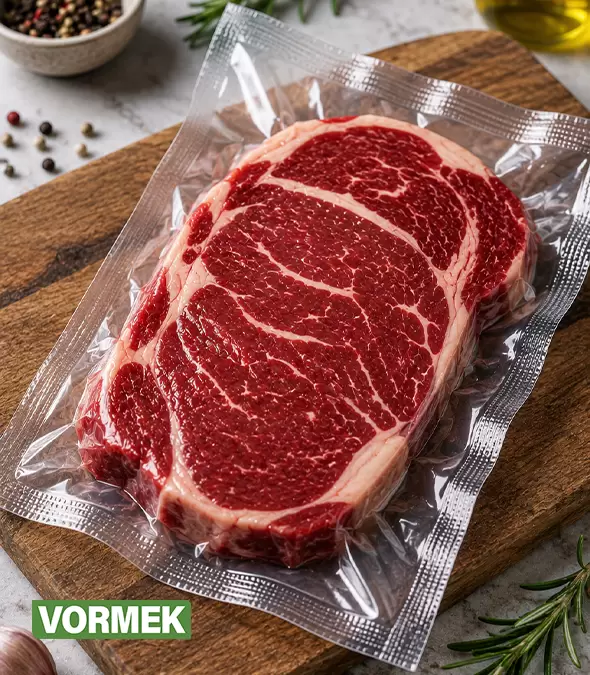
Vacuum Packaging
Vacuum packaging removes air from the package without replacing it with another gas mixture.
This method is widely used for:
- Primal beef cuts
- Export products
- Foodservice
- Frozen meat
- Long-term refrigerated storage
Without oxygen, meat naturally changes from bright red to a darker purplish-red because deoxymyoglobin becomes the dominant pigment. This is a normal biochemical reaction and should not be confused with spoilage.
Vacuum packaging significantly reduces oxidative rancidity while slowing the growth of aerobic microorganisms.
Vacuum Skin Packaging (VSP)
Vacuum Skin Packaging combines vacuum preservation with premium product presentation.
During sealing, a highly extensible top film closely conforms to the product surface, eliminating headspace while securely fixing the meat inside the tray.
VSP offers several advantages:
- Premium shelf appearance
- Reduced drip movement
- Excellent package stability
- Improved leak resistance
- Longer refrigerated shelf life
It is commonly used for premium steaks, Wagyu beef, dry-aged beef, and other high-value retail products.
Match the Machine to the Packaging Film
Packaging films are engineered with different barrier and sealing properties. Even an advanced tray sealer cannot consistently produce high-quality packages if the selected film is incompatible with the sealing system.
When evaluating packaging films, processors should consider:
- Oxygen barrier performance
- Water vapor barrier
- Seal strength
- Seal initiation temperature
- Puncture resistance
- Optical clarity
- Anti-fog performance
- Machine compatibility
Selecting the correct film helps maintain package integrity throughout production, transportation, and refrigerated storage.
Understand Barrier Film Performance
Barrier performance directly influences shelf life by controlling gas exchange between the package and the surrounding environment.
The most common multilayer structures include:
| Film Structure | Typical Application |
|---|---|
| PET/PE | Standard tray sealing |
| PET/EVOH/PE | High-barrier MAP packaging |
| PA/PE | Vacuum packaging |
| PP/EVOH/PP | Microwave-ready packaging |
| Skin Film | Vacuum Skin Packaging |
Among these materials, EVOH (Ethylene Vinyl Alcohol) provides excellent oxygen barrier performance and is widely used for fresh meat packaged under MAP.
OTR and WVTR Matter More Than Film Thickness
Many buyers compare films based only on thickness. In reality, barrier performance is often more important.
Oxygen Transmission Rate (OTR)
OTR measures the amount of oxygen passing through the packaging material over a specified time.
A low OTR helps:
- Maintain MAP gas composition
- Reduce lipid oxidation
- Preserve meat color
- Extend shelf life
Water Vapor Transmission Rate (WVTR)
WVTR measures moisture transmission through the packaging material.
Proper WVTR helps:
- Reduce weight loss
- Control drip formation
- Improve package appearance
- Maintain product texture
For refrigerated red meat, selecting a film with appropriate OTR and WVTR values is generally more important than choosing the thickest available material.
Select the Appropriate Tray
Tray selection also influences package performance.
The tray should provide:
- Dimensional stability
- Uniform sealing surfaces
- Mechanical strength
- Compatibility with barrier films
- Resistance to deformation during transportation
Common tray materials include APET, PET/EVOH, PP, and CPET, each offering different advantages depending on the application.
The packaging machine should support multiple tray depths and dimensions while maintaining consistent sealing pressure across every cavity.
Match Packaging Technology to Product Type
| Product | Recommended Packaging | Recommended Equipment |
|---|---|---|
| Fresh beef steaks | High-O₂ MAP | Automatic Tray Sealer |
| Ground beef | MAP | Automatic Tray Sealer with gas flushing |
| Lamb chops | MAP | Automatic Tray Sealer |
| Premium steaks | Vacuum Skin Packaging | Skin Packaging Machine |
| Bone-in beef | MAP with puncture-resistant film | Automatic Tray Sealer |
| Export primal cuts | Vacuum Packaging | Chamber Vacuum Machine |
| Frozen beef | Vacuum Packaging | Chamber Vacuum Machine |
Packaging Compatibility Checklist
Before selecting a machine, confirm that it is compatible with:
- Required tray dimensions
- Planned film structures
- MAP and vacuum requirements
- Desired gas mixtures
- Future packaging formats
- Printed and unprinted films
- Anti-fog lidding films
- Expected shelf-life targets
Choosing a packaging machine that is fully compatible with the intended product and packaging materials minimizes seal failures, reduces packaging waste, improves shelf life, and creates a more reliable production process.
Packaging Selection Flow
Identify Meat Product
         │
         ▼
Determine Required Shelf Life
         │
         ▼
Choose MAP, Vacuum or VSP
         │
         ▼
Select Tray Material
         │
         ▼
Choose High-Barrier Film
         │
         ▼
Verify Machine Compatibility
         │
         ▼
Validate Packaging Performance
How to Choose Between Semi-Automatic and Fully Automatic Packaging Machines
Once the appropriate packaging technology has been identified, the next decision is selecting the right level of automation. This choice affects production efficiency, labor costs, package consistency, operational flexibility, and long-term profitability.
A common misconception is that a fully automatic machine is always the best option. In reality, the ideal solution depends on production volume, SKU diversity, labor availability, and future expansion plans. The objective is to maximize productivity while maintaining a reasonable return on investment.
When Is a Semi-Automatic Tray Sealer the Best Choice?
Semi-automatic tray sealers are designed for processors with relatively low production volumes or frequent product changeovers. In these systems, operators manually load and unload trays while the machine performs the sealing, vacuum, and MAP cycle automatically.
Typical applications include:
- Artisan butcher shops
- Regional meat processors
- Premium specialty meat producers
- Product development facilities
- Seasonal production lines
Advantages
- Lower capital investment
- Compact footprint
- Quick installation
- Flexible for multiple tray sizes
- Short setup time
- Simple operator training
For processors packaging several small production batches each day, these advantages often outweigh the benefits of full automation.
However, manual handling gradually limits productivity as production volumes increase.
When Does a Fully Automatic Machine Become the Better Investment?
As production grows, labor efficiency becomes increasingly important.
Fully automatic tray sealers automate tray indexing, film transport, sealing, package discharge, and integration with downstream equipment such as checkweighers, labelers, metal detectors, and case packers.
They are generally recommended for:
- Medium and large meat processors
- Supermarket suppliers
- Export-oriented facilities
- Multi-shift operations
- Companies expecting continuous growth
Key benefits include:
- Higher production capacity
- Lower labor cost per package
- Consistent package quality
- Stable sealing parameters
- Reduced operator dependency
- Improved traceability
- Better production planning
Although the purchase price is higher, improved productivity often results in a significantly lower cost per packaged unit.
Compare Total Production Performance—Not Just Machine Speed
Machine speed should never be evaluated in isolation.
Instead, processors should compare:
- Packs produced per hour
- Operator requirements
- Package reject rate
- Downtime
- Film waste
- Changeover time
- Cleaning time
- Maintenance requirements
These factors determine the real production output rather than the theoretical machine capacity stated in brochures.
Why Overall Equipment Effectiveness (OEE) Matters
Modern food manufacturers increasingly evaluate packaging lines using Overall Equipment Effectiveness (OEE).
OEE combines three key indicators:
- Availability – Percentage of scheduled production time during which the machine is operating.
- Performance – Actual production speed compared with the designed speed.
- Quality – Percentage of acceptable packages produced without rework or rejection.
Improving OEE often delivers greater productivity gains than simply purchasing a faster machine.
For example, reducing changeover time, minimizing film tracking errors, and preventing seal failures can increase effective production without increasing nominal machine speed.
Flexibility Is Essential for Multi-SKU Production
Most red meat processors package several products during the same production shift.
Examples include:
- Beef steaks
- Minced beef
- Lamb chops
- Burger patties
- Family-size packs
- Premium retail portions
Frequent product changes require rapid machine adjustment.
Look for equipment offering:
- Tool-free mold replacement
- Stored packaging recipes
- Automatic parameter adjustment
- Quick film roll replacement
- Multiple tray compatibility
Reducing changeover time increases productive operating hours while improving overall line efficiency.
Modern Control Systems Improve Process Consistency
Today’s high-performance tray sealers are controlled by programmable PLC systems with touchscreen Human-Machine Interfaces (HMIs).
Recipe management allows operators to store production settings for different products, including:
- Sealing temperature
- Sealing time
- Vacuum level
- MAP gas cycle
- Film advance length
- Tray dimensions
This reduces operator error and ensures repeatable package quality across different production batches.
Hygienic Design Is a Critical Selection Criterion
Because fresh meat is highly susceptible to microbial contamination, hygienic equipment design should be considered during machine selection.
Look for features such as:
- AISI 304 stainless-steel construction
- Sloped surfaces for water drainage
- Open-frame architecture
- Easy access for sanitation
- Washdown-compatible components
- Hygienic conveyor design
These characteristics simplify cleaning procedures and support compliance with HACCP, ISO 22000, and modern hygienic design principles.
Select Equipment That Can Grow With Your Business
Packaging equipment typically remains in service for more than ten years. During that period, processors often introduce new products, larger retail packs, sustainable packaging materials, or higher production volumes.
Choosing a modular platform allows future upgrades without replacing the entire machine.
Potential upgrades may include:
- Additional tooling
- Vacuum Skin Packaging capability
- Higher-capacity vacuum pumps
- Vision inspection systems
- Automatic denesters
- Labeling and coding systems
- Remote diagnostics
Scalable equipment reduces future capital expenditure while extending the useful life of the production line.
Semi-Automatic vs Fully Automatic Comparison
| Evaluation Factor | Semi-Automatic | Fully Automatic |
|---|---|---|
| Daily production | Low–Medium | Medium–Very High |
| Labor requirement | Higher | Lower |
| Investment cost | Lower | Higher |
| Package consistency | Good | Excellent |
| Future scalability | Moderate | Excellent |
| Integration with complete packaging lines | Limited | Extensive |
| Cost per package | Higher at large volumes | Lower at high volumes |
Automation Selection Flow
Current Production Volume
          │
          ▼
Less than 3,000 packs per shift?
      │                 │
     Yes                No
      │                 │
      ▼                 ▼
Semi-Automatic     Production Growth Expected?
                        │            │
                       No           Yes
                        │            │
                        ▼            ▼
             Automatic Tray     Fully Automatic
                 Sealer         Packaging Line
How to Evaluate Budget, ROI, and After-Sales Support Before Buying a Red Meat Packaging Machine
The final stage of the selection process is evaluating the financial and operational value of the investment. While technical specifications determine whether a machine can perform the required packaging task, long-term profitability depends on its operating cost, reliability, service support, and return on investment.
Many processors focus primarily on purchase price. However, the least expensive machine is rarely the most economical over its lifetime. Frequent downtime, excessive packaging waste, poor technical support, and limited upgrade capability often result in significantly higher operating costs.
The objective is to select equipment that delivers the lowest Total Cost of Ownership (TCO) while providing reliable production for many years.
Evaluate the Total Cost of Ownership (TCO)
The purchase price represents only a fraction of the total investment. A complete financial evaluation should include all costs associated with owning and operating the equipment.
Typical TCO components include:
- Machine purchase price
- Installation and commissioning
- Operator training
- Energy consumption
- Compressed air consumption
- Packaging material waste
- Preventive maintenance
- Spare parts
- Production downtime
- Future upgrades
A machine with a higher purchase price but lower operating costs often becomes the more profitable investment within a few years.
Calculate Return on Investment (ROI)
Return on Investment should be calculated using measurable operational improvements rather than estimated production increases alone.
Typical sources of financial return include:
- Reduced labor costs
- Lower film consumption
- Fewer rejected packages
- Improved Overall Equipment Effectiveness (OEE)
- Longer product shelf life
- Reduced product waste
- Increased production capacity
Example ROI
| Annual Improvement | Estimated Saving |
|---|---|
| Labor reduction | $30,000 |
| Packaging material savings | $15,000 |
| Reduced product waste | $18,000 |
| Higher production efficiency | $22,000 |
| Total Annual Benefit | $85,000 |
If upgrading to a higher-performance packaging machine requires an additional investment of $170,000, the estimated payback period is approximately two years, assuming production volume remains stable.
Assess the Quality of After-Sales Support
Reliable technical support is just as important as machine performance.
Before purchasing equipment, ask the supplier:
- Are spare parts available locally?
- What is the average service response time?
- Is remote technical support available?
- Is operator training included?
- Are preventive maintenance programs offered?
- How long are critical components supported?
Strong after-sales support minimizes downtime and protects production continuity.
Questions to Ask Before Purchasing
Before making a final decision, verify that the supplier can clearly answer the following questions:
- Can the machine package all planned product formats?
- Is it compatible with current and future tray designs?
- Does it support both MAP and vacuum packaging?
- Can sealing recipes be stored and recalled?
- How long does a mold change take?
- What is the expected OEE under production conditions?
- Which spare parts should be kept in stock?
- What preventive maintenance schedule is recommended?
Clear answers to these questions often reveal the true long-term value of the equipment.
Red Meat Packaging Machine Selection Checklist
| Selection Criteria | ✓ |
|---|---|
| Production capacity matches demand | □ |
| Compatible with selected trays and films | □ |
| Supports required MAP or vacuum process | □ |
| Hygienic stainless-steel construction | □ |
| Quick changeover capability | □ |
| Low operating cost | □ |
| Reliable local technical support | □ |
| Spare parts readily available | □ |
| Modular design for future expansion | □ |
| Positive ROI and acceptable TCO | □ |
Conclusion
Choosing the right red meat packaging machine requires balancing technical performance with long-term business objectives. Production capacity, packaging technology, film compatibility, automation level, hygienic design, and after-sales support should all be evaluated together rather than individually.
Processors that base purchasing decisions solely on machine price often encounter higher operating costs, reduced productivity, and limited flexibility as production grows. By contrast, selecting equipment according to Total Cost of Ownership (TCO) and Return on Investment (ROI) helps maximize efficiency throughout the machine’s service life.
The ideal packaging system is one that consistently delivers high-quality seals, supports food safety, minimizes waste, integrates with future production requirements, and provides dependable technical support when needed.
Investing in the right packaging technology today creates a stronger foundation for higher productivity, improved product quality, and sustainable business growth tomorrow.
Frequently Asked Questions
1. What is the best packaging machine for fresh red meat?
For most retail applications, an automatic tray sealer equipped with Modified Atmosphere Packaging (MAP) technology offers the best balance between shelf life, product appearance, and production efficiency.
2. Should I choose MAP or vacuum packaging?
MAP is generally preferred for fresh retail meat because it preserves color and extends shelf life. Vacuum packaging is better suited for bulk distribution, export, and long-term refrigerated or frozen storage.
3. How much extra production capacity should I plan for?
Most manufacturers recommend selecting equipment capable of handling approximately 20–30% more than current production to accommodate future growth and seasonal demand.
4. Which packaging film is best for fresh beef?
High-barrier multilayer films incorporating materials such as EVOH, PET, PA, and PE are commonly used because they provide excellent oxygen barrier performance and maintain package integrity.
5. When is it time to upgrade to a fully automatic packaging line?
Processors producing more than 3,000–5,000 packs per shift, expanding into supermarket supply, or facing labor shortages typically benefit from full automation.
6. Why is after-sales support so important?
Fast technical assistance, readily available spare parts, preventive maintenance, and operator training reduce downtime and help maintain consistent production throughout the equipment’s service life.
Packaging Machine Selection Framework
Define Production Requirements
            │
            ▼
Select Packaging Technology
(MAP, Vacuum or VSP)
            │
            ▼
Choose Compatible Tray and Film
            │
            ▼
Determine Automation Level
            │
            ▼
Evaluate TCO and ROI
            │
            ▼
Assess After-Sales Support
            │
            ▼
Select the Packaging Machine