Introduction: Preserving Aroma and Flavor Through Better Spice Packaging
Aroma is one of the most important indicators of spice quality. Black pepper, cumin, cardamom, cinnamon, paprika, turmeric, dried herbs, and seasoning blends all depend on complex combinations of volatile compounds, essential oils, pigments, and flavor-active constituents to deliver their characteristic sensory profile.
These compounds, however, are not permanently stable.
Processing operations such as drying, grinding, blending, and filling can increase their exposure to the surrounding environment. Grinding is particularly important because it disrupts plant tissues and increases the surface area available for oxygen contact, moisture transfer, and the release of volatile compounds.
Packaging therefore plays a direct role in determining how much of the original sensory quality remains when the product reaches the consumer.
An effective spice packaging system should control several deterioration mechanisms simultaneously. It must limit oxygen ingress, restrict moisture transfer, retain volatile aroma compounds, protect light-sensitive constituents where necessary, and maintain package integrity throughout storage and distribution.
The challenge is that no single packaging specification is appropriate for every spice. Whole peppercorns and finely ground pepper, for example, differ substantially in exposed surface area and aroma-loss potential. Similarly, paprika may require particular attention to pigment stability, while hygroscopic seasoning blends may require stronger moisture protection.
Packaging selection should therefore be based on the characteristics of the actual product, its target shelf life, and the conditions it is expected to encounter throughout the supply chain.
Why Spices Lose Potency
Spice potency decreases when the chemical and physical characteristics responsible for aroma, flavor, color, and functionality deteriorate.
The rate of deterioration depends on product composition, particle size, initial moisture content, water activity, oxygen exposure, light, temperature, packaging permeability, and seal integrity.
Understanding these mechanisms is essential before selecting packaging materials or equipment.
Oxidation of Essential Oils and Aroma Compounds
Many spices contain essential oils rich in volatile compounds such as terpenes, aldehydes, phenolic compounds, esters, ketones, and sulfur-containing molecules.
These substances contribute directly to characteristic aroma and flavor, but some are susceptible to oxidation. Exposure to oxygen can alter their chemical composition, reduce desirable aromatic notes, and contribute to undesirable sensory changes during storage.
Oxidation may also affect natural pigments.
Paprika and chili products contain color compounds that can deteriorate during storage, while other spices may experience progressive changes in appearance when exposed to unfavorable combinations of oxygen, light, and temperature.
Oxygen affecting the product may come from three main sources:
- oxygen initially present in the package headspace;
- oxygen trapped within spaces between spice particles;
- oxygen entering through packaging materials or package defects.
This distinction is important for packaging design. A material with excellent oxygen-barrier properties cannot remove oxygen already present when the package is sealed.
For sensitive products, both initial oxygen exposure and subsequent oxygen ingress should therefore be considered.
Moisture Migration, Caking, and Flowability
Although spices are generally classified as low-moisture foods, many powdered products are hygroscopic and can absorb water from humid surroundings.
Moisture uptake can alter physical properties before obvious spoilage occurs. Powder may begin to agglomerate, form lumps, or lose its free-flowing characteristics. This can affect consumer acceptance and create difficulties during industrial handling and dosing.
Seasoning blends can be particularly challenging because different ingredients may have different hygroscopic properties.
Water activity should also be distinguished from total moisture content. Moisture content indicates the amount of water present, while water activity (aw) reflects the availability of water for chemical, physical, and microbiological processes.
Packaging cannot correct an unsuitable initial product condition, but an effective moisture barrier can reduce water exchange between the spice and the surrounding environment.
This is why Water Vapor Transmission Rate (WVTR) becomes an important packaging specification for moisture-sensitive spices.
Volatile Compound Loss and Aroma Scalping
Not all aroma deterioration is caused by oxidation.
Volatile molecules can also leave the product and migrate into the package headspace or through the packaging structure. In addition, some polymers may absorb certain aroma compounds—a phenomenon often described as aroma scalping.
The significance of these interactions depends on the chemical nature of the volatile compound, polymer composition, storage temperature, contact time, and package structure.
Consequently, a film with acceptable OTR and WVTR values does not automatically guarantee excellent aroma retention.
For highly aromatic products such as cardamom, cumin, cloves, cinnamon, oregano, rosemary, and certain spice blends, compatibility between the product and packaging structure should be considered during shelf-life validation.
Why Ground Spices Lose Aroma Faster
Particle size has a major influence on spice stability.
Whole spices naturally retain many aroma compounds within intact plant structures. Grinding breaks these structures and exposes a much larger surface area to the surrounding atmosphere.
As particle size decreases, several deterioration mechanisms can become more important:
- volatile compounds can escape more readily;
- oxygen contact increases;
- moisture exchange may accelerate;
- and sensitive constituents become more exposed to light and temperature.
Finely ground spices therefore often require stronger packaging protection than the corresponding whole product.
A packaging specification developed for whole cumin seeds, for example, should not automatically be applied to ground cumin without validation.
Light and Temperature Accelerate Quality Loss
Light can promote deterioration of photosensitive pigments and other sensitive compounds. The significance varies by spice, packaging format, retail environment, and exposure duration.
Transparent packaging may provide attractive product visibility but can offer limited protection against prolonged light exposure. This trade-off is particularly relevant for strongly colored or light-sensitive products.
Temperature also influences deterioration rates. Elevated storage temperatures generally accelerate chemical reactions, oxidation, and the loss of volatile compounds.
For products distributed through warm climates or uncontrolled warehouses, packaging trials conducted only under mild laboratory conditions may therefore overestimate real-world shelf life.
Key Factors Affecting Spice Aroma and Flavor
| Deterioration Factor | Potential Quality Effect | Packaging Priority |
|---|---|---|
| Oxygen | Oxidation of aroma compounds and pigments | Oxygen barrier and headspace control |
| Moisture | Caking and reduced flowability | Moisture barrier |
| Volatile migration | Loss of characteristic aroma | Aroma-retentive structure |
| Light | Pigment and compound degradation | Light protection |
| Temperature | Faster oxidation and aroma loss | Appropriate storage conditions |
| Fine particle size | Increased exposure and volatile loss | Higher barrier protection |
| Seal defects | Oxygen/moisture ingress | Reliable package integrity |
For spice processors, these mechanisms should be evaluated together rather than independently. The Spices industry landing page can serve as an internal reference when considering complete packaging solutions for products with different physical and sensory characteristics.
The next step is translating these product sensitivities into measurable packaging requirements, particularly oxygen barrier, moisture barrier, aroma retention, and light protection.
Barrier Film & Light Protection for Spice Packaging
Selecting the correct packaging material is one of the most important technical decisions in preserving spice aroma and flavor. The package must provide sufficient resistance to oxygen and moisture while limiting volatile compound loss and, where necessary, protecting sensitive ingredients from light.
The required barrier should be determined according to product sensitivity rather than simply choosing the material with the lowest permeability. Target shelf life, package dimensions, storage temperature, relative humidity, filling process, sealing conditions, and distribution environment all influence the final specification.
What Is the Best Packaging Material for Spices?
There is no universal best packaging material for spices. Each polymer or laminate provides a different combination of barrier performance, mechanical strength, sealability, transparency, printability, and cost.
Polyethylene (PE) provides useful moisture resistance and excellent heat-sealing characteristics. It is commonly used as the inner sealant layer of flexible packages. However, PE alone may provide insufficient oxygen and aroma protection for highly sensitive spices intended for extended storage.
Polypropylene (PP) combines good moisture resistance with clarity and mechanical performance. Different PP structures are widely used for dry-food packaging, although additional barrier layers may be necessary for oxidation-sensitive or highly aromatic products.
Polyethylene terephthalate (PET) provides mechanical strength, dimensional stability, printability, and good processing performance. It is frequently used as an outer layer in laminated packaging rather than as the sole protective layer for sensitive spices.
For demanding applications, these polymers can be combined with functional barrier materials to create multilayer packaging structures.
Why Multilayer Films Are Used for Aromatic Spices
A single polymer rarely provides every property required for long-term spice preservation.
Multilayer structures allow different functions to be assigned to individual layers. A typical flexible package may include:
- an outer layer for mechanical strength and print protection;
- a functional barrier layer;
- and an inner food-contact layer optimized for heat sealing.
Ethylene Vinyl Alcohol (EVOH) is one example of a material used to provide high oxygen-barrier performance in multilayer structures. However, EVOH is sensitive to moisture, and its oxygen-barrier performance can decrease at elevated relative humidity. It is therefore normally incorporated within a structure where surrounding layers help protect it from moisture.
This illustrates why barrier-film selection should consider the complete laminate rather than evaluating one polymer independently.
OTR: Controlling Oxygen Transmission
Oxygen Transmission Rate (OTR) indicates the quantity of oxygen that passes through a defined area of packaging material over a specified period under stated test conditions.
For oxidation-sensitive spices, lower OTR can help slow oxygen ingress during storage. However, an OTR value should never be interpreted without considering the conditions under which it was measured.
Temperature and relative humidity can affect barrier performance, particularly in moisture-sensitive barrier polymers.
Package geometry is also important. A larger package surface area provides more area through which oxygen can permeate. Therefore, film-level OTR data should ultimately be translated into expected performance for the finished package.
OTR also addresses oxygen entering through the material; it does not account for excessive oxygen trapped inside the package during filling or leakage through defective seals.
WVTR: Protecting Spices Against Humidity
Water Vapor Transmission Rate (WVTR) describes the transmission of water vapor through packaging material under specified conditions.
For hygroscopic spices and seasoning blends, a sufficiently low WVTR helps limit moisture exchange with the surrounding environment.
This is especially important when products are distributed in humid climates. A film that performs adequately under moderate conditions may not provide the same protection when exposed to high temperature and relative humidity.
When specifying moisture barriers, manufacturers should consider the initial moisture condition of the product, desired shelf life, package surface area, expected humidity, and sensitivity of the powder to caking.
Metallized Films vs. Aluminum-Foil Laminates
Metallized films and aluminum-foil laminates can provide significantly greater barrier and light protection than many conventional transparent polymer films.
In a metallized structure, a very thin metallic layer is deposited onto a polymer substrate. This can improve resistance to oxygen, moisture, and light while maintaining relatively low material weight.
Aluminum foil provides an even more substantial physical barrier when incorporated correctly into a laminate. Foil-containing structures can offer very high resistance to oxygen, moisture, and light, making them useful for highly sensitive spices and extended shelf-life applications.
However, barrier performance is not the only selection criterion. Manufacturers must also evaluate flex resistance, potential pinholing, sealing compatibility, package appearance, machinability, cost, and sustainability objectives.
Transparent vs. Light-Protective Spice Packaging
Transparent packaging offers a clear commercial advantage: consumers can see the color, particle size, and general appearance of the spice.
For light-sensitive products, however, full transparency may create an additional deterioration pathway.
Paprika, chili powder, turmeric, dried herbs, and other naturally pigmented products may require greater protection depending on their formulation and expected retail exposure.
Options include:
- opaque packaging;
- metallized films;
- foil-containing laminates;
- UV-protective structures;
- heavily printed films;
- or packages with limited transparent windows.
A partially transparent design can sometimes provide a practical compromise by allowing product visibility while reducing total light exposure.
Choosing Barrier Performance According to Spice Type
Different products require different priorities:
| Spice Type | Primary Packaging Risk | Barrier Priority |
|---|---|---|
| Whole peppercorns | Aroma and humidity | Moisture and aroma barrier |
| Ground black pepper | Oxidation and volatile loss | Oxygen and aroma barrier |
| Paprika/chili powder | Oxidation, color, light | Oxygen and light barrier |
| Turmeric | Pigment and moisture sensitivity | Moisture and light protection |
| Dried herbs | Volatile loss and light | Aroma and light barrier |
| Seasoning blends | Hygroscopicity and oxidation | Moisture plus appropriate oxygen barrier |
These recommendations are starting points rather than fixed specifications. Two products within the same spice category may require different packaging because of differences in formulation, grinding, processing history, initial moisture, or shelf-life target.
Packaging Material Selection Should Be Validated
Film datasheets are valuable for screening materials, but they cannot fully predict the shelf life of a packaged spice.
The final structure should be tested using the actual product, package dimensions, sealing process, and expected storage conditions. Aroma intensity, color, moisture, water activity, and other relevant quality indicators can then be monitored over time.
This approach allows packaging engineers to select a material based on measurable product protection rather than simply choosing the highest-barrier or most expensive structure.
Once the appropriate barrier material has been identified, its protective performance depends heavily on the next stage of the process: creating a consistent, contamination-free seal.
Sealing Techniques That Preserve Aroma
Selecting a high-barrier packaging material is only part of an effective spice preservation strategy. The barrier must remain continuous after filling and sealing. Even a small channel, wrinkle, contaminated area, or incomplete bond can create a pathway for oxygen and moisture to enter the package and for volatile aroma compounds to escape.
For spice processors, this issue is particularly important because powders and fine particles can easily migrate into the sealing zone during filling. Seal integrity must therefore be considered together with filling accuracy, dust control, packaging atmosphere, and process validation.
How Heat Sealing Protects Spice Aroma
Heat sealing creates a bond between compatible thermoplastic layers by applying a controlled combination of temperature, pressure, and time.
Three parameters are particularly important:
Sealing temperature: The sealant layer must reach an appropriate temperature to create an effective bond. Insufficient heat may result in incomplete sealing, while excessive temperature can cause distortion, thinning, sticking, or damage to the package.
Dwell time: The material must remain under sealing conditions long enough to develop the required bond. Increasing dwell time may improve sealing up to a point, but excessive dwell time can reduce line speed without necessarily improving package integrity.
Sealing pressure: Adequate pressure promotes contact between sealing surfaces. However, pressure cannot compensate for inappropriate temperature, insufficient dwell time, or heavy product contamination.
These parameters form a sealing window rather than a single ideal setting. Industrial packaging lines should operate within a validated range capable of producing consistent seals despite normal variations in film, machine conditions, and production speed.
Preventing Spice Powder from Contaminating the Seal
Seal contamination is one of the most significant practical challenges when packaging ground spices.
Fine particles can become airborne during dosing or accumulate around the package opening. If powder becomes trapped between the sealant surfaces, it can prevent complete polymer-to-polymer contact and potentially create weak areas or microscopic channels.
The risk can be reduced through coordinated process control, including:
- controlling product drop height;
- reducing unnecessary filling turbulence;
- optimizing dosing speed;
- minimizing dust generation;
- maintaining sufficient clearance between product level and seal area;
- keeping sealing surfaces clean;
- and preventing overfilling.
Accurate filling therefore contributes indirectly to aroma preservation.
A weighing system such as WeightControl can support consistent portioning and help reduce excessive product levels that may increase contamination around the sealing area.
For products with different flow characteristics, bulk densities, or dosing requirements, the Mechoris Visco product page can also serve as an internal reference when evaluating filling technology as part of the complete packaging line.
Headspace Oxygen and Aroma Preservation
Even when a package is manufactured from a low-OTR material and sealed perfectly, oxygen initially trapped inside the package can still contribute to oxidation.
This is particularly relevant for powders because air may remain not only in the visible headspace but also between individual particles.
For oxidation-sensitive products, manufacturers may therefore evaluate methods for reducing initial oxygen exposure.
The objective is not necessarily to eliminate all headspace. Package shape, product protection, dosing consistency, and consumer expectations must also be considered. Instead, headspace should be optimized according to the product and packaging format.
Residual oxygen measurement can provide useful information when validating atmosphere-control processes. The appropriate target should be established through product-specific trials rather than applying one universal residual-oxygen value to every spice.
Nitrogen Flushing for Spice Packaging
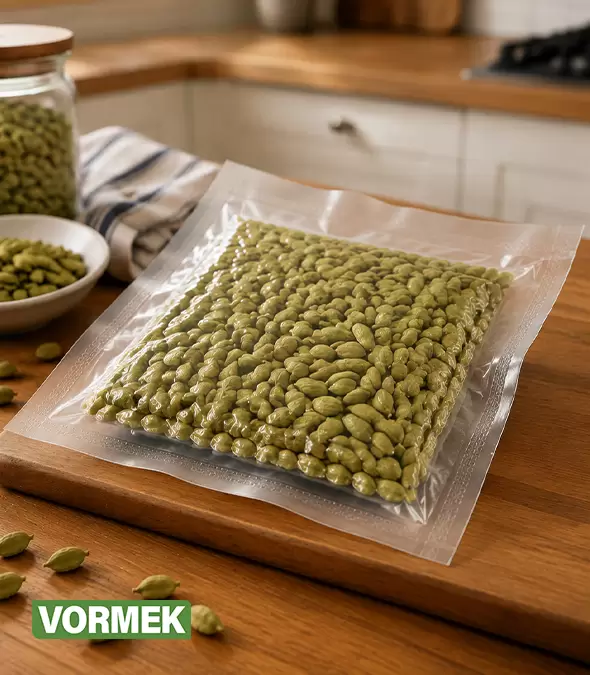
Nitrogen flushing is one method used to reduce oxygen concentration before final sealing.
Nitrogen is relatively inert in this application and can displace part of the oxygen-containing air surrounding the product. For selected oxidation-sensitive spices, dried herbs, and seasoning blends, this can help reduce the amount of oxygen initially available for oxidative reactions.
However, gas flushing should never be considered independently of the packaging material.
A package may contain low residual oxygen immediately after sealing but gradually accumulate oxygen if the film has insufficient barrier performance. Similarly, a high-barrier package will provide limited benefit if leakage occurs through the seal.
A successful system therefore depends on the combination of:
controlled initial oxygen + appropriate OTR + reliable seal integrity
Nitrogen flushing should be validated with the final product, packaging material, filling weight, headspace volume, and intended shelf life.
Vacuum Packaging vs. Nitrogen Flushing for Spices
Vacuum packaging and nitrogen flushing both reduce oxygen exposure, but they achieve this in different ways.
Vacuum removes air from the package before closure. This can be effective for certain products, but fine spice powders require careful process control. Rapid pressure changes may cause powder movement, product migration toward the sealing area, or contamination of vacuum components.
Vacuum can also compress flexible packages and alter their retail appearance.
Nitrogen flushing can reduce oxygen while maintaining a less compressed package. However, its effectiveness depends on gas flow, package geometry, product characteristics, filling level, and sealing sequence.
Neither method is automatically superior. The appropriate approach should be selected according to product behavior, required shelf life, packaging format, and equipment configuration.
Seal Integrity Testing for Spice Packaging
Visual inspection is useful for identifying obvious defects, but it cannot reliably detect every package-integrity problem.
A seal can appear acceptable while containing microscopic channels, wrinkles, powder contamination, or localized areas of inadequate bonding.
Depending on the packaging format and quality-control requirements, manufacturers may consider:
- seal-strength testing to evaluate mechanical seal performance;
- burst or pressure testing to assess package resistance and identify weak regions;
- vacuum-based leak testing to detect loss of package integrity;
- dye penetration methods, where appropriate for the package design;
- and other validated leak-detection techniques.
The selected test should match the package format and the type of defect that needs to be detected.
Seal strength and seal integrity should also be distinguished. A mechanically strong seal can still contain a small channel that permits gas or moisture transfer.
Monitoring the Sealing Process
Package testing should be supported by routine process monitoring.
Sealing temperature, pressure, dwell time, production speed, seal-surface cleanliness, and packaging-material consistency should remain within validated operating limits.
When a parameter moves outside its established range, corrective action should occur before a large quantity of potentially defective packages is produced.
This approach shifts quality control from simply inspecting finished packages toward controlling the process that creates them.
For spice manufacturers, this is critical because aroma loss may not become obvious immediately after packaging. A microscopic seal defect created during production may only become apparent after weeks or months of storage.
Reliable sealing is therefore not simply a closing operation. It is the final step that preserves the oxygen, moisture, aroma, and light-barrier strategy built into the packaging material.
How to Validate Spice Packaging for Shelf Life
Laboratory specifications for packaging materials are essential, but they do not prove that a spice will maintain acceptable quality throughout its intended shelf life. Final performance depends on the interaction between the product, packaging structure, sealing process, internal atmosphere, and storage environment.
For this reason, shelf-life validation should be performed using the actual spice and final commercial package.
Key Parameters to Monitor During Shelf-Life Testing
A professional shelf-life study should focus on quality indicators relevant to the specific product. These may include:
Aroma and sensory intensity:
Trained sensory evaluation can help determine whether characteristic aroma and flavor decline during storage or whether undesirable oxidative notes develop.
Moisture content and water activity:
Monitoring these parameters helps identify moisture migration and determine whether the package provides sufficient protection against environmental humidity.
Color stability:
Color measurement is particularly useful for products such as paprika, chili powder, turmeric, and dried herbs where visual quality contributes directly to consumer acceptance.
Oxidative stability:
Depending on the composition of the spice or seasoning, appropriate analytical indicators may be monitored to evaluate oxidative deterioration.
Residual oxygen:
For nitrogen-flushed packages, measuring residual oxygen immediately after packaging and during storage can help evaluate the effectiveness of atmosphere control and package integrity.
Seal integrity:
Packages should be checked throughout the study because mechanical stresses during storage and distribution can affect seals even when initial production quality is acceptable.
Shelf-life studies should also use storage conditions representative of the intended market. Temperature and relative humidity should reflect realistic distribution rather than only ideal conditions.
Accelerated studies can provide useful comparative information during packaging development, but they should be interpreted carefully. The relationship between accelerated conditions and real-time deterioration may differ among aroma compounds, pigments, and packaging materials.
Practical Packaging Strategy for Spice Manufacturers
A systematic approach helps manufacturers avoid selecting packaging solely on film cost or general barrier claims.
| Step | Technical Question | Packaging Decision |
|---|---|---|
| 1. Characterize Product | Is the spice ground, hygroscopic, aromatic, or light-sensitive? | Identify major deterioration mechanisms |
| 2. Define Shelf Life | How long must quality remain acceptable? | Establish measurable quality limits |
| 3. Select Barrier | What OTR, WVTR, aroma, and light protection is needed? | Choose suitable film or laminate |
| 4. Optimize Filling | Does the product generate dust or contaminate seals? | Select suitable dosing and filling control |
| 5. Control Atmosphere | Is oxidation a major concern? | Evaluate headspace control or nitrogen flushing |
| 6. Validate Sealing | Is the sealing window stable in production? | Set temperature, pressure, and dwell-time limits |
| 7. Test Shelf Life | Does the final package protect the actual product? | Confirm the commercial specification |
This approach treats packaging as a complete preservation system rather than a collection of independent components.
The Spices industry landing page, WeightControl, and Mechoris Visco product page can be incorporated as internal links when manufacturers need further information about spice packaging, weighing, and filling technologies.
Frequently Asked Questions About Preserving Aroma in Spice Packaging
What is the best packaging material for preserving spice aroma?
There is no single best material for every spice. Highly aromatic or oxidation-sensitive products may require multilayer high-barrier films, metallized structures, or foil-containing laminates, while less sensitive products may perform adequately in simpler structures.
The selection should be based on OTR, WVTR, aroma retention, light protection, sealability, shelf-life target, and actual storage conditions.
How can packaging prevent spices from losing flavor?
Packaging slows flavor deterioration by limiting exposure to oxygen, moisture, and light while reducing the loss of volatile compounds.
Performance depends on the complete system. Barrier properties, residual oxygen, seal integrity, storage temperature, and interaction between the spice and packaging material all influence flavor retention.
Why do ground spices lose aroma faster than whole spices?
Grinding damages plant tissues and increases the surface area exposed to the environment. This facilitates volatile-compound loss and increases contact with oxygen and moisture.
Consequently, ground spices generally require more protective packaging than their whole-spice equivalents.
What OTR and WVTR are suitable for spice packaging?
There is no universal OTR or WVTR specification for all spices.
Required values depend on product sensitivity, package size, target shelf life, temperature, humidity, and distribution conditions. A packaging engineer should therefore define performance requirements using product-specific shelf-life data rather than selecting a generic barrier value.
Is nitrogen flushing necessary for spice packaging?
Not always.
Nitrogen flushing can be beneficial for selected oxidation-sensitive products because it reduces initial oxygen concentration. However, stable spices or products with shorter shelf-life requirements may not require atmosphere modification.
Its effectiveness should be verified through residual-oxygen measurements and shelf-life testing.
Can transparent packaging preserve spice quality?
Yes, provided the spice is sufficiently stable to light and the transparent material supplies the required oxygen, moisture, and aroma barriers.
For light-sensitive products, opaque, metallized, UV-protective, printed, or foil-containing packaging may provide better protection.
Why is seal integrity important for spice shelf life?
The seal completes the protective barrier around the product. Channels, wrinkles, powder contamination, or incomplete bonding can allow oxygen and moisture to enter even when a high-performance film is used.
Seal integrity should therefore be validated and routinely monitored during production.
How should spice packaging shelf life be tested?
Testing should use the actual product, commercial packaging structure, final sealing conditions, and representative storage environment.
Relevant measurements may include sensory quality, aroma retention, color, moisture content, water activity, residual oxygen, oxidation indicators, flowability, and package integrity.
Conclusion: Building a Complete Aroma-Preservation System
Preserving aroma and flavor in spice packaging requires an integrated approach based on the deterioration mechanisms of the individual product.
Oxygen-barrier materials can slow oxidative reactions, while moisture barriers help protect hygroscopic powders against caking and changes in flowability. Aroma-retentive structures reduce volatile losses, and light-protective packaging can help preserve sensitive pigments and compounds.
These material properties must be supported by accurate filling and reliable sealing. Powder contamination, inappropriate sealing parameters, excessive residual oxygen, or microscopic leaks can undermine the performance of even an advanced barrier structure.
For selected oxidation-sensitive spices, nitrogen flushing can provide additional protection, but only when combined with suitable film permeability and dependable package integrity.
Most importantly, packaging specifications should not be selected solely from theoretical material properties. The final spice, packaging structure, filling process, sealing conditions, atmosphere, and distribution environment must be evaluated as one system.
Product-specific shelf-life validation then provides the evidence needed to determine whether the package can maintain acceptable aroma, flavor, color, moisture characteristics, and physical quality until the end of its intended commercial life.
For spice processors, this systems-based approach offers the most reliable route to packaging that does more than contain the product—it protects the sensory characteristics that define its value.