Pet Food Packaging Machines
Pet food production increasingly requires the same level of process control, hygiene, packaging consistency and automation expected across modern food manufacturing. From wet dog and cat food to fresh refrigerated meals, pâtés, meat-based recipes and products containing gravy or chunky ingredients, each application presents different challenges for filling, sealing and package protection.
Selecting the right pet food packaging machine is therefore not simply a matter of choosing a machine that can seal a tray. The packaging system must match the product’s viscosity, particle size, portion weight, tray geometry, packaging material, target output and required shelf-life strategy.
For wet and fresh pet food manufacturers in particular, packaging performance depends on the interaction between filling accuracy, tray handling, seal integrity, packaging atmosphere and hygienic production practices. A poorly matched process can result in product giveaway, contaminated sealing areas, rejected packs, unnecessary manual handling and production bottlenecks.
Vormek develops pet food packaging machines and integrated solutions for filling, tray sealing, modified atmosphere packaging (MAP), vacuum processes and automated tray handling. Systems can be configured around individual production requirements, from standalone packaging operations to integrated lines combining dosing, tray handling, sealing and downstream equipment.
For manufacturers planning to automate an existing process or increase production capacity, the objective should be to create a packaging line that delivers consistent packs while remaining flexible enough to support different recipes, tray formats and future production requirements.
Pet Food Packaging Solutions for Wet, Fresh and Prepared Products
Pet food is not a single packaging application. A homogeneous pâté, a chunky meat recipe with gravy and a refrigerated fresh pet meal can behave very differently during filling and sealing.
The appropriate pet food packaging solution should therefore be selected according to the physical and microbiological characteristics of the product, packaging format, storage conditions and production requirements.
Depending on the application, a production line may incorporate tray sealing, MAP, vacuum packaging, automated filling and additional line automation.
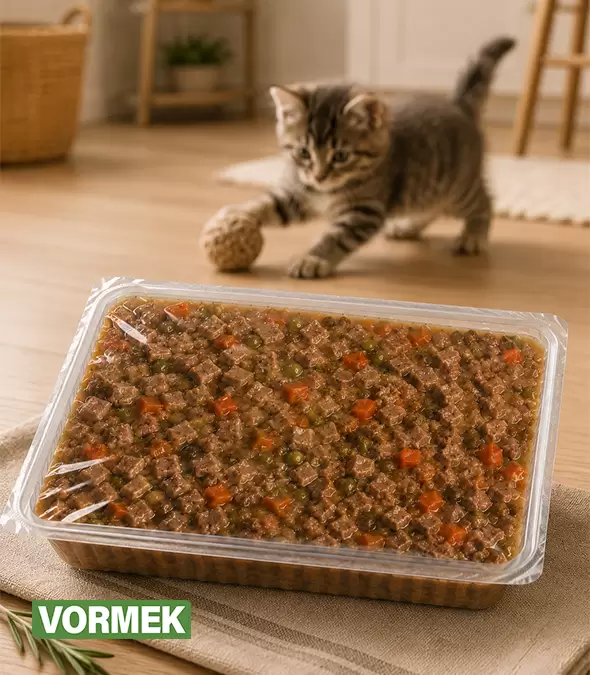
Wet Pet Food Packaging Machines
Wet pet food presents particular packaging challenges because formulations can contain high levels of moisture, fat, sauces, meat particles and other inclusions.
A wet pet food packaging machine must maintain controlled tray movement while limiting splashing and contamination of the sealing flange. Filling technology must also be capable of handling the specific consistency of the recipe.
Typical applications include:
- Wet dog food
- Wet cat food
- Meat-based pet food
- Pâté-style formulations
- Chunky recipes
- Products containing gravy or sauce
- Multi-component pet meals
- Premium refrigerated pet food
- Veterinary and specialised diets
For products packaged in preformed trays, automated filling followed by tray sealing can provide a practical platform for industrial production.
Pet Food Tray Sealing Machines
A pet food tray sealer applies and seals top film to the flange of a preformed tray.
Industrial tray sealing provides controlled sealing temperature, pressure and dwell time, helping manufacturers maintain consistent package quality across repeated production cycles.
Depending on the application, tray sealing can be configured for:
- Standard top sealing
- Vacuum processes
- Modified atmosphere packaging
- Printed or unprinted top film
- Multiple tray formats
- Integration with automatic filling
- Integration with tray denesting and downstream equipment
Seal quality depends on more than machine settings. Film and tray compatibility, flange cleanliness, product temperature and tooling condition all contribute to the final result.
Dog Food Packaging Machines
A dog food packaging machine may need to accommodate a wide range of portion sizes and product consistencies.
Fresh and wet dog food increasingly includes recipes containing meat, vegetables, sauces and other components. These formulations can require controlled dosing followed by stable tray transportation and reliable sealing.
Larger portion sizes may also affect tooling configuration and the number of trays that can be processed during each machine cycle.
Machine selection should therefore consider not only target packs per hour but also the required pack weight, tray dimensions and recipe characteristics.
Cat Food Packaging Machines
Cat food applications often use relatively small portion formats, increasing the importance of accurate dosing and efficient multi-cavity tooling.
For a cat food packaging machine, manufacturers should evaluate:
- Portion accuracy
- Tray dimensions
- Number of trays per cycle
- Product viscosity
- Particle size
- Required packaging atmosphere
- Format changeover requirements
- Target hourly output
At high production volumes, even small variations in portion weight can create significant cumulative product giveaway.
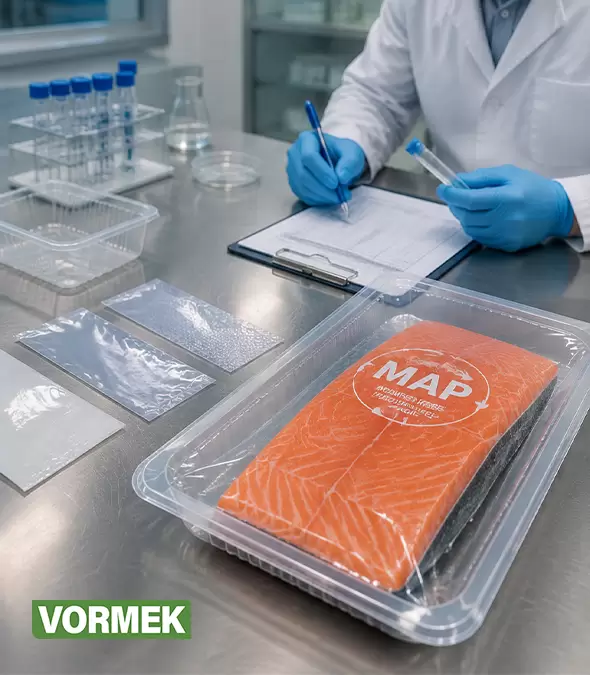
Modified Atmosphere Packaging for Pet Food
Modified atmosphere packaging modifies the atmosphere surrounding the product before the package is sealed.
For suitable refrigerated pet food applications, MAP may form part of a broader shelf-life strategy incorporating hygienic processing, temperature control, appropriate formulation and suitable barrier packaging.
A MAP tray sealing process can include:
- Tray positioning
- Vacuum generation
- Gas introduction
- Film sealing
- Film cutting
- Package discharge
The required gas composition should be established for the specific pet food formulation and packaging system rather than applying a universal mixture.
Important variables include product composition, fat level, moisture, microbial characteristics, storage temperature, film barrier properties, residual oxygen and distribution conditions.
Shelf-life testing under the intended commercial conditions remains essential when establishing or changing a MAP process.
Vacuum Packaging for Pet Food
Vacuum packaging removes air from the package before sealing and can be suitable for selected pet food products, ingredients and bulk applications.
Potential applications include:
- Processed meat-based pet food
- Semi-moist products
- Pet food ingredients
- Bulk ingredients
- Selected pet treats
- Products where reduced package volume is desirable
Vacuum packaging is not automatically the best solution for every pet food application. Products that are delicate or presentation-sensitive may deform under vacuum.
Product structure, packaging material and desired presentation should therefore be evaluated before selecting the process.
Automated Filling for Wet and Viscous Pet Food
Filling is a critical stage in wet pet food packaging.
Unlike low-viscosity homogeneous liquids, many pet food recipes contain combinations of meat particles, vegetables, fibres, gravy and fats.
A conventional liquid filler may not be suitable for these formulations.
For viscous and heterogeneous applications, Mechoris Visco Servo can be integrated with the packaging line to provide controlled dosing before sealing.
Servo-controlled filling can help manufacturers manage portion consistency while adapting filling parameters to the characteristics of individual recipes.
This is particularly important where product cost is high, because repeated overfilling across large production volumes can create significant giveaway.
Packaging Challenges in Pet Food Processing
The performance of a pet food packaging line is influenced by much more than machine cycle speed.
Manufacturers must control the interaction between product characteristics, filling, tray handling, packaging materials, sealing and cleaning.
How to Package Pet Food with Different Viscosities
Wet pet food can range from relatively fluid gravy-based recipes to dense pâtés and chunky formulations.
The filling system should therefore be selected according to:
- Product viscosity
- Maximum particle size
- Product homogeneity
- Required portion weight
- Filling temperature
- Recipe variation
- Target production rate
A filling technology that performs well with a smooth product may not provide the same performance with large particles or heterogeneous recipes.
Manufacturers producing several formulations on the same line should evaluate the operating range of the filler rather than selecting equipment based on only one product.
Maintaining Accurate Pet Food Portion Weight
Fill accuracy has a direct economic impact.
Overfilling creates product giveaway, while underfilling can create pack inconsistency and potential compliance issues.
The financial effect becomes particularly important at scale.
If a production line consistently gives away only a small amount of additional product in every tray, the cumulative loss across hundreds of thousands of packs can become substantial.
Accurate dosing can therefore influence:
- Product yield
- Raw-material utilisation
- Cost per pack
- Production consistency
- Overall line efficiency
A controlled filling process should be considered part of the economics of the entire packaging line.
Preventing Seal Contamination in Wet Pet Food Trays
Seal contamination is one of the most important operational challenges when packaging wet products.
Gravy, fat, sauce or solid food particles can reach the tray flange during filling or transportation.
Contamination in the sealing area may contribute to:
- Weak seals
- Leaking packages
- Rejected packs
- Rework
- Packaging waste
- Reduced package integrity
Filling parameters, nozzle position, fill level and tray acceleration should therefore be controlled to minimise unnecessary product movement.
Stable tray handling between the filler and tray sealer is particularly important for products containing mobile sauces or gravy.
Controlling Oxygen Exposure in Pet Food Packaging
Depending on the formulation, oxygen exposure can contribute to fat oxidation and other quality deterioration mechanisms.
Packaging technology can help manage oxygen exposure, but the package is only one component of the complete product system.
Shelf-life performance can be influenced by:
- Raw-material quality
- Recipe composition
- Processing method
- Hygiene
- Filling temperature
- Packaging atmosphere
- Barrier properties
- Seal integrity
- Storage temperature
- Distribution conditions
For this reason, changes to packaging technology should be validated using the actual product, packaging materials and intended storage conditions.
Packaging High-Fat Pet Food Formulations
Many meat-based pet foods contain significant quantities of fat.
Oxidation can negatively influence aroma, flavour and overall product quality. Appropriate barrier materials and controlled processing may therefore be particularly important for high-fat formulations.
Film and tray structures should be selected according to the required barrier properties and intended shelf life.
Hygienic Design for Pet Food Packaging Equipment
Wet pet food processing can expose packaging equipment to meat residues, sauces, oils and other organic material.
Machine design should support effective cleaning and routine hygiene procedures.
Important characteristics can include:
- Stainless-steel construction
- Accessible product-contact areas
- Cleaning-friendly surfaces
- Reduced residue accumulation points
- Accessible conveyors
- Removable components where appropriate
- Accessible filling and sealing areas
Cleaning requirements should be evaluated during machine selection because cleaning time directly affects production availability, particularly in facilities performing frequent recipe changes.
Packaging Multiple Pet Food Tray Sizes
Pet food brands frequently offer several portion sizes and product ranges.
A manufacturer may need to package small cat-food portions, individual dog meals, larger multi-meal trays and specialised dietary products on the same production line.
Supporting multiple tray formats can reduce the need for separate machines for individual SKUs.
Manufacturers should therefore evaluate tooling design, format-change procedures and changeover time when selecting a machine.
Scaling Pet Food Production with Automation
Manual packaging operations can become a significant bottleneck as production increases.
Manual tasks may include:
- Tray loading
- Filling
- Tray positioning
- Sealing
- Inspection
- Product transfer
Automation can progressively reduce repetitive handling and improve process consistency.
The objective, however, should not simply be to purchase the fastest individual machine.
An efficient packaging line requires compatible capacities across filling, tray handling, sealing and downstream processes.
Best Pet Food Packaging Machine by Product Type
Machine selection should begin with the product and production process rather than with a predefined machine model.
| Pet Food Application | Typical Packaging Approach | Primary Requirement |
|---|---|---|
| Wet dog food | Filling + tray sealing | Hygienic handling and seal integrity |
| Wet cat food | Accurate filling + tray sealing | Portion control |
| Fresh refrigerated pet meals | MAP tray sealing | Controlled atmosphere and cold chain |
| Pâté-style pet food | Servo filling + tray sealing | Consistent dosing |
| Chunky meat recipes | Viscous filling + tray sealing | Particle handling |
| Pet food with gravy | Controlled filling + sealing | Reduced splash and flange contamination |
| Bulk ingredients | Vacuum packaging | Air removal and compact packaging |
| Premium prepared pet meals | Automated packaging line | Presentation and consistency |
| Multiple recipes and SKUs | Flexible integrated system | Efficient format changeover |
A technical machine assessment should consider product properties, pack dimensions, target output, packaging material, required shelf life, factory space, hygiene requirements and expected future production capacity.
How Does an Automatic Pet Food Packaging Line Work?
A complete automatic pet food packaging line can integrate several packaging stages into a coordinated process.
A typical configuration may be:
Tray denesting → product filling → tray transfer → vacuum/MAP → sealing → film cutting → coding → inspection → discharge
The final layout depends on product type, capacity and required automation level.
Automatic Tray Denesting
A tray denester separates trays from a stack and places them individually onto the production line.
Automated denesting can reduce repetitive manual loading and provide more consistent tray positioning.
Pet Food Filling
The filling system doses the required quantity of product into each tray.
For viscous or heterogeneous formulations, Mechoris Visco Servo can be considered where its filling characteristics correspond to the product.
Controlled Tray Transfer
After filling, trays need to reach the sealing station without excessive acceleration, splashing or displacement of the product.
This is especially important when the formulation contains gravy or other mobile components.
Vacuum and MAP Process
For MAP applications, the system can evacuate air from the package before introducing the selected gas mixture.
Vacuum level, gas pressure and process time must be established according to the product and package.
Tray Sealing
Heat and pressure create the seal between the tray and top film.
Critical process variables include:
- Sealing temperature
- Sealing pressure
- Dwell time
- Film structure
- Tray material
- Flange condition
The optimum sealing window should be validated using the actual production tray and film.
Coding and Traceability
Coding systems can be incorporated to provide production dates, batch identification and other required traceability information.
Inspection and Product Discharge
Sealed packs can proceed to inspection and then to secondary packaging or other downstream operations.
Recommended Vormek Pet Food Packaging Machines
Vormek systems can be configured according to product characteristics, production capacity, tray format and required automation level.
LuxPacker Pet Food Tray Sealer
For manufacturers requiring automated tray packaging, LuxPacker provides a platform for integrating tray sealing into an industrial pet food production process.
Depending on the selected configuration and application, LuxPacker can support requirements such as:
- Repeatable tray handling
- Controlled sealing parameters
- Automated production
- Reduced manual handling
- Different packaging formats
- Integration with filling systems
- MAP processes where specified
- Future production-line expansion
The final configuration should always be established using the actual tray dimensions, film specification, product characteristics and required throughput.
Mechoris Visco Servo Pet Food Filling Machine
Mechoris Visco Servo is intended for applications requiring controlled filling of viscous products.
Potential pet food applications include:
- Meat mixtures
- Pâtés
- Thick sauces
- Gravy-based products
- Recipes containing particles
- Multi-component prepared pet meals
Servo-controlled filling allows filling movement to be configured according to the application, supporting consistent dosing and integration with automated tray packaging.
Integrated Pet Food Filling and Tray Sealing Line
For medium- and high-volume production, an integrated system can connect multiple packaging stages.
A potential line configuration is:
Automatic tray denesting → Mechoris Visco Servo → controlled tray transfer → LuxPacker → MAP/sealing → coding → inspection → discharge
The objective of integration is to create a balanced production process rather than simply connecting several independent machines.
Pet Food Packaging Machine Capacity and Production Speed
A manufacturer’s required output is normally expressed in packs per minute or packs per hour.
However, actual pet food packaging machine capacity depends on several variables:
- Tray dimensions
- Number of trays per machine cycle
- Tool configuration
- Filling time
- Product viscosity
- MAP or vacuum requirements
- Film handling
- Upstream production capacity
- Operator workflow
- Downstream equipment
For example, a high-speed tray sealer cannot deliver its theoretical maximum line output if the filling process supplies trays more slowly.
Capacity should therefore be evaluated at line level.
This provides a more realistic understanding of achievable production than comparing machine cycle rates alone.
MAP vs Vacuum vs Tray Sealing for Pet Food
The appropriate technology depends on the product and commercial requirements.
| Packaging Technology | Suitable Applications | Main Benefit | Key Consideration |
|---|---|---|---|
| Standard tray sealing | Processed and prepared pet food | Secure retail presentation | Shelf life depends on complete process |
| MAP tray sealing | Selected chilled pet food | Controlled package atmosphere | Requires validated gas/material system |
| Vacuum packaging | Suitable products and ingredients | Reduced air in package | Can compress sensitive products |
| Automated filling + sealing | Medium/high-volume wet pet food | Consistency and reduced manual handling | Requires line balancing |
No packaging method should be selected solely on the basis of its theoretical shelf-life potential.
Product safety, processing method, packaging presentation, distribution requirements and economics should all be considered.
Pet Food Packaging Materials and Barrier Films
Packaging machinery, tray and top film function as a system.
Important packaging-material characteristics can include:
- Oxygen barrier
- Water-vapour barrier
- Sealability
- Mechanical strength
- Puncture resistance
- Transparency
- Anti-fog characteristics
- Temperature resistance
- Compatibility with filling conditions
- Recyclability considerations
Tray structures may include PP, PET-based or multilayer materials depending on the application.
Top films can also use multilayer structures selected according to sealing and barrier requirements.
Machine tooling, tray material and film should therefore be evaluated together rather than independently.
Hygienic Design and Cleaning of Pet Food Packaging Machines
Effective cleaning supports both food safety and reliable machine operation.
Pet food residues may accumulate around filling equipment, conveyors and tooling when access is limited.
Routine cleaning may need to include:
- Filling nozzles
- Product-contact components
- Tray transport areas
- Conveyor surfaces
- Sealing areas
- Guards
- Accessible internal machine surfaces
The appropriate cleaning procedure depends on the processed product and the manufacturer’s hygiene programme.
Facilities with frequent product or recipe changes should also consider cleaning and changeover time when calculating effective line capacity.
Pet Food Packaging Automation and Total Cost of Ownership
Initial machine price represents only one component of packaging economics.
A broader assessment can consider:
Packaging cost per pack = labour + packaging material + product giveaway + energy + maintenance + downtime + rejected packs
Automation may influence several of these variables simultaneously.
Accurate filling can reduce unnecessary giveaway. Stable tray positioning can help reduce sealing problems. Automated material handling can reduce dependence on repetitive manual processes.
As annual production increases, relatively small improvements in each pack can have a significant cumulative effect.
For this reason, pet food manufacturers should evaluate total cost of ownership (TCO) alongside initial equipment price.
Related Technical Guides for Pet Food Packaging
Manufacturers researching pet food packaging equipment may also find the following technical guides useful.
Tray Sealer Buying Guide: How to Choose the Right Machine
Learn how tray dimensions, packaging atmosphere, production volume, tooling and automation influence tray sealer selection.
Internal link: Tray Sealer Buying Guide
Modified Atmosphere Packaging Guide
Learn how vacuum, gas flushing, barrier films, residual oxygen and other process variables influence MAP packaging performance.
Internal link: Modified Atmosphere Packaging Technical Guide
Semi-Automatic vs Automatic Tray Sealer
Compare production capacity, labour requirements, factory footprint and automation potential when deciding between semi-automatic and automatic tray sealing equipment.
Internal link: Semi-Automatic vs Automatic Tray Sealer
These technical resources should be linked directly from this industry page to create a clear internal content path between pet food applications, packaging technologies and relevant Vormek equipment.
How to Choose the Right Pet Food Packaging Machine
Before requesting a quotation, manufacturers should define the key technical characteristics of the application.
Product Specifications
Provide:
- Pet food category
- Recipe characteristics
- Viscosity
- Maximum particle size
- Filling temperature
- Required portion weight
Tray and Packaging Specifications
Provide:
- Tray dimensions
- Tray material
- Top-film specification
- Number of tray formats
- Desired packaging method
- Printed-film registration requirements, if applicable
Production Capacity
Define:
- Required packs per hour
- Operating shifts
- Production days
- Number of SKUs
- Changeover frequency
- Expected future capacity
Shelf-Life Requirements
Identify:
- Current shelf life
- Target shelf life
- Storage temperature
- Distribution conditions
- MAP requirements, if applicable
Factory and Utility Requirements
Provide information regarding:
- Available floor space
- Electrical supply
- Compressed air
- Packaging gas supply where applicable
- Cleaning procedures
- Existing upstream equipment
- Existing downstream equipment
Providing these details allows a packaging system to be evaluated according to actual production requirements rather than assumptions.
Get a Custom Quote for a Pet Food Packaging Machine
Every pet food production facility has different requirements.
A manufacturer producing premium refrigerated dog meals may require a significantly different configuration from a high-volume producer filling wet cat food into small portion trays.
Vormek can evaluate the packaging application according to product characteristics, filling requirements, tray dimensions, sealing technology, MAP requirements, automation level and target capacity.
For a technical evaluation, manufacturers should provide:
- Product description
- Product photographs or samples
- Tray dimensions
- Tray material
- Required portion weight
- Target packs per hour
- Required packaging method
- Current packaging process
- Available factory space
- Desired level of automation
These parameters can then be used to determine an appropriate machine configuration or integrated packaging line.
Frequently Asked Questions About Pet Food Packaging Machines
What is the best packaging machine for wet pet food?
Tray sealing combined with suitable filling technology is often appropriate for wet pet food supplied in preformed trays. The correct system depends on product viscosity, particle size, portion weight, tray dimensions, required capacity and shelf-life strategy.
What machine is used to package wet dog food?
Wet dog food can be packaged using an integrated filling and tray sealing line. For viscous or heterogeneous recipes, the filling system should be selected according to viscosity and particle size before the tray is sealed.
What machine is suitable for cat food packaging?
The appropriate cat food packaging machine depends on product format and required output. For wet cat food in preformed trays, accurate filling and multi-cavity tray sealing can provide an efficient production configuration.
Can pet food be packaged with modified atmosphere packaging?
MAP can be considered for selected pet food applications, particularly certain refrigerated products. The gas mixture, packaging materials, storage conditions and shelf life should be validated for the specific formulation.
What filling machine is suitable for chunky pet food?
Pet food containing meat particles, vegetables or other inclusions requires filling equipment capable of handling heterogeneous products. A servo-controlled viscous filling system such as Mechoris Visco Servo may be suitable depending on viscosity and maximum particle dimensions.
Can one pet food packaging machine handle different tray sizes?
A suitably configured tray sealer can support multiple tray formats through tooling changes, provided the required trays remain within the machine’s operating range.
How can seal failures in pet food trays be reduced?
Manufacturers should control fill level and splashing, keep tray flanges clean, use compatible film and tray materials, establish appropriate sealing parameters and routinely inspect tooling and package integrity.
How is pet food packaging machine capacity calculated?
Required capacity should be evaluated according to target packs per hour and the complete production process. Filling speed, tray dimensions, number of trays per cycle, MAP requirements, tray handling and downstream operations all affect achievable output.
Can filling and tray sealing be integrated into one line?
Yes. Filling systems, tray transport, tray sealing, coding and other modules can be integrated into a coordinated packaging line when their capacities and control requirements are appropriately matched.
Conclusion: Choosing a Reliable Pet Food Packaging Solution
Pet food packaging is increasingly a specialised industrial process requiring control over filling accuracy, hygiene, tray handling, seal integrity, packaging materials, shelf-life conditions and production capacity.
The right pet food packaging machine should therefore be selected as part of the complete manufacturing process rather than as an isolated piece of equipment.
For wet dog food, wet cat food, fresh pet meals, pâtés and other prepared products, combining controlled filling with automated tray sealing can provide a scalable foundation for industrial production.
MAP or vacuum technologies can also be incorporated where technically appropriate, provided that the product, packaging materials, atmosphere and storage conditions are properly validated.
For viscous and heterogeneous formulations, Mechoris Visco Servo can support controlled product dosing, while LuxPacker can provide the automated tray sealing platform required for scalable production.
Ultimately, successful pet food packaging depends on matching the machine to the actual product and production environment.
By considering recipe characteristics, portion size, tray format, sealing requirements, production capacity, hygiene and future growth from the beginning, manufacturers can build a packaging process designed for consistent performance and long-term scalability.
Planning a new pet food packaging line or upgrading an existing process? Contact Vormek with your product specifications, tray dimensions, target output and packaging requirements to receive a solution configured for your application.