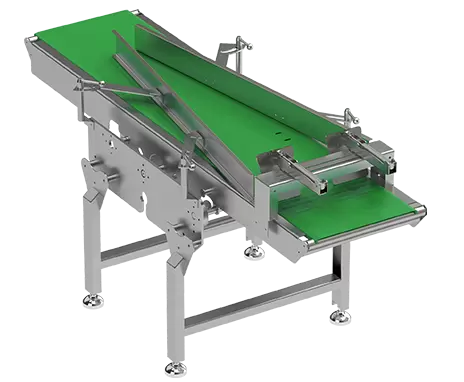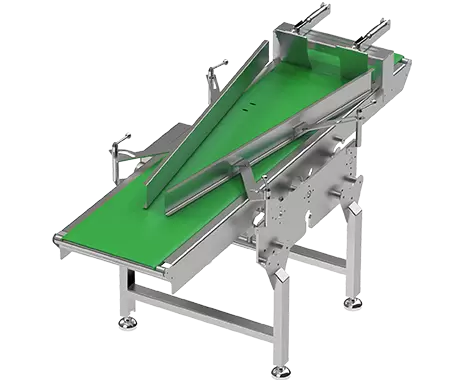
Introduction to the Vormek Converix VLM-500
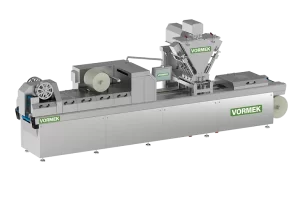
After the automatic tray sealing process, products typically leave the packaging machine in two or three lanes. While this output layout is efficient at the packaging stage, it creates a major challenge for downstream equipment such as automatic labelers, inkjet printers, quality control systems, and cartoners. These systems require products to enter in a single, orderly lane to operate correctly.
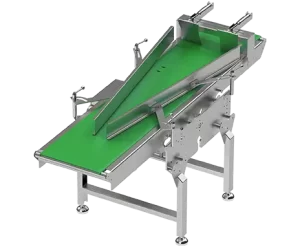
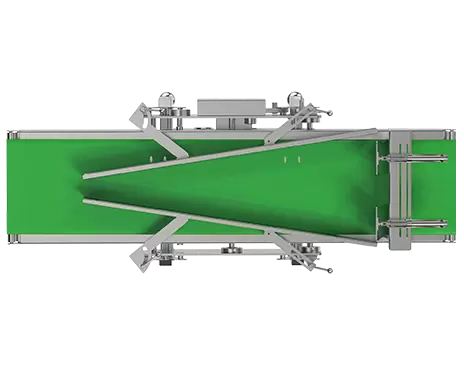
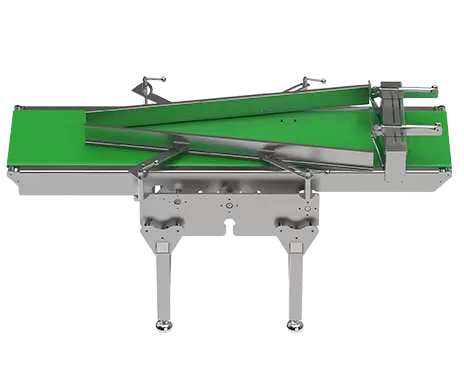
In many factories, this bottleneck is filled by manual operator intervention—an approach that is not only costly but also severely reduces line productivity due to human error, fatigue, and inconsistency. The Converix VLM-500 is designed precisely for this purpose. Positioned after the tray sealer, it converts multiple output lanes into one controlled, orderly flow ready for the next stages.
The technical slogan captures its design philosophy: Multiple Lines. One Smooth Flow.
What Is a Multi-Lane to Single-Line Sorter and Why Do We Need It?
In many packaging lines equipped with automatic tray sealers, finished products exit in multiple lanes. Although this output method increases packaging speed, it makes downstream equipment necessary. The Converix VLM-500 merges multiple parallel paths into one single line, ensuring downstream equipment can operate at full efficiency.
| Stage | Description |
|---|---|
| Stage 1: Multi-Lane Output | Products leave the tray sealer in two or three lanes. |
| Stage 2: Single-Line Merging | The sorter guides products into one orderly, continuous line for downstream equipment. |
This single-line output offers three key advantages:
| Benefit | Description |
|---|---|
| Eliminates manual sorting | No operator needed to pick and place containers from multiple lanes. |
| Enables automatic downstream equipment | Labelers, inkjet printers, and cartoners receive a consistent single-file infeed. |
| Improves line efficiency | Removes bottlenecks and maintains continuous flow. |
Common Industry Challenges with Manual Lane Merging
In many factories, merging multiple lanes into one is still done manually by operators. This approach has several disadvantages:
| Challenge | Description |
|---|---|
| Manual operator intervention | The operator must remove containers from multiple lanes and place them on the next conveyor. |
| High labor costs | Monthly wages for repetitive, non-skilled work. |
| Human error and fatigue | Quality drops at the end of a shift, missed containers, and irregular placement. |
| Production line bottleneck | Products pile up behind downstream equipment, reducing overall line speed. |
| Limits on automatic equipment | Labelers and inkjet printers generally require single-file infeed. |
| Hygiene issues | Operator hand contact with containers increases the risk of cross-contamination. |
Engineering Architecture and Technical Specifications
1. Servo-Driven Motion System
Unlike standard conveyors that run at fixed speed, this machine is equipped with an industrial servo motor. This technology enables precise, continuous speed adjustment: full synchronization with the packaging machine’s output speed, prevention of product accumulation or gaps, reduced mechanical impact and package damage, and optimized energy consumption.
2. Two-Piece Design with Quick-Release Capability (Very Important)
The upper section, including the conveyor, is designed as an insert type and can be removed from the main body without special tools. This is a golden feature for production and maintenance teams: fast, thorough cleaning of the belt and parts, easy access to internal components, and reduced downtime for cleaning and service.
3. Food-Grade Conveyor Belt with Gentle Performance
The belts are made of PU food-grade material and fully comply with food-contact standards. Their smooth, vibration-free movement prevents damage to lightweight or sensitive containers.
4. Automatic Belt Tensioning System
On many conveyors, belt slack is a constant headache for technical teams. This machine includes an automatic tensioning mechanism that maintains the correct force and eliminates the need for frequent adjustments.
5. Anti-Tracking Belt Guide System
The belt is equipped with a guide rib that runs in a dedicated groove in the rollers. This design prevents the belt from drifting left or right over time and dramatically reduces errors.
6. Rollers with Industrial Bearings
The load is distributed across multiple rollers, and each roller is equipped with two industrial bearings. The result: smooth, vibration-free movement with very low wear.
7. Precise Power Transmission via Timing Belt
Power is transmitted from the servo motor through pulleys and an industrial timing belt. This method offers no slippage, accurate positioning, low operating noise, and longer service life for the motion system. The belt also includes a tensioning device that maintains proper belt tension with a preset mechanical force.
8. Corrosion-Resistant Materials
| Component | Material | Feature |
|---|---|---|
| Main body | 304 stainless steel | Corrosion-resistant, washable |
| Mechanical parts | Aluminum alloy with protective coating | Lightweight, strong, corrosion-resistant |
| Conveyor belt | PU food-grade | Washable, detergent-resistant |
9. Intelligent Control System
The machine can be controlled in two ways:
- Connection to the main packaging machine’s PLC (full speed and cycle synchronization)
- Independent electrical enclosure with its own PLC (suitable for adding the sorter to existing lines)
Control capabilities:
- Speed adjustment via inverter
- Operational status display on HMI touchscreen
- Automatic fault diagnosis and alert display
10. High Washability and Hygiene
- All surfaces in contact with products are smooth with no dead corners
- The conveyor belt is easily removable for cleaning and reinstallation
- The 304 stainless steel body resists industrial cleaning agents
Technical and Economic Benefits
| Category | Benefit | Description |
|---|---|---|
| Economic | Eliminates labor costs | Converts ongoing payroll expense into fixed investment |
| Economic | Fast ROI | Typically less than 12 months |
| Economic | Lower maintenance costs | Designed with minimal adjustment and repair needs |
| Technical | Higher line speed | Removes bottlenecks caused by manual sorting |
| Technical | Consistent performance | High repeatability with no quality drop during a shift |
| Hygienic | Less hand contact | Reduces cross-contamination risk and supports HACCP compliance |
| Management | Less operator dependency | No line stoppage due to absence or fatigue |
Impact on Productivity and Quality
From a production manager’s perspective, the most important productivity metrics are throughput, downtime, and consistency. The Converix VLM-500 eliminates the manual sorting station and removes the production bottleneck. Containers are guided immediately after packaging—without operator intervention—in a single, orderly line toward downstream equipment. The result is noticeably higher output per shift, elimination of human error, and greater packaging consistency.
Comparison with Common Market Technologies
| Criteria | Manual lane merger (with operator) | Converix – VLM-500 |
|---|---|---|
| Operator required | Yes (at least 1 person) | No |
| Flow consistency | Depends on operator skill | Very high |
| Speed adjustment | No | Yes (servo motor) |
| Easy cleaning | No | Yes (two-piece design) |
| Anti-tracking belt system | No | Yes |
| Automatic belt tensioning | No | Yes |
| Long-term maintenance cost | Labor only | Very low |
| Integration with automatic equipment | No | Full |
Suitable Industries
| Industry | Products | Need for Single-Line Sorting |
|---|---|---|
| Ready meals | Ready-made stews, thick soups, semi-prepared meals | Downstream labeling and cartoning require single-file infeed |
| Protein products | Meat, poultry, fish packaging lines | Automatic labelers and printers need orderly flow |
| Salads and vegetables | Packaged salads, fresh-cut vegetables | Consistent single-line output for quality control and packing |
| Dairy | Cheese, desserts, butter, cream | High-speed lines require smooth merging before labeling |
| Frozen and semi-prepared foods | Frozen meals, semi-prepared products | Automation demands reliable single-file flow |
| Nuts and dates | Packaged nuts, dates, dried fruits | Consistent merging for weighing and labeling |
A Smart Investment
The monthly salary that would have been paid to an operator can now be transformed into a fixed asset—the Converix VLM-500. An investment that works for the production line not for one year, but for many years. Human error, contamination, and delays from operator fatigue are completely eliminated. This is the essence of smart investment: converting ongoing expenses into lasting assets.
Key Advantages at a Glance
- Servo-driven motion system – Precise, continuous speed adjustment
- Two-piece design with quick-release – Fast, easy cleaning and maintenance
- Food-grade PU conveyor belt – Gentle, vibration-free product handling
- Automatic belt tensioning – No frequent adjustments needed
- Anti-tracking belt guide – Prevents belt drift and reduces errors
- Industrial bearings on rollers – Smooth, low-wear operation
- Precise timing belt transmission – No slippage, accurate positioning
- 304 stainless steel construction – Robust, hygienic, washable
- Intelligent control (PLC + HMI) – Connection to main machine or independent enclosure
- Eliminates operator – Reduces labor costs and human errors
- Fast ROI – Typically less than 12 months
Request a Quote
Ready to streamline your line? Contact Vormek to discuss how the Converix – VLM-500 can be configured for your application.
Multiple Lines. One Smooth Flow.