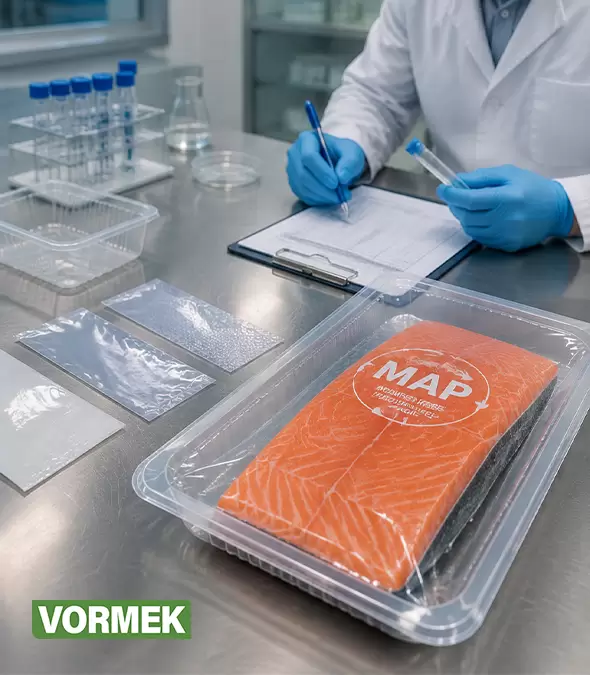
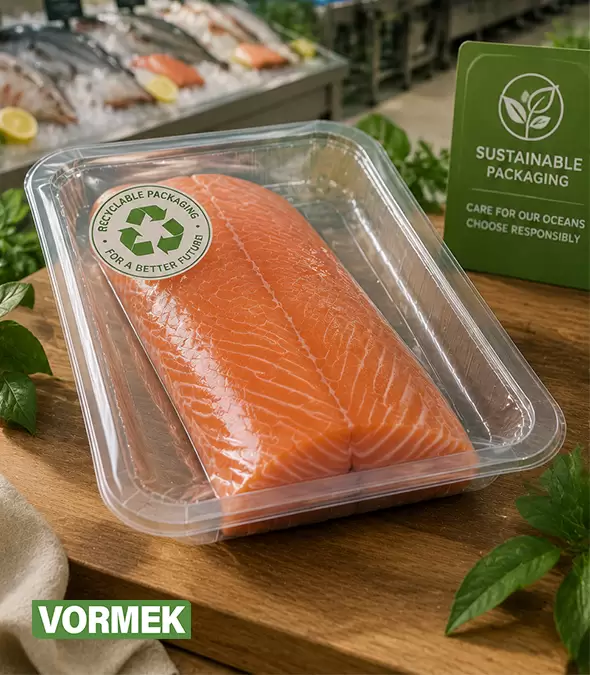
Ready Meals Packaging Machines
Ready meal packaging must protect food quality while supporting high production efficiency, consistent seal integrity, attractive presentation, and safe distribution. For manufacturers producing chilled, frozen, or heat-and-eat meals, selecting the right ready meals packaging machine is therefore a critical production decision rather than simply a choice of sealing equipment.
Vormek develops packaging systems for prepared-food manufacturers using tray sealing, modified atmosphere packaging (MAP), and vacuum technologies. Solutions can be configured around different tray formats, production capacities, packaging materials, automation levels, and line-integration requirements.
The correct configuration depends on the entire product-package-process relationship. A chilled pasta meal, for example, may require different barrier properties and atmosphere control from a frozen rice dish or a multi-compartment meal containing meat, vegetables, and sauce.
For this reason, machine selection should consider not only packaging speed but also product characteristics, target shelf life, tray and film compatibility, hygiene, gas requirements, labor, changeover frequency, and future production growth.
Ready Meals Packaging Solutions
Industrial ready meals cover a wide range of products, including pasta dishes, rice meals, cooked meat and poultry, vegetable-based meals, casseroles, stews, meal components, and multi-compartment combinations. Their packaging requirements can vary substantially.
Three technologies are particularly relevant: top sealing, modified atmosphere packaging, and vacuum-based packaging.
What Is the Best Packaging Method for Ready Meals?
There is no universal packaging method for every prepared meal. The most appropriate solution depends on the food formulation, distribution temperature, required shelf life, packaging format, and production environment.
A practical comparison is shown below:
| Packaging Method | Typical Application | Main Benefit | Key Consideration |
|---|---|---|---|
| Top Seal | Chilled or frozen prepared meals | Efficient tray closure and presentation | Tray-film compatibility |
| MAP Tray Sealing | Chilled ready meals | Controlled package atmosphere | Product-specific validation |
| Vacuum Packaging | Suitable oxygen-sensitive products | High level of air removal | Product deformation and liquid movement |
| Vacuum + Gas | Selected industrial applications | Flexible atmosphere control | Accurate process control required |
The strongest solution is not necessarily the technology offering the most complex packaging cycle. It is the system capable of delivering the required product protection and production performance at a commercially sustainable cost per pack.
Tray Sealing for Ready Meals
Tray sealing is widely used for prepared foods because it combines preformed trays with a flexible lidding film and can be integrated efficiently into industrial production lines.
During packaging, filled trays enter the sealing station, where the film is bonded to the tray flange under controlled temperature, pressure, and sealing time.
Reliable sealing depends on several variables working together:
- tray and lidding-film compatibility;
- sealing temperature;
- pressure distribution;
- dwell time;
- tray-flange cleanliness;
- film tension and positioning;
- tooling condition.
Ready meal trays may use PP, CPET, PET-based structures, aluminum, or other food-grade materials depending on the intended product and application. Microwaveable, ovenable, refrigerated, and frozen products can each impose different material requirements.
For this reason, tray and film selection should be considered during machine specification—not after the equipment has been selected.
Modified Atmosphere Packaging (MAP) for Ready Meals
MAP packaging for ready meals is particularly relevant to chilled products where controlling the atmosphere inside the tray can support an established shelf-life strategy.
In a typical MAP tray-sealing process, air is removed from the package and replaced with a controlled gas mixture before final sealing. Carbon dioxide and nitrogen are commonly relevant gases for many prepared-food applications, although the correct composition depends on the specific product.
Carbon dioxide may help suppress certain spoilage microorganisms, while nitrogen can function as an inert balance gas and help maintain package volume.
However, a single MAP gas ratio should never be assumed to work for all ready meals.
Gas selection must be evaluated together with:
- food composition;
- pH and water activity;
- initial microbial load;
- cooking and cooling history;
- product temperature;
- package headspace;
- tray and film permeability;
- storage temperature;
- target shelf life.
The final combination should be validated for the actual product and distribution conditions.
Industrial MAP performance also depends on repeatability. The machine must consistently manage evacuation, gas introduction, film positioning, and sealing across thousands of packages—not simply produce one successful test tray.
Vacuum Packaging for Prepared Meals
Vacuum packaging can be suitable for selected prepared-food applications where substantial air removal is beneficial and the product can tolerate reduced package pressure.
The process removes air before sealing, reducing oxygen around the product. However, it is not automatically preferable to MAP.
Meals containing significant free liquid, delicate components, or presentation-sensitive toppings may require careful vacuum control. Excessive evacuation can cause sauces to migrate toward the sealing area, liquids to foam, or soft food structures to deform.
The choice between vacuum packaging and MAP for ready meals should therefore be based on the behavior of the actual food rather than oxygen removal alone.
How Packaging Supports Ready Meal Shelf Life
Packaging can contribute significantly to maintaining ready meal quality, but it does not determine shelf life independently.
Shelf-life performance results from the interaction of processing hygiene, formulation, thermal treatment, cooling, packaging atmosphere, barrier properties, seal integrity, and storage temperature.
MAP or vacuum packaging should never be used as a substitute for effective hygiene or cold-chain control.
For commercially produced chilled meals, shelf-life targets should therefore be established through appropriate product-specific testing and microbiological validation under representative storage conditions.
This systems-based approach allows the packaging machine, materials, food process, and quality-control program to work together rather than treating packaging as an isolated final production step.
Packaging Challenges in Ready Meals Processing
Ready meals are among the more technically demanding food categories to package because a single tray may contain ingredients with different moisture levels, textures, temperatures, and flow characteristics. Meat, vegetables, starches, oils, and sauces can all behave differently during filling, evacuation, gas flushing, sealing, cooling, and distribution.
A reliable ready meals packaging machine must therefore manage not only package closure but also the practical challenges that affect seal integrity, food safety, presentation, and production efficiency.
How Do You Prevent Seal Failure in Ready Meal Trays?
Seal integrity is one of the most important quality parameters in tray packaging. A weak, incomplete, or contaminated seal can compromise package performance even when the machine itself is operating correctly.
Ready meals create a particular challenge because sauces, oils, starches, moisture, seasoning, and small food particles can reach the tray flange during filling.
The main variables affecting seal performance include:
- tray and film sealing-layer compatibility;
- flange cleanliness;
- sealing temperature;
- sealing pressure;
- dwell time;
- film positioning and tension;
- tooling condition;
- tray dimensional consistency.
For products containing sauces or free liquid, filling accuracy and smooth tray transport are particularly important. Rapid acceleration or unstable conveyor movement can move product onto the sealing surface before the tray reaches the sealing station.
Machine parameters should therefore be optimized using the actual tray, film, and product rather than relying solely on generic sealing settings.
Packaging Ready Meals with Sauces and Liquids
Sauces create both mechanical and process-control challenges.
During vacuum or MAP cycles, pressure changes can cause some liquids to foam, expand, or migrate. If product reaches the flange, sealing reliability may be reduced.
This is particularly relevant to prepared foods such as curries, stews, pasta with sauce, meat with gravy, and other high-moisture meals.
Suitable process design may involve controlled evacuation, sufficient headspace, stable tray movement, accurate portioning, and product-specific machine settings.
The objective is not necessarily to apply the strongest possible vacuum. It is to achieve the required atmosphere while maintaining product position and a clean sealing area.
How Can Condensation Be Reduced in Ready Meal Packaging?
Condensation can reduce product visibility and negatively affect retail presentation, particularly where transparent lidding film is used.
Its formation depends on factors including product temperature at packaging, cooling conditions, moisture release, storage temperature, and film characteristics.
Where clear product visibility is important, an appropriate anti-fog lidding film may be considered. However, anti-fog properties do not replace correct temperature management.
For chilled ready meals, the relationship between cooking, cooling, filling, sealing, and refrigerated storage should be evaluated as one continuous process.
Choosing the Right Tray and Lidding Film
Tray and film selection should be treated as part of machine specification because they operate together as a packaging system.
Depending on the application, ready meal trays may need to withstand refrigeration, freezing, microwave reheating, conventional oven heating, transport, or combinations of these conditions.
Important material properties include:
- Seal compatibility: The tray and film sealing layers must create a reliable bond within a practical operating window.
- Barrier performance: Oxygen and water-vapor transmission characteristics should support the validated packaging and shelf-life strategy.
- Mechanical performance: Trays and films must tolerate handling, stacking, transport, and distribution without unacceptable deformation or damage.
- Opening characteristics: Where peelable films are required, opening force should remain practical and consistent.
- Temperature resistance: Packaging intended for microwave or oven reheating requires materials designed for the relevant thermal conditions.
For MAP applications, barrier performance becomes especially important because an unsuitable package structure may allow the internal atmosphere to change faster than intended.
Maintaining Consistent MAP Results at Production Scale
A successful MAP trial does not automatically guarantee consistent industrial production.
At higher throughput, variations in product fill, headspace, tray position, gas supply, vacuum performance, film tracking, and sealing parameters can influence package-to-package consistency.
An industrial MAP packaging machine for ready meals should therefore provide repeatable control over critical process settings.
Recipe-based controls can be useful when manufacturers run multiple products or tray formats. Validated settings can be stored for different SKUs, reducing dependence on manual parameter adjustment during changeovers.
Process verification remains essential. Depending on the product and quality plan, manufacturers may monitor factors such as residual gas composition, seal integrity, leakage, package appearance, and storage performance.
Hygienic Design for Ready Meal Packaging Equipment
Many ready meals are cooked or partially cooked before final packaging, making control of post-process contamination particularly important.
Packaging equipment should support effective sanitation through hygienic construction and accessibility.
Relevant design considerations include:
- stainless-steel construction in appropriate areas;
- accessible surfaces for cleaning;
- minimized product traps and difficult-to-clean zones;
- removable or cleanable tooling components;
- hygienic conveyor arrangements;
- protection of sensitive electrical and pneumatic components;
- materials suitable for the intended cleaning environment.
AISI 304 stainless steel is widely used in food-processing machinery, while AISI 316 may be appropriate for specific environments requiring greater corrosion resistance.
Equipment design must ultimately work within the manufacturer’s sanitation procedures, HACCP plan, and applicable food-safety requirements.
Semi-Automatic vs Automatic Ready Meal Packaging Machines
The right automation level depends primarily on production volume, labor requirements, SKU diversity, and future growth.
Semi-automatic equipment can be suitable for lower-volume production, frequent product changes, or operations where manual tray handling remains commercially practical.
As output increases, an automatic ready meal packaging machine can reduce repetitive handling and provide more consistent tray movement through the sealing process.
Automation can also support integration with equipment such as:
- tray denesters;
- filling and dosing systems;
- conveyors;
- checkweighers;
- inspection systems;
- labeling equipment;
- end-of-line automation.
However, machine speed should never be evaluated in isolation.
How Much Packaging Capacity Does a Ready Meal Producer Need?
Theoretical maximum speed is not the same as effective production capacity.
Manufacturers should calculate output according to realistic operating conditions, including product loading, MAP cycle time, changeovers, film replacement, cleaning, planned maintenance, and downstream limitations.
A high-speed tray sealer provides little benefit if filling cannot supply trays consistently or downstream equipment creates a bottleneck.
For this reason, machine specification should consider required packs per hour, production shifts, peak demand, expected growth, and overall line efficiency.
Selecting capacity with reasonable operational headroom can also make future production growth easier to accommodate without prematurely replacing the packaging system.
The objective is therefore not to purchase the fastest machine available, but to select a packaging platform capable of delivering the required effective output, package consistency, hygiene, and cost efficiency under real production conditions.
Recommended Vormek Machines
Choosing the right ready meals packaging machine requires matching equipment capability to the actual production environment. Tray dimensions, product characteristics, required output, MAP requirements, number of SKUs, available labor, and future automation plans should all influence the final specification.
For ready meal producers, Vormek offers packaging platforms that can support different levels of automation—from flexible tray sealing to integrated industrial production.
Which Ready Meal Packaging Machine Should You Choose?
Machine selection should begin with production requirements rather than maximum advertised speed.
A manufacturer running several recipes in shorter batches may prioritize flexibility and efficient format changes. A large processor supplying supermarkets may instead require higher throughput, automated tray handling, repeatable MAP performance, and integration with filling and downstream equipment.
| Production Requirement | Suitable Approach | Main Priority |
|---|---|---|
| Multiple SKUs and shorter runs | Flexible tray sealing | Fast, practical changeovers |
| Growing production volume | Automatic tray sealing | Capacity and labor efficiency |
| Chilled meals requiring MAP | MAP tray sealing | Atmosphere and seal control |
| High-volume retail production | Integrated automatic line | Throughput and repeatability |
| Several tray formats | Changeable tooling | Format flexibility |
| Planned factory expansion | Modular automation | Future integration |
The final configuration should be based on effective packs per hour, not cycle rate alone.
LuxPacker for Flexible Automatic Tray Sealing
LuxPacker is a relevant option for ready meal producers seeking automated tray sealing with flexibility for different prepared-food applications.
The system can support products packed in preformed trays and can be configured according to the required sealing process and production environment. For appropriate applications, MAP capability allows atmosphere modification before final tray sealing.
Typical ready meal applications can include:
- pasta and rice dishes;
- meat and poultry meals;
- vegetable-based meals;
- meals containing sauces;
- multi-component prepared foods;
- catering and foodservice portions.
For manufacturers transitioning from more manual packaging operations, automated tray handling can reduce repetitive operator involvement around the sealing process while improving process consistency.
LuxPacker can also be considered within a wider production line where tray handling, filling, inspection, weighing, labeling, or downstream equipment needs to operate around the tray-sealing stage.
Internal link: Use LuxPacker as contextual anchor text to the dedicated product page.
ProMotion for High-Output Ready Meal Packaging
ProMotion is positioned for ready meal manufacturers requiring a higher level of automation, production capacity, and line integration.
At industrial volumes, packaging performance depends on more than the tray sealer itself. Upstream equipment must supply trays consistently, while downstream systems must process sealed packages without restricting overall line output.
Depending on project requirements, an automated ready meal line can incorporate:
Tray Denesting → Filling → Tray Handling → MAP/Sealing → Checkweighing → Inspection → Labeling → Secondary Packaging
This approach is particularly relevant to high-volume chilled meal producers, central kitchens, foodservice suppliers, private-label manufacturers, and processors supplying large retail networks.
For MAP production, effective capacity must also account for evacuation and gas-replacement stages. The fastest dry-cycle specification does not necessarily represent the throughput achievable with the actual food and packaging process.
Internal link: Use ProMotion as the primary anchor to its relevant product page.
What Specifications Matter When Buying a Ready Meal Tray Sealer?
Before requesting a quotation, manufacturers should provide enough application data for the machine to be configured around the real production requirement.
Key information includes:
- Product: Meal type, ingredients, consistency, sauce content, and temperature during packaging.
- Tray: Material, dimensions, depth, flange geometry, and number of compartments.
- Film: Material structure, width, barrier properties, peel requirements, anti-fog requirements, and printed or transparent format.
- Packaging process: Standard top sealing, MAP, vacuum-related requirements, or another specified process.
- Capacity: Required packs per minute or packs per hour under realistic production conditions.
- Shelf-life objective: Intended storage period, temperature, and distribution conditions.
- Production profile: Number of shifts, SKU count, changeover frequency, and peak demand.
- Automation: Manual or automatic tray loading, filling integration, inspection, weighing, labeling, and downstream handling.
Providing this information early reduces the risk of selecting equipment that is technically capable of sealing the tray but poorly matched to the complete production process.
Ready Meal Packaging Machine Cost: What Should Buyers Compare?
Purchase price is only one part of packaging economics.
A more useful evaluation considers total cost of ownership (TCO) and the cost of producing an acceptable finished package.
Relevant cost factors include:
- initial machine investment;
- tooling for each tray format;
- labor requirements;
- lidding film consumption;
- MAP gas consumption where applicable;
- energy and compressed-air requirements;
- preventive maintenance;
- spare parts;
- cleaning and changeover time;
- expected uptime;
- rejected packages;
- future automation requirements.
For example, a lower-cost semi-automatic system may be economically attractive at moderate volumes. As output and labor requirements increase, an automatic system may achieve a lower effective cost per pack despite requiring greater initial investment.
The correct comparison therefore depends on expected production over the machine’s operating life.
How to Plan for Future Production Growth
Ready meal portfolios can change considerably during the service life of packaging equipment. New recipes, retailer requirements, tray formats, packaging materials, and production targets may all emerge.
Manufacturers expecting growth should therefore evaluate flexibility before purchasing.
Important questions include:
- Can additional tray formats be introduced with suitable tooling?
- How long does a typical format change take?
- Can new upstream or downstream equipment be integrated later?
- Can validated settings be stored for multiple recipes?
- Is there sufficient capacity for projected production growth?
- Can the packaging platform support a higher level of automation in the future?
This is particularly important when comparing a machine such as LuxPacker with a more extensively automated ProMotion configuration.
The objective should be to avoid both underinvestment and unnecessary overcapacity.
A well-specified ready meal packaging system should meet current production requirements while providing enough flexibility for realistic growth, new product introductions, and future line integration.
Related Technical Guides
Selecting a ready meals packaging machine is only one part of building an efficient packaging process. Manufacturers should also evaluate MAP parameters, automation level, packaging materials, production capacity, and total operating cost.
For deeper technical guidance, explore these related resources:
How to Choose a Ready Meals Packaging Machine
Learn how product characteristics, tray formats, required output, shelf-life objectives, and automation requirements affect equipment selection.
Suggested internal anchor: How to Choose a Ready Meals Packaging Machine
MAP Packaging for Ready Meals
Explore the principles of modified atmosphere packaging for prepared foods, including gas selection, barrier materials, package headspace, seal integrity, cold-chain management, and product-specific shelf-life validation.
Suggested internal anchor: MAP Packaging for Ready Meals
Semi-Automatic vs Automatic Tray Sealer
Compare semi-automatic and automatic tray sealers based on production volume, labor requirements, line integration, investment, and long-term ROI.
Suggested internal anchor: Semi-Automatic vs Automatic Tray Sealer
These guides create a logical internal-linking path between technical information, the ready meals industry page, and relevant Vormek equipment.
Get a Custom Quote for a Ready Meals Packaging Machine
An accurate quotation should be based on the actual packaging application rather than machine size or theoretical speed alone.
To specify the appropriate configuration, provide information about:
- meal type and product characteristics;
- product temperature during packaging;
- tray material and dimensions;
- lidding-film specification;
- required packaging method: top seal or MAP;
- target production capacity;
- number of daily production shifts;
- target shelf life and storage conditions;
- required automation level;
- available factory utilities and installation space;
- upstream and downstream equipment.
For MAP applications, packaging trials with the intended food, tray, and film can help establish suitable process parameters before the final configuration is approved.
Whether the project requires the flexibility of LuxPacker or a more extensively automated ProMotion solution, Vormek can configure the packaging system around product, capacity, and line-integration requirements.
Request a custom quote for your ready meal packaging line.
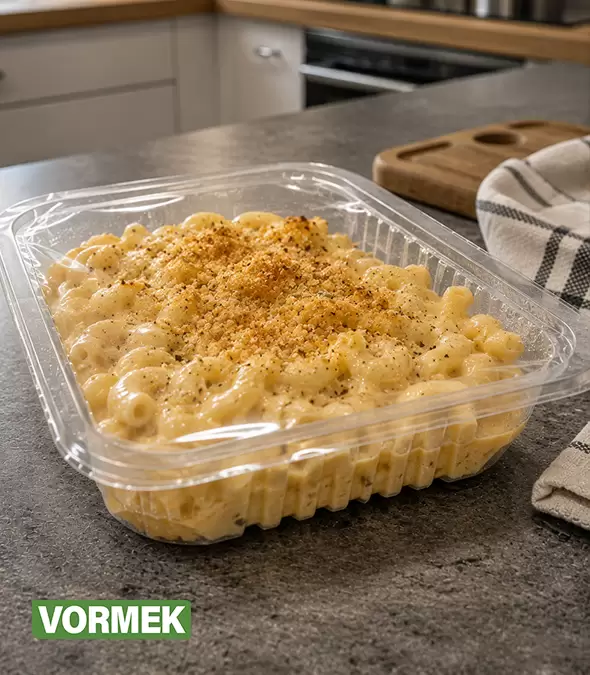
Frequently Asked Questions About Ready Meals Packaging Machines
What is a ready meals packaging machine?
A ready meals packaging machine is equipment used to package prepared foods in formats suitable for storage, distribution, retail, or foodservice. Depending on its configuration, it may perform tray sealing, MAP, vacuum processing, film handling, and integration with other packaging-line equipment.
What is the best packaging machine for ready meals?
Tray sealers are widely used because they can package many prepared foods in preformed trays using standard top sealing or MAP. The best machine depends on the meal, tray format, target shelf life, required output, automation level, and distribution conditions.
Can ready meals be packaged with modified atmosphere packaging?
Yes. MAP is used for many chilled prepared foods where atmosphere modification forms part of the validated shelf-life strategy. Gas composition must be selected according to the specific product, packaging materials, headspace, storage temperature, and microbiological considerations.
Does MAP make ready meals shelf-stable?
No. MAP alone does not make a ready meal shelf-stable. Many MAP ready meals still require refrigeration. Food safety depends on the complete process, including formulation, thermal treatment where applicable, hygiene, cooling, packaging integrity, and controlled storage temperature.
What type of trays are used for ready meals?
Ready meals may use PP, CPET, PET-based, aluminum, or other suitable food-grade trays. Material selection depends on sealing requirements, barrier performance, storage conditions, and whether the package must withstand refrigeration, freezing, microwave reheating, or oven heating.
Can one tray sealer package different tray sizes?
Many industrial tray sealers can process multiple tray formats using dedicated tooling, provided each format falls within the machine’s operating range. Manufacturers with frequent SKU changes should consider tooling cost and changeover time when comparing machines.
How much does a ready meal packaging machine cost?
Price varies according to automation level, production capacity, tooling, MAP or vacuum capability, controls, and line integration. Total cost of ownership should also include labor, film, gas, maintenance, energy, changeovers, and expected production efficiency.
Should I choose a semi-automatic or automatic ready meal packaging machine?
Semi-automatic equipment can be suitable for lower volumes and flexible production. Automatic systems become increasingly attractive as throughput rises, particularly where labor efficiency, consistent tray handling, and integration with filling, inspection, or labeling equipment are important.
Conclusion
The right ready meals packaging machine should be selected as part of the complete food-production system—not as an isolated tray sealer.
Product formulation, hygiene, cooling, tray and film compatibility, sealing parameters, atmosphere control, storage temperature, production capacity, and quality assurance all contribute to final package performance.
For chilled products, MAP can support an appropriate shelf-life strategy when gas composition, packaging materials, process conditions, and cold-chain requirements are correctly established and validated. For other applications, conventional top sealing or vacuum-based technologies may provide a more suitable solution.
Automation should follow the same application-driven approach. Flexible systems can be effective for manufacturers running multiple products at moderate volumes, while high-output operations may benefit from automated tray handling and integration with filling, checkweighing, inspection, labeling, and end-of-line processes.
Vormek solutions such as LuxPacker and ProMotion allow ready meal producers to select a packaging platform according to current production requirements while considering future capacity and automation.
Ultimately, the strongest investment is not simply the fastest or least expensive machine. It is the packaging system that consistently delivers seal integrity, food protection, effective throughput, operational flexibility, and a competitive cost per pack throughout its working life.