Introduction
Red meat is among the most demanding food categories to package correctly. Unlike many processed food products, fresh beef, lamb, veal, and other red meats continue to undergo biological and biochemical changes after slaughter. Oxygen exposure, microbial growth, purge formation, oxidation, and temperature fluctuations all directly affect product quality, shelf life, appearance, and consumer acceptance.
For modern processors, packaging is no longer simply the final production step—it has become a critical part of food safety management, operational efficiency, logistics, and brand positioning. Retailers expect visually attractive products with extended shelf life, while consumers demand fresh-looking meat with minimal preservatives and maximum safety.
To meet these expectations, processors increasingly rely on advanced technologies such as Modified Atmosphere Packaging (MAP), vacuum packaging, skin packaging, and high-performance tray sealing systems. Selecting the right packaging equipment not only preserves product quality but also minimizes waste, improves production consistency, and increases profitability across the supply chain.
At Vormek, we design industrial packaging machines specifically engineered for meat processors seeking reliable sealing performance, precise gas flushing, hygienic construction, and scalable automation. Whether you operate a small butcher facility or a high-capacity industrial meat plant, our solutions are designed to protect product quality while optimizing production efficiency.
Red Meat Packaging Solutions
Packaging requirements vary significantly depending on product type, distribution channel, and desired shelf life. Fresh steaks, minced meat, diced beef, premium cuts, marinated products, and retail-ready portions each require different packaging strategies.
An effective red meat packaging system must achieve several critical objectives simultaneously:
- Preserve natural meat color
- Reduce microbial growth
- Minimize moisture loss
- Prevent oxygen contamination
- Improve transportation stability
- Extend refrigerated shelf life
- Create attractive retail presentation
- Maintain package integrity throughout distribution
Modern packaging technologies combine advanced machinery with engineered barrier films and optimized gas mixtures to create ideal preservation conditions.
Common Packaging Methods
| Packaging Method | Best Application | Main Benefits |
|---|---|---|
| Modified Atmosphere Packaging (MAP) | Fresh retail meat | Bright color, longer shelf life |
| Vacuum Packaging | Wholesale & export | Excellent protection, oxidation control |
| Vacuum Skin Packaging (VSP) | Premium steaks | Premium appearance, minimal purge |
| Tray Sealing | Supermarkets | High productivity, attractive presentation |
| Thermoforming | High-volume production | Lower packaging cost per unit |
Each solution offers unique advantages depending on production goals.
Modified Atmosphere Packaging (MAP)
Modified Atmosphere Packaging has become the preferred solution for retail fresh meat.
Instead of sealing meat inside normal air, the package atmosphere is replaced with a carefully controlled gas mixture that slows spoilage while maintaining an attractive product appearance.
Typical MAP objectives include:
- Maintaining bright red meat color
- Reducing aerobic bacterial growth
- Delaying oxidation
- Improving shelf life
- Preserving sensory quality
For fresh red meat, oxygen often plays an important role in maintaining the desirable bright-red oxymyoglobin color. Carbon dioxide suppresses microbial growth, while nitrogen serves as an inert filler gas that maintains package integrity.
The optimal gas ratio depends on:
- Beef
- Lamb
- Veal
- Minced meat
- Marinated products
- Distribution distance
- Retail shelf life targets
Accurate gas control requires industrial-grade tray sealers equipped with high-performance vacuum systems and precise gas-flushing technology.
Vacuum Packaging
Vacuum packaging removes air from the package before sealing.
Without oxygen, oxidation slows dramatically, allowing processors to significantly extend refrigerated storage life.
Vacuum packaging is commonly used for:
- Export meat
- Bulk beef cuts
- Foodservice products
- Aging beef
- Processing plants
- Distribution centers
Although vacuum-packaged meat develops a darker purplish appearance due to deoxymyoglobin formation, the bright red color quickly returns after opening and exposure to oxygen.
Major advantages include:
- Reduced oxidation
- Lower microbial growth
- Less freezer burn
- Improved transportation durability
- Reduced package volume
- Longer refrigerated shelf life
Vacuum Skin Packaging (VSP)
Premium meat brands increasingly choose Vacuum Skin Packaging because of its exceptional retail presentation.
A heated upper film conforms tightly around the meat, creating a second-skin appearance while eliminating internal air pockets.
Benefits include:
- Premium shelf appearance
- Reduced purge accumulation
- Better product immobilization
- Improved consumer perception
- Extended shelf life
- Better display stability
VSP is especially popular for premium steaks, Wagyu beef, dry-aged beef, and export-quality products.
Tray Sealing Technology
Tray sealing remains the industry’s most versatile packaging solution.
Modern tray sealers can perform:
- Vacuum sealing
- Gas flushing
- MAP packaging
- Skin packaging
- Standard top sealing
- Leak-resistant sealing
- Printed film registration
- Automatic tray handling
Compared with manual packaging operations, automated tray sealers provide:
- Higher production speed
- Repeatable sealing quality
- Lower labor costs
- Improved hygiene
- Reduced operator dependency
- Better package consistency
Industrial processors often integrate tray sealers with automatic denesters, conveyors, checkweighers, metal detectors, labeling systems, and inspection equipment to create complete packaging lines.
Why Packaging Quality Matters
Packaging failures can have severe operational and financial consequences.
Common issues include:
- Seal leaks
- Gas loss
- Excess purge
- Package collapse
- Color deterioration
- Shortened shelf life
- Retail rejection
- Product recalls
Even minor sealing inconsistencies can significantly reduce product shelf life and damage brand reputation.
For this reason, meat processors increasingly invest in packaging systems capable of delivering repeatable sealing pressure, accurate temperature control, consistent vacuum levels, and reliable gas replacement ratios.
Packaging Challenges in Red Meat Processing
Red meat packaging is far more complex than simply placing meat into a tray and sealing it with a film. Every packaging decision directly influences microbial stability, product appearance, shelf life, transportation performance, regulatory compliance, and ultimately consumer confidence.
Fresh meat remains a biologically active product throughout its shelf life. Enzymatic activity continues after slaughter, microorganisms multiply if conditions allow, and muscle pigments continuously react with oxygen. These natural processes require packaging systems that precisely control the product’s environment from the packaging line to the retail shelf.
Industrial processors therefore evaluate packaging as an integrated preservation system rather than a standalone operation.
Maintaining Meat Color Without Compromising Shelf Life
One of the greatest challenges in fresh red meat packaging is preserving the bright cherry-red color consumers associate with freshness.
The color of beef depends primarily on the chemical state of myoglobin, the oxygen-binding protein naturally present in muscle tissue.
Three primary pigment states influence meat appearance:
| Myoglobin State | Color | Packaging Environment |
|---|---|---|
| Deoxymyoglobin | Purplish-red | Vacuum packaging |
| Oxymyoglobin | Bright cherry red | High-oxygen MAP |
| Metmyoglobin | Brown | Oxygen depletion or oxidation |
Consumers often judge freshness within seconds of seeing a package. Even when microbiological quality remains acceptable, premature browning can significantly reduce purchase intent.
Packaging equipment must therefore maintain a controlled atmosphere capable of stabilizing the desired pigment state throughout the product’s intended shelf life.
Selecting the Correct MAP Gas Composition
Modified Atmosphere Packaging is effective only when the gas mixture matches the specific characteristics of the meat product.
Factors influencing gas selection include:
- Species (beef, lamb, veal)
- Fat content
- Product thickness
- Surface area
- Distribution distance
- Storage temperature
- Expected retail display duration
A typical high-oxygen MAP system for fresh beef may contain elevated oxygen levels to maintain the oxymyoglobin pigment, combined with carbon dioxide to suppress aerobic spoilage microorganisms and nitrogen as an inert filler gas.
Typical functions of packaging gases include:
| Gas | Primary Function |
|---|---|
| Oxygen (O₂) | Maintains bright red color |
| Carbon Dioxide (CO₂) | Inhibits microbial growth |
| Nitrogen (N₂) | Prevents package collapse and acts as an inert filler |
The actual gas ratio should always be validated through product-specific shelf-life studies rather than relying on generic industry recommendations.
Industrial tray sealers equipped with high-accuracy gas flushing systems ensure that every package receives a consistent atmosphere, minimizing variability across production batches.
Preventing Seal Failures
A package is only as reliable as its seal.
Even microscopic seal defects may allow oxygen ingress, gas loss, microbial contamination, and moisture leakage.
Common causes of sealing defects include:
- Incorrect sealing temperature
- Inconsistent sealing pressure
- Inadequate dwell time
- Product contamination in the seal area
- Poor-quality trays
- Incorrect film selection
- Damaged sealing tools
- Misaligned trays
High-performance tray sealers continuously control sealing parameters to produce uniform seals across every cycle.
Advanced industrial machines also monitor process consistency, helping operators identify deviations before defective packages leave the production line.
Managing Meat Purge
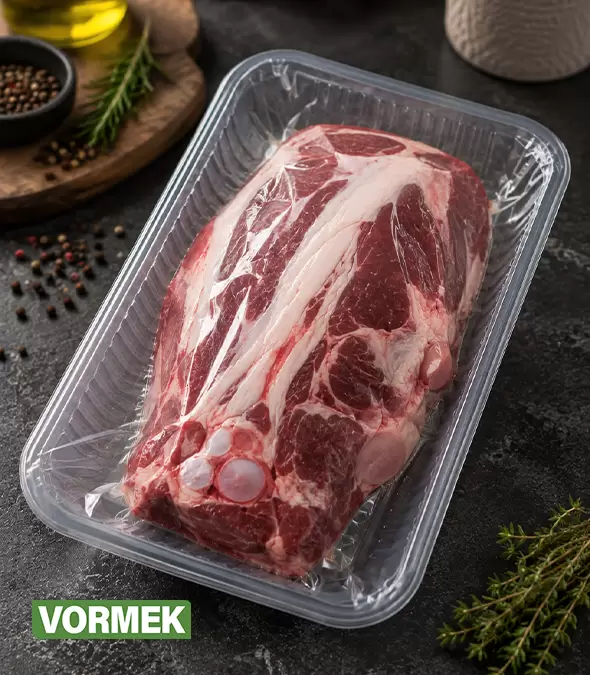
Purge—the liquid released from meat during storage—is one of the most common quality concerns in fresh meat packaging.
Although purge is a natural consequence of muscle protein degradation, excessive purge negatively affects:
- Consumer perception
- Product appearance
- Retail acceptance
- Label readability
- Shelf presentation
Packaging equipment alone cannot eliminate purge, but it can significantly reduce its visual impact through appropriate package design and controlled vacuum or MAP conditions.
Vacuum Skin Packaging is particularly effective because the upper film closely conforms to the product, minimizing liquid movement inside the package.
Barrier Film Compatibility
Packaging machinery performs optimally only when paired with appropriate packaging materials.
Barrier films differ substantially in their oxygen transmission rate (OTR), water vapor transmission rate (WVTR), puncture resistance, sealability, and thermoforming characteristics.
Film selection should consider:
- Required shelf life
- Gas permeability
- Mechanical strength
- Anti-fog properties
- Printing requirements
- Seal compatibility
- Recycling objectives
- Storage temperature
Using an unsuitable film can compromise even the most advanced packaging equipment.
For example:
- Excessively permeable films reduce MAP effectiveness.
- Poor seal layers increase leakage risk.
- Weak puncture resistance leads to package failures during transportation.
Successful packaging systems always evaluate machinery and packaging materials together rather than independently.
Hygienic Machine Design
Red meat processors operate under strict food safety regulations that require packaging equipment to support effective sanitation.
Modern hygienic design principles include:
- Stainless steel construction (AISI 304 or AISI 316 where appropriate)
- Open-frame architecture
- Smooth welds
- Minimal horizontal surfaces
- Easy-access cleaning zones
- Hygienic cable routing
- Corrosion-resistant components
- Washdown-compatible electrical protection
These design features reduce the accumulation of meat residues and simplify cleaning procedures, helping processors comply with HACCP and sanitation protocols.
Temperature Control Throughout Packaging
Packaging cannot compensate for poor temperature management.
The cold chain begins immediately after slaughter and continues through processing, packaging, storage, transportation, retail display, and consumer purchase.
Packaging operations should ideally occur under refrigerated conditions appropriate for fresh meat processing.
Temperature fluctuations accelerate:
- Microbial growth
- Oxidation
- Color deterioration
- Purge formation
- Shelf-life reduction
Packaging equipment must therefore operate reliably in chilled production environments while maintaining consistent sealing performance.
Oxygen Control and Residual Oxygen Levels
Residual oxygen remaining inside a package after gas flushing directly influences shelf life.
Excess oxygen may lead to:
- Oxidative rancidity
- Color instability
- Aerobic microbial growth
- Reduced product quality
Industrial processors frequently verify residual oxygen using dedicated gas analyzers during production.
Routine monitoring enables packaging teams to confirm that sealing integrity, vacuum performance, and gas replacement efficiency remain within validated process limits.
Production Speed Without Sacrificing Quality
Increasing throughput should never compromise package integrity.
Modern processors seek packaging systems capable of balancing:
- High output
- Accurate sealing
- Stable vacuum levels
- Precise gas flushing
- Repeatable package quality
- Minimal downtime
Well-designed automation reduces operator intervention while improving process consistency.
Features such as automatic tray denesting, servo-controlled film transport, recipe management, and touchscreen controls allow rapid product changeovers with minimal production interruption.
Traceability and Food Safety Compliance
Packaging plays a central role in modern food traceability systems.
Every package should be capable of carrying essential production information, including:
- Production date
- Batch number
- Expiration date
- Plant identification
- Product code
- Weight
- Barcode or QR code
Automated packaging lines integrate easily with labeling, printing, and inspection systems to ensure consistent product identification.
Comprehensive traceability improves recall efficiency, regulatory compliance, and consumer confidence.
Sustainability Considerations
Environmental performance has become an important purchasing criterion for retailers and consumers alike.
Packaging equipment can contribute to sustainability by supporting:
- Reduced film consumption
- Accurate tray utilization
- Lower product waste
- Energy-efficient operation
- Recyclable packaging materials
- Lightweight packaging formats
Perhaps the greatest sustainability benefit comes from reducing food waste. Extending the shelf life of fresh meat by even a few days can significantly decrease product losses throughout the supply chain, resulting in lower environmental impact and improved profitability.
The Cost of Inadequate Packaging
Poor packaging decisions extend far beyond visible product defects.
Packaging failures may lead to:
- Reduced shelf life
- Increased product returns
- Retail complaints
- Higher food waste
- Brand reputation damage
- Production downtime
- Additional labor costs
- Regulatory non-compliance
Investing in reliable packaging technology is therefore not simply an equipment purchase—it is a long-term investment in product quality, operational efficiency, and customer satisfaction.
Recommended Vormek Machines
Selecting the right packaging machine requires more than matching production capacity. Processors should evaluate the entire packaging workflow, including product characteristics, packaging format, hygiene requirements, future expansion plans, automation level, and total cost of ownership.
Vormek develops industrial packaging equipment specifically for food manufacturers that require consistent sealing quality, reliable operation, and scalable production. Whether packaging fresh steaks for premium retail, minced beef for supermarkets, or bulk primal cuts for export, the correct machine configuration improves product protection while maximizing operational efficiency.
Automatic Tray Sealers
Automatic tray sealers are the preferred solution for medium- to high-volume fresh meat production.
These systems combine precision sealing with optional vacuum and Modified Atmosphere Packaging (MAP), enabling processors to achieve repeatable package quality across every production cycle.
Typical applications include:
- Fresh beef steaks
- Lamb chops
- Veal portions
- Minced meat
- Marinated meat products
- Retail-ready family packs
- Foodservice trays
Key advantages include:
- Consistent seal integrity
- High packaging throughput
- Accurate MAP gas flushing
- Quick recipe changes
- Automatic film transport
- Printed film registration
- Reduced labor requirements
- Excellent hygiene performance
Automatic tray sealers are well suited for processors supplying supermarket chains where appearance, shelf life, and packaging consistency are critical.
High-Speed Tray Sealers
Large meat processors often require packaging systems capable of continuous operation over multiple production shifts.
High-speed tray sealers are engineered for:
- Large-scale meat plants
- Export facilities
- Centralized packaging centers
- Contract packaging operations
Typical production benefits include:
- Continuous high-capacity operation
- Multi-lane tray handling
- Servo-driven motion control
- Integrated quality monitoring
- Stable gas replacement performance
- Reduced cycle variation
When integrated with upstream and downstream automation, these machines create highly efficient packaging lines with minimal manual intervention.
Vacuum Chamber Packaging Machines
Vacuum chamber systems remain one of the most reliable solutions for packaging wholesale and export meat products.
They are particularly suitable for:
- Large beef cuts
- Bone-in meat
- Vacuum aging
- Frozen meat
- Export packaging
- Foodservice distribution
Primary benefits include:
- Excellent oxygen removal
- Strong vacuum consistency
- Long refrigerated storage potential
- Durable package protection
- Reduced freezer burn
- Compact package dimensions
For processors focused on export logistics or long-term refrigerated storage, vacuum chamber technology offers exceptional product stability.
Thermoforming Packaging Machines
High-output meat facilities frequently choose thermoforming technology to reduce packaging material costs while maximizing production efficiency.
Instead of using preformed trays, thermoforming systems create packages directly from rollstock film.
Advantages include:
- Lower packaging material consumption
- High production capacity
- Flexible package dimensions
- Vacuum packaging
- MAP capability
- Vacuum Skin Packaging compatibility
- Automated continuous operation
Thermoforming is particularly attractive for processors producing millions of packages annually, where small material savings translate into significant long-term cost reductions.
Packaging Line Integration
Packaging machinery delivers the greatest value when integrated into a complete production line.
A typical automated red meat packaging line may include:
- Portioning equipment
- Product inspection
- Automatic tray denesting
- Product loading
- Tray sealing with MAP
- Labeling
- Checkweighing
- Metal detection
- Case packing
- Palletizing
This integrated approach improves productivity while reducing handling and contamination risks.
Choosing the Right Packaging Solution
Machine selection depends on several production variables rather than a single performance metric.
| Production Requirement | Recommended Solution |
|---|---|
| Fresh retail beef | Automatic Tray Sealer with MAP |
| Premium steak presentation | Vacuum Skin Packaging |
| Export meat | Vacuum Chamber |
| High-volume production | Thermoforming Machine |
| Family-size supermarket trays | Tray Sealer |
| Bulk wholesale packaging | Vacuum Chamber |
The most suitable solution should be validated through production trials using the processor’s actual products, trays, films, and distribution conditions.
Automation Features That Improve Productivity
Modern packaging equipment incorporates advanced automation technologies that reduce variability while increasing production efficiency.
Common features include:
- PLC-controlled operation
- Touchscreen HMI
- Servo-driven positioning
- Automatic film indexing
- Recipe management
- Gas pressure monitoring
- Vacuum control
- Tool temperature regulation
- Alarm diagnostics
- Production data recording
These capabilities enable processors to maintain consistent package quality while simplifying operator training and reducing downtime.
Why Reliability Matters
Packaging equipment often operates at the end of the production line, meaning any unexpected stoppage can interrupt the entire manufacturing process.
Reliable machinery helps processors achieve:
- Consistent daily output
- Lower maintenance costs
- Reduced product waste
- Improved production planning
- Stable delivery schedules
- Higher Overall Equipment Effectiveness (OEE)
Equipment designed for industrial use should provide dependable performance across demanding operating conditions while supporting preventive maintenance programs.
Internal Resources for Packaging Professionals
Successful packaging depends not only on machinery but also on process knowledge. The following technical resources provide additional guidance for optimizing packaging performance.
Related Technical Guides
To learn more about complementary packaging technologies, explore these resources:
- Shelf Life Extension for Ready Meals with MAP Technology – /blog/shelf-life-extension-ready-meals-map/
- Food Safety Standards for Poultry Packaging Equipment – /blog/food-safety-standards-poultry-packaging-equipment/
- Packaging Challenges and Solutions for Seafood & Fish Processing – /industries/seafood-fish-packaging/
These articles provide practical guidance on shelf-life optimization, hygienic machine design, gas-flushing strategies, packaging validation, and regulatory considerations across different food categories.
Related Vormek Solutions
Many red meat processors expand their packaging capabilities by integrating complementary equipment from the Vormek portfolio.
For additional automation and packaging flexibility, explore:
- Pack Meister – advanced packaging technologies designed for integrated production workflows and higher operational efficiency.
- Gosealer – high-performance sealing solutions developed for consistent seal integrity across demanding food packaging applications.
These solutions can be incorporated into complete packaging lines to support higher throughput, improved package consistency, and simplified production management.
Get a Custom Quote
Every red meat processing operation has unique packaging requirements. Factors such as product type, tray dimensions, production capacity, shelf-life targets, automation level, and distribution channels all influence the ideal packaging solution.
The Vormek engineering team works closely with processors to evaluate production needs and recommend packaging systems that align with operational goals. From compact tray sealers for growing businesses to fully integrated, high-capacity packaging lines, each solution is designed to deliver reliable performance, hygienic operation, and consistent package quality.
A customized evaluation typically considers:
- Product dimensions and weight
- Production capacity (packs per hour)
- Packaging format (MAP, vacuum, or skin packaging)
- Tray and film specifications
- Gas mixture requirements
- Future production expansion
- Available factory space
- Integration with existing production equipment
Request a customized consultation to identify the most efficient packaging solution for your facility.
Frequently Asked Questions (FAQ)
1. Which packaging method is best for fresh red meat?
There is no universal solution. Modified Atmosphere Packaging (MAP) is widely preferred for retail-ready fresh meat because it helps preserve appearance while extending refrigerated shelf life. Vacuum packaging is generally more suitable for wholesale distribution, export, and long-term refrigerated storage.
2. Why is MAP commonly used for beef packaging?
MAP replaces the air inside the package with a controlled gas mixture that helps maintain product color, suppress microbial growth, and extend shelf life without relying on chemical preservatives. The exact gas composition should always be validated for each product and distribution chain.
3. What is the difference between tray sealing and vacuum packaging?
Tray sealing refers to sealing a preformed tray with a top film and may include MAP or standard sealing. Vacuum packaging removes air from the package before sealing and is typically used with flexible pouches rather than rigid trays.
4. How important is seal integrity in meat packaging?
Seal integrity is critical. Even minor seal defects can allow oxygen to enter the package, resulting in gas loss, microbial contamination, shortened shelf life, and potential product rejection by retailers.
5. Which packaging materials are recommended for red meat?
High-barrier multilayer films are commonly used because they provide excellent oxygen and moisture protection while maintaining strong sealing performance. The optimal film depends on the packaging method, storage conditions, and required shelf life.
6. Can one machine package different meat products?
Yes. Modern industrial tray sealers typically support multiple tooling configurations and programmable recipes, allowing processors to package steaks, minced meat, lamb, veal, marinated products, and other fresh meat items with minimal changeover time.
7. What factors should be considered when choosing a packaging machine?
Important considerations include:
- Production capacity
- Packaging format
- Automation level
- Hygiene requirements
- Available floor space
- Maintenance accessibility
- Packaging material compatibility
- Future expansion plans
- Total cost of ownership
8. How does packaging contribute to food safety?
Proper packaging reduces the risk of contamination by creating a controlled environment that limits microbial growth, protects the product during transportation, and helps maintain the cold chain. Combined with Good Manufacturing Practices (GMP) and HACCP, effective packaging is an essential part of a comprehensive food safety system.
9. Is thermoforming more economical than tray sealing?
For very high production volumes, thermoforming can reduce packaging material costs because packages are formed directly from rollstock film. However, tray sealing often offers greater flexibility for processors producing multiple tray sizes or a wide variety of products.
10. How can processors maximize packaging efficiency?
Efficiency improves when processors optimize the entire packaging system rather than focusing on one component. Selecting the appropriate machine, barrier film, gas mixture, sanitation program, and preventive maintenance strategy can reduce downtime, minimize waste, and improve Overall Equipment Effectiveness (OEE).
Comparison Table: Selecting the Right Packaging Technology
| Packaging Technology | Typical Applications | Key Advantages | Primary Considerations |
|---|---|---|---|
| Modified Atmosphere Packaging (MAP) | Fresh retail beef and lamb | Extended shelf life, attractive appearance | Requires accurate gas control and barrier films |
| Vacuum Packaging | Wholesale, export, primal cuts | Excellent oxygen removal and storage stability | Darker product color until exposed to air |
| Vacuum Skin Packaging (VSP) | Premium steaks and retail-ready cuts | Premium presentation, reduced purge | Specialized films and tooling required |
| Tray Sealing | Supermarket trays and family packs | Flexible, efficient, and scalable | Performance depends on tray and film compatibility |
| Thermoforming | High-volume industrial production | Lower material costs and continuous automation | Higher initial investment and dedicated production setup |
Conclusion
Packaging has become one of the most influential factors in the commercial success of fresh red meat products. Beyond protecting the product, an effective packaging system helps preserve quality, enhance food safety, extend refrigerated shelf life, reduce food waste, improve retail presentation, and increase operational efficiency across the supply chain.
Modern processors must balance multiple variables, including microbiological stability, oxygen control, package integrity, material compatibility, production speed, and sustainability. Achieving this balance requires more than selecting a packaging machine—it requires an integrated packaging strategy supported by validated processes, appropriate packaging materials, and reliable industrial equipment.
Vormek packaging solutions are designed to meet these challenges through precision engineering, hygienic construction, advanced automation, and flexible packaging technologies tailored to the needs of today’s meat processors. Whether the objective is premium retail presentation, export-ready vacuum packaging, or high-capacity MAP production, selecting the right equipment can significantly improve product consistency, reduce operational costs, and strengthen long-term business performance.
As consumer expectations and food safety standards continue to evolve, investing in advanced packaging technology is no longer simply a production upgrade—it is a strategic decision that supports product quality, regulatory compliance, and sustainable growth throughout the meat supply chain.