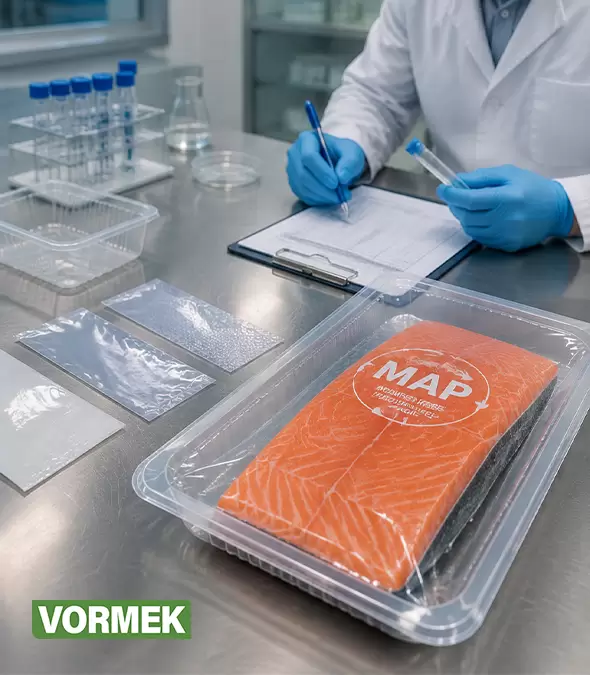
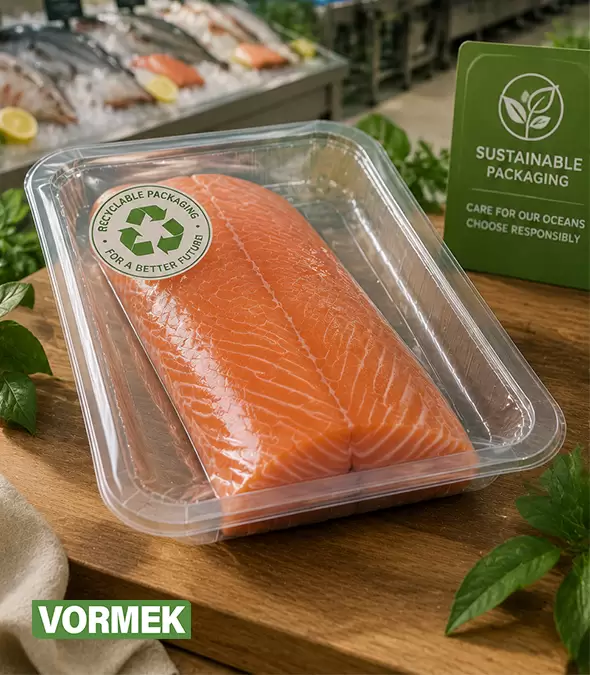
Seafood is among the most perishable food categories in the global food industry. High water activity, naturally occurring enzymes, unsaturated lipids, and psychrotrophic microorganisms accelerate quality deterioration soon after harvest. Without an appropriate packaging strategy, processors face shorter shelf life, increased product losses, inconsistent retail quality, and greater food safety risks.
Packaging has therefore evolved far beyond its traditional role as a transport container. In modern seafood processing, it functions as an integrated preservation system that works alongside hygienic processing, rapid chilling, and cold-chain management to maintain product quality throughout distribution.
Whether packaging fresh fish fillets, whole fish, shrimp, shellfish, smoked seafood, or ready-to-cook seafood meals, processors must carefully balance product protection, operational efficiency, regulatory compliance, and consumer expectations. The choice of packaging technology directly influences oxygen exposure, moisture retention, microbial growth, product appearance, and ultimately commercial profitability.
VORMEK develops industrial packaging solutions specifically designed to address these challenges. Combining Modified Atmosphere Packaging (MAP), vacuum packaging, tray sealing, and automated filling technologies, VORMEK systems help seafood manufacturers improve packaging consistency while supporting longer refrigerated shelf life and attractive retail presentation.
Rather than relying on a single packaging method for every application, VORMEK focuses on selecting the most appropriate technology according to product characteristics, production capacity, distribution requirements, and shelf-life objectives.
Seafood & Fish Packaging Solutions
No single packaging system is suitable for every seafood product. Packaging requirements vary significantly depending on species, fat content, processing method, distribution distance, and retail presentation.
For example, a fresh Atlantic salmon portion destined for supermarket shelves requires different packaging parameters than frozen shrimp for export or a seafood salad packed as a ready-to-eat meal. Each product presents unique challenges in terms of oxidation, purge formation, microbial growth, package integrity, and consumer perception.
Selecting the appropriate packaging technology begins with understanding these differences.
| Seafood Product | Primary Packaging Objective | Recommended Technology |
|---|---|---|
| Fresh Fish Fillets | Preserve freshness and extend refrigerated shelf life | MAP Tray Sealing |
| Salmon Portions | Minimize lipid oxidation while maintaining premium appearance | MAP or Vacuum Skin Packaging |
| Shrimp | Reduce dehydration and maintain product colour | MAP Tray Sealing |
| Mussels and Shellfish | Protect against contamination during chilled distribution | Tray Sealing |
| Smoked Fish | Reduce oxygen exposure and flavour deterioration | Vacuum Packaging |
| Frozen Seafood | Prevent freezer burn and moisture loss | Vacuum Chamber Packaging |
| Seafood Salads | Hygienic filling and leak-proof retail packaging | Servo Filling + Tray Sealing |
| Ready-to-Cook Seafood Meals | Product protection throughout chilled distribution | MAP Tray Sealing |
This product-specific approach enables processors to optimise shelf life without compromising product quality or production efficiency.
Why Packaging Technology Matters in Seafood Processing
Unlike many processed foods, seafood continues to undergo biological and biochemical changes even after harvesting. Packaging cannot stop these natural processes, but it can significantly slow their progression when combined with appropriate refrigeration and hygienic manufacturing practices.
An effective seafood packaging system should achieve several objectives simultaneously:
- Reduce exposure to atmospheric oxygen.
- Slow the growth of spoilage microorganisms.
- Minimise moisture loss and drip formation.
- Protect delicate muscle structure during transport.
- Maintain attractive product presentation throughout retail display.
- Prevent package leakage and seal failure.
- Support regulatory compliance and food safety programmes.
- Improve operational efficiency by reducing product waste and rework.
These objectives require much more than selecting a tray or a sealing film. Packaging performance depends on the interaction between product characteristics, packaging materials, equipment capability, gas composition, and process validation.
Packaging Technologies Used in the Seafood Industry
Modern seafood processors typically employ one or more of the following packaging technologies depending on the product and distribution chain.
Modified Atmosphere Packaging (MAP)
MAP replaces the air naturally present inside the package with a controlled gas mixture designed to slow quality deterioration. Properly validated MAP systems can reduce aerobic spoilage, preserve colour, and extend refrigerated shelf life for many chilled seafood products.
However, successful MAP depends on far more than gas composition alone. Film barrier properties, residual oxygen levels, gas-to-product ratio, storage temperature, and seal integrity must all be validated for each product.
Vacuum Packaging
Vacuum packaging removes most of the air surrounding the product before sealing. This approach is widely used for frozen seafood, smoked fish, and selected chilled products where limiting oxygen exposure is essential.
Advantages include:
- Reduced oxidation
- Lower risk of freezer burn
- Compact package design
- Improved storage efficiency
- Reduced moisture evaporation
Because reduced-oxygen packaging requires strict food safety controls, vacuum packaging should always be implemented within a validated HACCP programme.
Vacuum Skin Packaging (VSP)
Vacuum Skin Packaging has become increasingly popular for premium seafood products. During the sealing process, a highly flexible film conforms closely to the contours of the product, creating an attractive presentation while restricting product movement inside the tray.
Typical applications include:
- Premium salmon portions
- Tuna steaks
- Fresh white fish
- Premium shellfish
Besides improving visual presentation, VSP helps minimise mechanical damage during transportation and enhances shelf differentiation in retail environments.
Tray Sealing
Tray sealing remains one of the most versatile packaging methods for seafood processors.
Its flexibility allows manufacturers to package a wide range of products using the same production platform while accommodating different tray dimensions, film types, and packaging atmospheres.
Depending on the application, tray sealing systems may operate with:
- Atmospheric sealing
- Vacuum sealing
- Vacuum–gas replacement (MAP)
- Skin packaging configurations
This versatility makes tray sealing suitable for both medium-volume processors and fully automated industrial production lines.
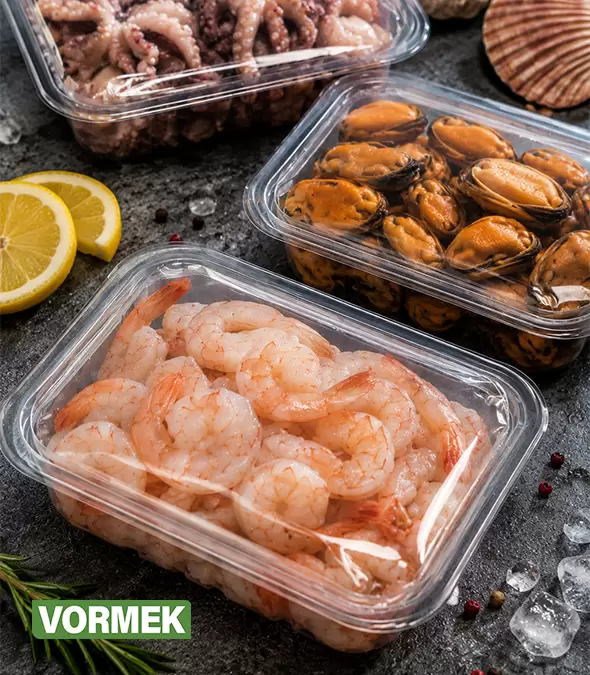
Packaging Challenges in Seafood & Fish Processing
Selecting the right packaging technology begins with understanding why seafood is one of the most challenging food categories to preserve. Unlike many processed foods, seafood undergoes rapid biochemical, microbiological, and physical changes immediately after harvest. Even under refrigeration, naturally occurring enzymes remain active, psychrotrophic microorganisms continue to multiply, and oxidative reactions gradually reduce sensory quality.
For seafood processors, packaging should therefore be viewed as a validated preservation system rather than simply a method of enclosing the product. Effective packaging controls the environment surrounding the food, but it cannot compensate for poor raw material quality, inadequate sanitation, or interruptions in the cold chain.
The objective is not merely to extend shelf life—it is to preserve product quality while maintaining food safety throughout storage, transportation, and retail display.
Understanding Seafood Spoilage Mechanisms
Successful packaging starts with understanding why seafood deteriorates.
Four principal mechanisms influence product quality:
1. Microbial Growth
Fresh seafood naturally contains spoilage microorganisms acquired from the aquatic environment, harvesting operations, processing equipment, and handling practices.
Although refrigeration slows microbial activity, many psychrotrophic bacteria continue to grow at chilled temperatures. As microbial populations increase, they produce volatile compounds responsible for:
- Fishy odours
- Surface slime
- Soft texture
- Discoloration
- Excess package purge
Packaging technologies such as Modified Atmosphere Packaging (MAP) can delay the growth of many aerobic spoilage organisms, but they should never be considered a substitute for hygienic processing or proper refrigeration.
2. Lipid Oxidation
Many commercially valuable seafood species—including salmon, trout, tuna, sardines, and mackerel—contain high concentrations of polyunsaturated fatty acids.
While these lipids provide important nutritional benefits, they are also highly susceptible to oxidation.
Oxidative deterioration may result in:
- Rancid flavour
- Loss of fresh aroma
- Colour fading
- Nutritional degradation
- Reduced consumer acceptance
Limiting oxygen exposure through vacuum packaging or properly validated MAP significantly slows these reactions.
3. Enzymatic Activity
Even after harvest, naturally occurring enzymes remain active within seafood muscle tissue.
These enzymes contribute to:
- Texture softening
- Protein degradation
- Moisture release
- Muscle separation
- Reduced structural integrity
Packaging cannot stop enzymatic reactions entirely, but rapid chilling combined with appropriate packaging considerably reduces their rate.
4. Moisture Migration and Drip Loss
Water loss affects both product quality and commercial yield.
As muscle proteins gradually lose their ability to retain water, liquid accumulates inside the package, reducing visual appeal and increasing the risk of contamination during handling.
Effective packaging systems should therefore minimise:
- Purge formation
- Moisture evaporation
- Product dehydration
- Seal contamination caused by liquid residues
Selecting appropriate trays, absorbent pads, and high-barrier films plays an important role in controlling these issues.
Modified Atmosphere Packaging (MAP)
Modified Atmosphere Packaging is one of the most widely adopted preservation technologies for chilled seafood.
Instead of sealing products in normal air, MAP replaces the package atmosphere with a carefully controlled gas mixture selected for the specific product.
When properly validated, MAP may:
- Delay microbial spoilage
- Reduce oxidative deterioration
- Preserve colour and texture
- Improve retail presentation
- Extend refrigerated shelf life
However, successful MAP depends on much more than selecting gas percentages.
Critical validation parameters include:
- Gas composition
- Gas-to-product ratio
- Residual oxygen concentration
- Film oxygen barrier
- Seal integrity
- Product temperature
- Storage conditions
- Declared shelf life
For this reason, gas composition should always be considered part of an integrated packaging system rather than an independent processing parameter.
Understanding the Role of Packaging Gases
Each gas used in MAP performs a different function.
Carbon Dioxide (CO₂)
Carbon dioxide is the primary antimicrobial gas used in seafood packaging.
It dissolves readily into the water phase of seafood products, lowering surface pH and slowing the growth of many aerobic spoilage microorganisms.
However, increasing CO₂ concentration is not always beneficial.
Excessive CO₂ may contribute to:
- Increased drip loss
- Package collapse
- Texture changes in certain species
- Consumer acceptance issues
The optimum concentration therefore depends on product characteristics and should always be validated experimentally.
Nitrogen (N₂)
Nitrogen functions primarily as an inert balance gas.
Unlike carbon dioxide, nitrogen has relatively low solubility in seafood tissue. As a result, it helps maintain package headspace and reduces the degree of package collapse that may occur as CO₂ dissolves into the product.
Nitrogen also reduces oxygen concentration without directly participating in chemical reactions.
Oxygen (O₂)
Many chilled seafood products benefit from low residual oxygen because reduced oxygen slows lipid oxidation and limits the growth of aerobic spoilage microorganisms.
However, oxygen requirements vary between products, and gas selection should always be based on validated shelf-life studies rather than generic formulations.
Illustrative MAP Gas Ranges
The following table provides illustrative starting ranges only. These values should never be interpreted as universal processing specifications.
Final gas composition must always be validated according to:
- Product species
- Fat content
- Initial microbial load
- Storage temperature
- Film permeability
- Package volume
- Gas-to-product ratio
- Target shelf life
| Product | CO₂ | N₂ | O₂ |
|---|---|---|---|
| White Fish Fillets | 40–60% | Balance | Low residual |
| Salmon Portions | 40–60% | Balance | Low residual |
| Shrimp | 30–50% | Balance | Low residual |
| Smoked Seafood | 30–50% | Balance | Minimal |
These gas compositions are intended only as preliminary reference points. Final packaging parameters should always be established through microbiological, sensory, seal-integrity, and shelf-life validation studies.
Food-Safety Considerations for Reduced-Oxygen Packaging
While vacuum packaging and MAP effectively delay spoilage, they also create a reduced-oxygen environment that requires careful food safety management.
Lower oxygen concentrations may suppress many spoilage organisms, yet they do not eliminate foodborne pathogens. In some circumstances, delaying visible spoilage can make strict process control even more important because microbial hazards may develop before obvious quality defects become apparent.
For this reason, seafood packaged under reduced-oxygen conditions should always be produced within a validated food safety management system.
Key control measures include:
- HACCP-based process validation
- Continuous cold-chain management
- Product-specific shelf-life validation
- Residual oxygen monitoring
- Hygienic equipment design
- Routine seal-integrity verification
- Environmental monitoring programmes
- Time and temperature control throughout distribution
For ready-to-eat seafood products, processors should also evaluate product-specific hazards such as Listeria monocytogenes. In addition, the potential risk associated with non-proteolytic Clostridium botulinum should be considered when validating reduced-oxygen packaging systems, particularly for chilled seafood intended for extended refrigerated storage.
Packaging technology can significantly delay spoilage, but it cannot replace validated food safety controls or good manufacturing practices.
Selecting the Right Seafood Packaging Equipment
Choosing a packaging machine is not simply a matter of production speed or automation level. The right system must preserve product quality, integrate seamlessly with upstream and downstream processes, comply with food safety requirements, and remain flexible enough to accommodate future product development.
A packaging line that performs exceptionally well for smoked salmon may not be suitable for raw shrimp, while a machine designed for ready-to-eat seafood salads may be unnecessarily complex for frozen fish portions. Successful equipment selection therefore begins with a detailed evaluation of the product rather than the machine itself.
Before investing in packaging equipment, seafood processors should evaluate:
- Product characteristics and fragility
- Daily and peak production capacity
- Required shelf life
- Packaging format and retail presentation
- Packaging material compatibility
- Required automation level
- Cleaning and sanitation requirements
- Available factory space
- Future production expansion
- Total Cost of Ownership (TCO)
When these factors are assessed together, processors can select equipment that not only meets current production requirements but also supports long-term operational growth.
Engineering Considerations Before Equipment Selection
Experienced seafood processors typically evaluate packaging systems using several technical performance indicators rather than focusing solely on machine output.
Important engineering criteria include:
Seal Integrity
A package is only as reliable as its seal.
Incomplete or inconsistent seals may lead to:
- Gas leakage
- Premature spoilage
- Package contamination
- Reduced shelf life
- Product returns
Modern tray sealers should provide stable control of:
- Sealing temperature
- Sealing pressure
- Dwell time
- Cooling profile
Consistent control of these variables helps minimise channel leaks, wrinkles, incomplete fusion, and seal contamination.
Hygienic Design
Seafood processing environments demand equipment that can be cleaned quickly and thoroughly.
A hygienically designed packaging system should include:
- Stainless-steel product-contact surfaces
- Easy-to-clean machine geometry
- Minimal dirt-retention areas
- Washdown-compatible components
- Accessible maintenance points
Reducing cleaning time not only improves food safety but also increases available production time.
Packaging Material Compatibility
The packaging machine should operate reliably with different barrier materials without compromising seal quality.
Typical materials include:
- High-barrier MAP films
- Vacuum skin films
- Peelable lidding films
- Recyclable mono-material structures
- PET, PP and APET trays
Consistent film handling reduces wrinkles, registration errors, and sealing defects.
Process Validation
Even the most advanced machine cannot guarantee shelf life without process validation.
Packaging systems should therefore support routine verification of:
- Vacuum level
- Gas composition
- Residual oxygen
- Seal integrity
- Package appearance
Routine validation enables processors to identify process deviations before they affect product quality.
Recommended VORMEK Machines
VORMEK develops packaging systems that support a broad range of seafood applications—from small-batch processors to fully automated industrial production facilities.
Rather than offering a single universal solution, each system is engineered for a specific production objective.
Smart Sealer
Smart Sealer is VORMEK’s flagship tray sealing platform for chilled seafood applications requiring precise atmosphere control and consistent seal quality.
Typical applications include:
- Fresh fish fillets
- Salmon portions
- Shrimp
- Shellfish
- Seafood salads
- Ready-to-cook seafood meals
Unlike conventional tray sealers that rely on fixed operating parameters, Smart Sealer maintains packaging consistency through controlled management of sealing temperature, pressure, vacuum level, gas flushing, and dwell time.
This closed-loop process helps reduce several common causes of package failure, including:
- Channel leaks
- Incomplete seals
- Product contamination within the seal area
- Inconsistent package appearance
- Gas loss during storage
Key Technical Features
- Vacuum–gas replacement (MAP)
- PLC/HMI process control
- PID temperature regulation
- Automatic recipe management
- Multi-format tooling capability
- Printed-film registration compatibility
- Hygienic AISI 304 stainless-steel construction
- Quick tool change for product flexibility
Operational Benefits
- Stable package quality throughout long production runs
- Reduced product rework
- Improved seal repeatability
- Lower film waste
- Faster production changeovers
- Reliable operation across multiple seafood products
LuxPacker
For premium retail seafood, package appearance is almost as important as product quality.
Consumers often judge freshness before reading the label, making visual presentation a critical purchasing factor.
LuxPacker is designed for premium packaging applications where product visibility, seal quality, and presentation must remain consistent throughout refrigerated distribution.
Typical products include:
- Premium salmon
- Tuna loins
- Fresh cod portions
- Gourmet shellfish
- High-value seafood selections
LuxPacker combines accurate film positioning with controlled sealing conditions to minimise wrinkles, flange contamination, and cosmetic defects that may reduce consumer confidence.
Primary Advantages
- Premium retail appearance
- High seal consistency
- Excellent film presentation
- Compatibility with high-barrier lidding materials
- Suitable for premium branding strategies
Mechoris Visco Servo
Many seafood processors manufacture value-added products that require precise filling before sealing.
Examples include:
- Seafood salads
- Tuna mayonnaise salads
- Crab mixtures
- Shrimp salads
- Seafood pasta meals
- Fish spreads
- Marinated seafood products
Mechoris Visco Servo provides accurate servo-controlled portioning while maintaining gentle product handling.
The system is particularly suitable for formulations containing sensitive ingredients that may be damaged by aggressive pumping systems.
Technical Features
- High-accuracy servo dosing
- Adjustable filling parameters
- Gentle product transfer
- Recipe management
- Hygienic sanitary construction
- Fast Clean-in-Place compatibility
Benefits
- Reduced product giveaway
- Improved portion consistency
- Lower labour requirements
- Greater production efficiency
- Excellent integration with tray sealing systems
Praxpack Twinset
Large seafood manufacturers require packaging lines capable of operating continuously with minimal manual intervention.
Praxpack Twinset is VORMEK’s integrated packaging platform for high-capacity industrial production.
The system can be configured with:
- Automatic denesters
- Servo filling systems
- Vacuum–gas replacement
- Inline tray sealing
- Checkweighers
- Vision inspection
- Metal detection
- Automatic labelling
- End-of-line conveying
Such integration improves production efficiency while reducing manual handling and process variability.
Ideal Applications
- Export-oriented seafood plants
- High-volume fish processors
- Ready-meal manufacturers
- Central food production facilities
Selecting the Appropriate VORMEK Solution
| Processing Requirement | Recommended VORMEK Solution | Primary Packaging Technology |
|---|---|---|
| Fresh fish fillets | Smart Sealer | MAP Tray Sealing |
| Premium salmon portions | LuxPacker | Premium MAP Tray Sealing |
| Shrimp and shellfish | Smart Sealer | MAP Tray Sealing |
| Seafood salads | Mechoris Visco Servo + Smart Sealer | Servo Filling + MAP |
| Ready-to-cook seafood meals | Mechoris Visco Servo + Smart Sealer | Filling + Tray Sealing |
| Frozen seafood in vacuum pouches | VORMEK Vacuum Chamber | Vacuum Packaging |
| High-capacity industrial production | Praxpack Twinset | Fully Automated Packaging Line |
Why Seafood Processors Choose VORMEK
Beyond equipment performance, seafood manufacturers require packaging partners capable of supporting long-term operational success.
VORMEK packaging systems are designed around four engineering priorities:
- Packaging Consistency: Stable sealing parameters and repeatable package quality.
- Food Safety: Hygienic machine construction that supports sanitation and validation programmes.
- Operational Flexibility: Rapid product changeovers and compatibility with multiple tray formats.
- Scalable Automation: Equipment that can evolve from standalone machines to fully integrated production lines.
Rather than focusing solely on machine output, VORMEK solutions are engineered to help processors reduce waste, improve process reliability, maintain packaging quality, and support sustainable business growth.
Packaging Validation and Quality Assurance
Selecting the appropriate packaging technology and equipment is only part of a successful seafood packaging strategy. Long shelf life and consistent package quality ultimately depend on process validation. Even the most advanced packaging machine cannot compensate for poor process control, inadequate sanitation, or an unstable cold chain.
For seafood processors, packaging validation is a continuous quality assurance activity rather than a one-time commissioning exercise. Every critical parameter—including gas composition, seal integrity, package barrier performance, and storage conditions—should be routinely monitored and documented.
Validation helps ensure that every package leaving the production line performs as intended throughout its declared shelf life.
Seal Integrity: The Foundation of Package Performance
For chilled seafood packaged under vacuum or Modified Atmosphere Packaging (MAP), seal integrity is arguably the most critical quality parameter.
A package may appear visually acceptable while containing microscopic seal defects capable of allowing oxygen ingress or gas leakage. These failures can shorten shelf life, increase product waste, and compromise consumer confidence.
The most common causes of seal failure include:
- Product contamination within the seal area
- Incorrect sealing temperature
- Insufficient sealing pressure
- Inadequate dwell time
- Damaged tooling
- Wrinkled lidding film
- Poor tray dimensional consistency
- Operator setup errors
For this reason, processors should routinely verify seal quality using validated inspection procedures rather than relying solely on visual inspection.
Recommended Package Validation Tests
An effective quality assurance programme should include both routine in-line monitoring and scheduled laboratory verification.
| Validation Test | Purpose |
|---|---|
| Visual Seal Inspection | Detect wrinkles, contamination, incomplete fusion, or cosmetic defects |
| Headspace Gas Analysis | Verify CO₂, O₂ and N₂ concentrations after sealing |
| Residual Oxygen Measurement | Confirm oxygen remains within validated limits |
| Vacuum Decay Test | Detect microscopic leaks without damaging the package |
| Burst Test | Evaluate maximum seal strength under internal pressure |
| Dye Penetration Test | Identify channel leaks along the sealing interface |
| Shelf-Life Study | Validate declared refrigerated shelf life |
| Microbiological Testing | Confirm product quality throughout storage |
Routine verification significantly reduces the likelihood of packaging failures reaching the marketplace.
Selecting Packaging Materials
Packaging performance depends not only on the machine but also on the interaction between trays, films, absorbent components, and the product itself.
Selecting materials based solely on price often leads to inconsistent sealing performance and reduced shelf life.
Important selection criteria include:
Barrier Properties
High-barrier films help minimise oxygen transmission and reduce moisture loss during refrigerated storage.
Material selection should consider:
- Oxygen Transmission Rate (OTR)
- Water Vapour Transmission Rate (WVTR)
- Mechanical strength
- Sealability
- Transparency
- Anti-fog performance
The appropriate specification depends on the seafood product, distribution chain, and desired shelf life.
Tray Selection
The tray must withstand sealing temperatures while maintaining dimensional stability.
Typical materials include:
- PET
- APET
- CPET
- PP
Tray selection should also consider:
- Product weight
- Storage temperature
- Retail presentation
- Recyclability objectives
Absorbent Pads
Many chilled seafood products naturally release moisture during storage.
Absorbent pads help:
- Control purge
- Improve package appearance
- Reduce seal contamination
- Improve hygiene during retail handling
However, absorbent capacity should be selected according to the expected drip characteristics of each product rather than using a universal solution.
Common Packaging Failures—and How to Prevent Them
Understanding the root causes of packaging failures enables processors to implement corrective actions before quality is affected.
| Packaging Issue | Likely Cause | Recommended Corrective Action |
|---|---|---|
| Excessive package collapse | High CO₂ solubility or insufficient nitrogen | Optimise gas composition and headspace volume |
| Seal contamination | Product residue on sealing flange | Improve filling accuracy and tray presentation |
| Gas leakage | Damaged tooling or incorrect sealing parameters | Revalidate sealing temperature, pressure and dwell time |
| Excessive drip | Product characteristics or unsuitable packaging design | Optimise storage conditions and absorbent pad selection |
| Film wrinkles | Incorrect film tension or alignment | Adjust film transport and registration settings |
| Inconsistent package appearance | Variable processing conditions | Standardise operating procedures and equipment calibration |
Rather than treating these issues as isolated defects, processors should investigate the underlying process variables that contribute to recurring failures.
Related Technical Guides
For readers interested in expanding their knowledge of seafood packaging technologies, the following technical resources are recommended:
- MAP Packaging for Fresh Fish: Best practices for gas selection, shelf-life optimisation, and package validation.
- Vacuum Packaging vs. MAP for Seafood: A technical comparison of preservation mechanisms, applications, and operational considerations.
- How to Select the Right Tray Sealer: Factors influencing equipment selection, automation, and long-term production efficiency.
These complementary guides provide additional engineering insights that support informed investment decisions.
Frequently Asked Questions
What is the most suitable packaging method for fresh seafood?
There is no universal solution. The appropriate packaging technology depends on the seafood species, product formulation, distribution chain, target shelf life, and retail requirements. Properly validated MAP is widely used for many chilled seafood applications, while vacuum packaging is often preferred for frozen and smoked products.
Does MAP guarantee food safety?
No. MAP helps delay spoilage but does not replace hygienic processing, temperature control, or a validated HACCP programme. Food safety depends on the entire production system rather than packaging alone.
Why is residual oxygen important?
Residual oxygen directly influences lipid oxidation, colour stability, and microbial activity. Routine headspace gas analysis helps confirm that packaging parameters remain within validated specifications.
Can one packaging machine process different seafood products?
Yes. Modern tray sealing platforms equipped with recipe management and interchangeable tooling can accommodate multiple tray formats and seafood products while maintaining consistent sealing performance.
Which packaging material provides the best shelf life?
Shelf life depends on the combined performance of the packaging system. High-barrier films with appropriate OTR and WVTR values generally provide superior protection, but the final specification should always be validated for each product.
How often should packaging systems be validated?
Critical packaging parameters—including gas composition, seal integrity, vacuum level, and microbiological performance—should be verified routinely according to the processor’s quality management programme and risk assessment.
Conclusion
Seafood packaging is far more than a finishing operation—it is a scientifically controlled preservation process that directly influences product quality, food safety, commercial performance, and consumer confidence.
Successfully packaging seafood requires a balanced approach that combines validated packaging technology, hygienic equipment design, appropriate barrier materials, robust process control, and an uninterrupted cold chain. Modified Atmosphere Packaging (MAP), vacuum packaging, tray sealing, and vacuum skin packaging each offer distinct advantages when matched to the correct product and production objective.
Equally important is recognising that packaging technology must be supported by routine validation. Monitoring seal integrity, residual oxygen, gas composition, microbiological quality, and shelf-life performance enables processors to identify process deviations before they affect finished products.
VORMEK designs packaging solutions with this engineering philosophy in mind. From the flexibility of Smart Sealer and the premium presentation delivered by LuxPacker, to the precision portioning of Mechoris Visco Servo and the integrated automation of Praxpack Twinset, every system is developed to help seafood processors improve consistency, reduce waste, simplify validation, and maintain reliable production performance.
As seafood supply chains continue to evolve and consumer expectations become more demanding, investing in a technically validated packaging solution is no longer simply a production decision—it is a long-term investment in product quality, regulatory compliance, operational efficiency, and brand reputation.
Request a Technical Consultation
Every seafood processing facility presents unique challenges. Product characteristics, packaging formats, shelf-life targets, production capacity, and distribution conditions all influence the most appropriate packaging strategy.
The VORMEK engineering team works closely with processors to evaluate production requirements and recommend packaging solutions tailored to individual applications.
Whether your objective is to improve shelf life, increase production efficiency, upgrade packaging quality, or automate an existing packaging line, VORMEK can help develop a solution based on validated engineering principles rather than one-size-fits-all recommendations.
Contact VORMEK today to discuss your seafood packaging project and receive a customised technical proposal designed specifically for your production requirements.