Introduction
Seafood is one of the most challenging food categories to package correctly. Fresh fish, fillets, shellfish, smoked seafood and frozen products differ significantly in moisture content, fat composition, respiration and spoilage behaviour, meaning that a packaging solution suitable for one product may perform poorly for another.
High water activity, microbial activity, enzymatic reactions and lipid oxidation can rapidly reduce seafood quality. Packaging must therefore do more than provide physical containment. It must work alongside refrigeration, hygiene controls and the selected preservation method to protect product quality throughout distribution.
Many packaging failures occur not because manufacturers lack advanced machinery, but because one element of the packaging system has been incorrectly specified. The wrong packaging method, inconsistent seals, incompatible films or incorrectly sized equipment can shorten effective shelf life, increase rejects and raise production costs.
This guide examines four common seafood & fish packaging mistakes, explains why they occur and provides practical engineering and food-processing solutions. Manufacturers planning or upgrading seafood packaging operations can also explore the Seafood & Fish industry landing page for packaging solutions developed for chilled, frozen and value-added seafood applications.
Mistake #1: Choosing the Wrong Seafood Packaging Method
One of the most common fish packaging mistakes is selecting the packaging technology before fully evaluating the product.
Vacuum packaging, Modified Atmosphere Packaging (MAP), tray sealing, skin packaging and thermoforming each create different conditions around the food. The correct choice depends on the seafood species, processing method, storage temperature, target shelf life and distribution conditions.
Which Packaging Method Is Best for Fish and Seafood?
There is no universally “best” seafood packaging method.
A fresh chilled fillet may require a completely different solution from frozen shrimp, smoked salmon or marinated seafood. Packaging selection should therefore begin with the preservation objective rather than the available machine.
| Packaging Method | Typical Seafood Application | Main Benefit | Key Consideration |
|---|---|---|---|
| Tray Sealing | Fresh fillets and portions | Flexible retail presentation | Seal integrity |
| MAP | Chilled fish and seafood | Atmosphere control | Gas mix and temperature |
| Vacuum Packaging | Selected fish products | Reduced oxygen exposure | Food safety and cold chain |
| Skin Packaging | Premium fillets | Product immobilisation and presentation | Film/tray compatibility |
| Thermoforming | High-volume production | Integrated automated packaging | Film and tooling selection |
| Frozen Packaging | Fish, shrimp and portions | Protection during frozen storage | Moisture and mechanical barrier |
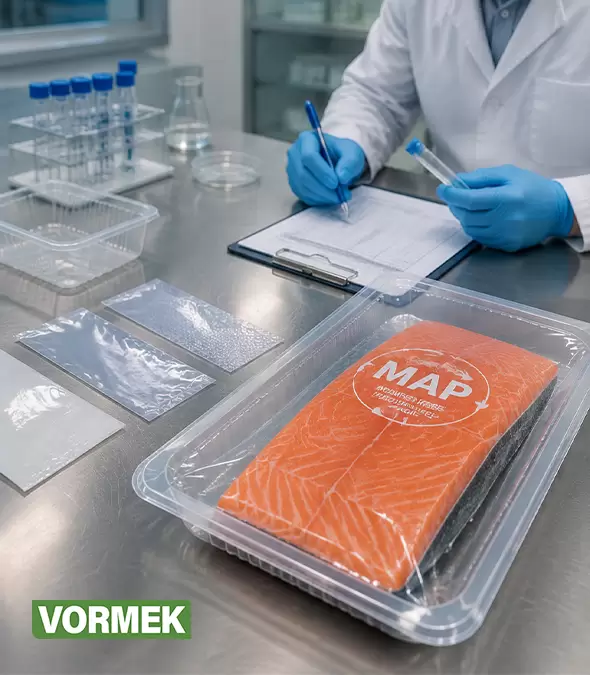
Modified Atmosphere Packaging for Fresh Fish
MAP can help control spoilage in chilled seafood when the gas mixture, package design and storage conditions are properly validated.
Carbon dioxide is commonly used because it can inhibit the growth of many spoilage microorganisms. Nitrogen may be used as an inert balance gas and can help maintain package volume.
However, copying a gas mixture from another seafood product is a mistake.
The appropriate atmosphere depends on factors such as:
- seafood species;
- fat content;
- product weight;
- package headspace;
- storage temperature;
- film permeability;
- initial microbial quality;
- required shelf life.
High carbon dioxide concentrations may also dissolve into seafood and package moisture, potentially contributing to package collapse or undesirable sensory changes. MAP settings should therefore be validated for the actual product and package.
Vacuum Packaging Fish
Vacuum packaging reduces oxygen inside the package and can help limit oxidation and the activity of aerobic spoilage microorganisms.
However, vacuum does not make seafood microbiologically safe by itself.
Reduced-oxygen packaged seafood requires particularly strict temperature and food-safety controls. Product characteristics, processing conditions, expected shelf life and applicable regulatory requirements must be assessed before adopting vacuum packaging.
The correct principle is:
Product requirements → Preservation objective → Packaging method → Film → Equipment → Validation
Choosing the machine first and trying to adapt every seafood product to it reverses this process and often leads to poor packaging performance.
How to Fix the Wrong Packaging Method
Before selecting a seafood packaging technology, define:
- product type and species;
- fresh, chilled, frozen, smoked or processed condition;
- product dimensions and weight;
- storage temperature;
- required shelf life;
- distribution conditions;
- retail presentation requirements;
- production capacity;
- food-safety requirements.
This information provides the technical basis for choosing between conventional sealing, MAP, vacuum, skin or thermoforming.
Mistake #2: Poor Seal Quality Control in Seafood Packaging
Seal integrity is one of the most important—and frequently underestimated—variables in seafood packaging.
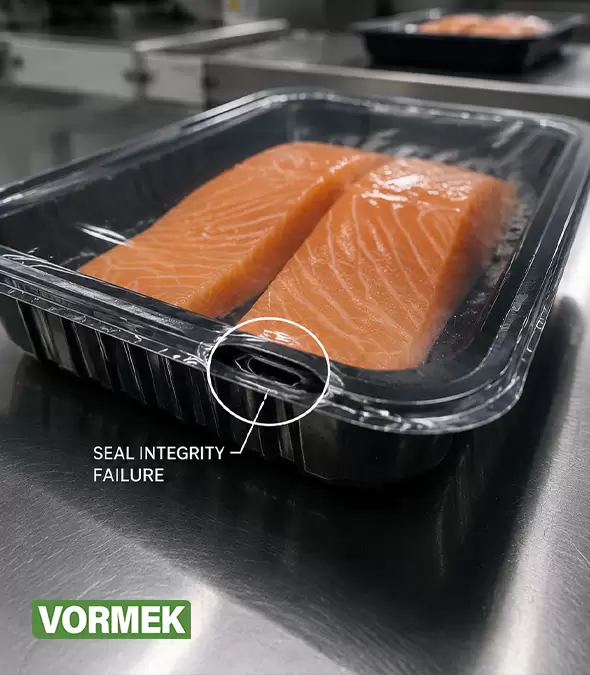
A package may leave the machine with the correct appearance and, in the case of MAP, the correct gas composition. But if the seal contains a microscopic channel or weak area, the protective conditions inside the package can gradually be lost.
Seafood makes sealing particularly challenging because moisture, fish oils, marinades, proteins and product particles can contaminate the tray flange.
What Causes Seafood Packaging Seal Failures?
Common causes include:
- moisture or oil on the sealing surface;
- product trapped in the flange;
- incorrect sealing temperature;
- insufficient pressure or dwell time;
- film wrinkles or poor tracking;
- damaged or distorted trays;
- uneven tooling pressure;
- worn sealing components;
- incompatible tray and lidding materials.
For MAP seafood, seal leakage is especially critical because gas exchange can change the atmosphere inside the package. Oxygen may enter while carbon dioxide escapes, reducing the effectiveness of the original MAP process.
A useful way to view MAP performance is:
Effective MAP = Correct Gas Mix + Low Residual O₂ + Suitable Film Barrier + Seal Integrity + Temperature Control
If one of these factors fails, the complete preservation system may underperform.
Why Increasing Seal Temperature Is Not Always the Solution
When leakage occurs, operators sometimes respond by simply increasing sealing temperature.
This can create new problems, including film distortion, tray deformation, excessive shrinkage or damage to the sealing layer.
Reliable heat sealing depends on a controlled combination of:
Temperature + Pressure + Dwell Time + Material Compatibility + Clean Seal Area
Rather than adjusting one parameter repeatedly, processors should establish a validated sealing window for each tray-and-film combination.
How to Improve Fish Packaging Seal Integrity
A seafood packaging quality-control programme should combine process monitoring with package testing.
| Parameter | What to Check | Main Risk |
|---|---|---|
| Seal temperature | Actual vs setpoint | Weak or overheated seals |
| Pressure | Uniformity | Incomplete bonding |
| Dwell time | Cycle consistency | Variable seal strength |
| Film tracking | Alignment and tension | Wrinkles and channels |
| Tray position | Correct alignment | Incomplete sealing |
| Seal flange | Moisture/product contamination | Leakage |
| MAP headspace | O₂/CO₂ levels | Incorrect atmosphere |
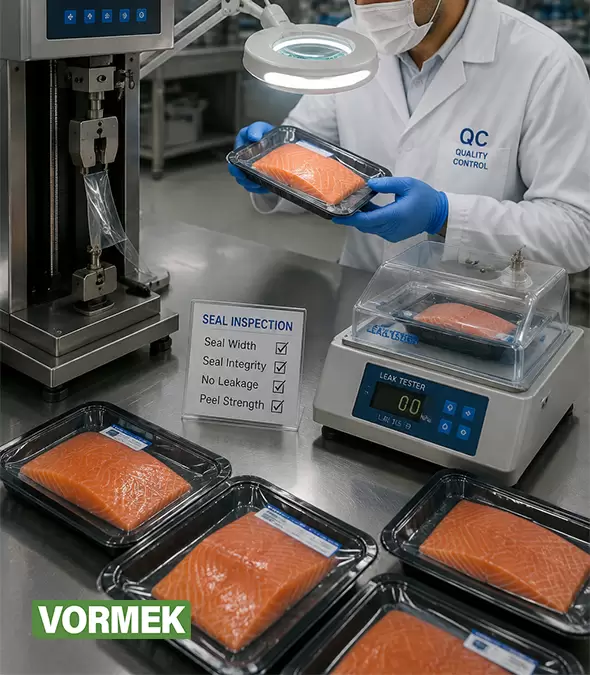
Depending on the package format and quality system, verification may include visual inspection, seal-strength testing, leak testing, burst testing, vacuum-decay testing or headspace gas analysis.
Processors should also control contamination before the tray reaches the sealing station. Correct product dosing, tray loading and product positioning can significantly reduce flange contamination.
For manufacturers evaluating automated tray sealing and MAP capabilities, the Smart Sealer product page provides an internal reference for equipment designed to deliver controlled sealing conditions in demanding food-packaging applications.
The key principle is straightforward: seal integrity should be measured and controlled as a process parameter—not judged by appearance alone.
Mistake #3: Ignoring Seafood Packaging Film Compatibility
Selecting the packaging machine and method correctly is only part of the process. The film must also be compatible with the product, tray, sealing system and required shelf life.
A common seafood packaging mistake is assuming that any food-grade lidding film will perform adequately. In practice, films differ considerably in oxygen transmission rate (OTR), water vapour transmission rate (WVTR), sealant chemistry, thickness, anti-fog properties, mechanical strength and temperature resistance.
For seafood products, these differences can directly influence package integrity, appearance and atmosphere stability.
Why Film Compatibility Matters in Fish Packaging
The packaging material forms the barrier between the seafood and the external environment. Its performance must therefore match the preservation method.
For example, a MAP package may initially contain the correct gas composition, but a film with unsuitable gas permeability can allow the internal atmosphere to change faster than expected.
Similarly, a high-barrier film provides little value if its sealing layer is incompatible with the tray material.
Film selection should consider:
- oxygen barrier requirements;
- water vapour barrier;
- carbon dioxide permeability;
- sealing-layer compatibility;
- sealing temperature range;
- puncture resistance;
- product geometry;
- anti-fog performance;
- storage temperature;
- expected shelf life.
The objective is not simply to choose the film with the highest barrier. It is to select a structure that performs correctly within the complete packaging system.
Film Barrier Requirements for MAP Seafood
Barrier performance is particularly important in Modified Atmosphere Packaging.
After gas flushing, the atmosphere inside the package is not necessarily static. Gases can interact with the product, dissolve into product moisture and move through the packaging material over time.
This means the atmosphere measured immediately after sealing may differ from the atmosphere measured several days later.
For this reason, film specifications should be evaluated together with:
Initial gas composition → Product gas absorption → Film permeability → Seal integrity → Storage temperature → Atmosphere over shelf life
OTR values should also be interpreted under the specified test conditions. Comparing two films solely by an OTR number without checking temperature, relative humidity and test method can lead to incorrect conclusions.
Anti-Fog Film for Fresh Seafood Packaging
Condensation is another practical issue in chilled seafood packaging.
Moisture can accumulate on the inner surface of the lidding film as temperature and humidity conditions change. Although this does not automatically indicate package failure, heavy fogging can reduce product visibility and negatively affect retail presentation.
Anti-fog films are therefore useful for many chilled seafood applications.
However, anti-fog performance should not be evaluated only immediately after packaging. It should be tested under realistic refrigerated storage and distribution conditions.
Tray and Film Seal Compatibility
The sealant layer of the film must be compatible with the sealing surface of the tray.
Different trays may use structures based on PP, PET or other polymer combinations, and films must be selected accordingly. A mismatch can result in:
- weak seals;
- inconsistent peel behaviour;
- excessive sealing temperatures;
- film tearing;
- channel leaks;
- package failure during transport.
A film that performs successfully on one tray should not automatically be approved for another tray simply because their dimensions are identical.
How to Fix Film Compatibility Problems
Before approving a packaging film, conduct trials using the actual:
- seafood product;
- tray;
- lidding film;
- packaging machine;
- sealing parameters;
- gas mixture, if applicable;
- storage temperature.
Evaluation should continue throughout the intended shelf-life period rather than ending immediately after packaging.
Key observations can include seal strength, leakage, condensation, pack appearance, headspace gas evolution, product quality and mechanical performance.
A successful film specification is therefore not simply a purchasing decision. It is a validated combination of product, material and process conditions.
Mistake #4: Using Undersized or Oversized Seafood Packaging Equipment
Packaging equipment should be sized according to the real production requirement—not simply according to the highest theoretical machine speed available.
Both undersized and oversized systems can create operational problems.
An undersized seafood packaging machine can become a production bottleneck, while an unnecessarily large system may increase investment, footprint, utilities and maintenance requirements without providing a meaningful production advantage.
What Happens When Packaging Equipment Is Undersized?
If upstream processing continuously produces more seafood than the packaging line can handle, product can accumulate before packaging.
This can lead to:
- increased waiting time;
- additional product handling;
- higher labour requirements;
- disrupted production flow;
- temperature-management challenges;
- pressure on operators to increase cycle speed;
- inconsistent package quality.
For chilled seafood, delays are particularly undesirable because time and temperature are closely linked to product quality and microbiological control.
Packaging capacity should therefore be evaluated as part of the entire production flow rather than as an isolated machine specification.
Why Oversized Packaging Machines Can Also Be a Mistake
Purchasing significantly more capacity than required may appear to provide future flexibility, but it can also reduce economic efficiency.
Potential consequences include:
- unnecessarily high capital expenditure;
- larger floor-space requirements;
- greater utility demand;
- more expensive tooling;
- increased maintenance complexity;
- poor equipment utilisation.
The best machine is not necessarily the fastest machine. It is the system that can reliably handle current production while providing reasonable capacity for expected growth.
Do Not Compare Machines by Packs per Minute Alone
Published throughput figures can be misleading when comparing seafood packaging equipment.
Actual production capacity depends on variables such as:
- tray dimensions;
- number of cavities per cycle;
- loading method;
- sealing-only or MAP operation;
- vacuum and gas-flushing requirements;
- product handling;
- film indexing;
- discharge configuration;
- changeover frequency.
For example, a machine capable of a high cycle rate during seal-only operation may achieve a different output when vacuum and gas replacement are introduced.
A more useful calculation is:
Effective Output = Packs per Cycle × Actual Cycles per Minute × Production Efficiency
If a machine produces four trays per cycle at six effective cycles per minute, its theoretical output is:
4 × 6 = 24 packs/minute
But theoretical output is not the same as sustained production output.
Calculate Required Capacity from Daily Production
Machine sizing should begin with the production target.
For example, assume a processor needs to package 9,600 trays during an 8-hour shift.
The basic average requirement is:
9,600 ÷ 480 minutes = 20 packs/minute
Selecting equipment rated at exactly 20 packs/minute would leave virtually no capacity for normal interruptions.
Real production includes:
- film changes;
- product changeovers;
- sanitation;
- minor stoppages;
- quality checks;
- tray-loading variation.
Capacity planning should therefore include an appropriate operating margin based on the actual production environment.
Packaging Machine Capacity Example
| Production Variable | Example |
|---|---|
| Daily target | 9,600 packs |
| Available shift time | 480 min |
| Average required output | 20 packs/min |
| Estimated operating efficiency | 80% |
| Required nominal capacity | 25 packs/min |
Required nominal capacity = 20 ÷ 0.80 = 25 packs/minute
This simple calculation helps prevent one of the most common equipment-selection errors: choosing a machine based only on ideal catalogue output.
Consider Future Growth Without Excessive Oversizing
Capacity planning should also account for realistic growth.
If production is expected to increase, the packaging system should provide sufficient flexibility for additional volume, tray formats or automation. However, future capacity should be based on credible forecasts rather than an undefined possibility of expansion.
Processors should evaluate:
Current Volume → Peak Demand → Operating Efficiency → Expected Growth → Required Capacity
Other factors such as available floor space, labour, utilities, upstream capacity and downstream handling should be included before the final equipment decision.
For seafood manufacturers, the correct equipment size is the point where capacity, packaging quality, flexibility and total operating cost are balanced.
A well-sized packaging line should not merely achieve the required output on paper. It should maintain that output consistently while preserving seal integrity, temperature control and product quality under real production conditions.
How to Audit Your Current Seafood & Fish Packaging Line
Correcting seafood packaging problems should begin with a structured line audit rather than isolated adjustments to machine settings. The objective is to identify where product requirements, packaging materials, process parameters and equipment performance are no longer aligned.
A useful audit should follow the product from arrival at the packaging area through sealing, inspection, secondary handling and refrigerated or frozen storage.
Step 1: Review Product and Shelf-Life Requirements
Start by confirming whether the current packaging specification still matches the product.
Review:
- seafood species and product format;
- fresh, chilled, frozen, smoked or processed condition;
- target shelf life;
- storage temperature;
- distribution time;
- package size and product weight;
- current spoilage or quality complaints.
If several seafood products are packaged on the same line, evaluate each one separately. A packaging specification validated for one fish species or product format should not automatically be applied to another.
Shelf-life assessment should consider microbiological, sensory and physicochemical quality as appropriate to the product. Packaging performance should always be evaluated together with validated temperature control and food-safety procedures.
Step 2: Check Seal Integrity and Reject Patterns
Review packaging rejects and identify recurring failure modes.
Instead of recording every rejected pack simply as “seal failure”, classify the actual defect:
Leak → Wrinkle → Contaminated Flange → Weak Seal → Tray Damage → Film Misalignment
This makes recurring problems easier to trace.
For example, frequent contamination on one side of the tray may indicate a loading or dosing problem rather than a sealing-machine fault.
Seal parameters should also be compared with the validated operating window for the specific tray and film combination.
Step 3: Verify Film and Tray Specifications
Confirm that the material currently being supplied matches the approved packaging specification.
Check:
- film structure and thickness;
- OTR and WVTR where relevant;
- sealant layer;
- tray material;
- anti-fog properties;
- storage-temperature suitability;
- mechanical resistance;
- supplier specification.
Material substitutions should be validated before routine production. Two films that appear visually identical may behave differently during sealing or refrigerated storage.
For MAP applications, package integrity and barrier performance should also be evaluated throughout the intended shelf life—not only immediately after sealing.
Step 4: Audit MAP Performance
Where Modified Atmosphere Packaging is used, measure rather than assume atmosphere performance.
Headspace gas analysis can be performed at defined intervals, for example:
Day 0 → Early Storage → Mid-Shelf Life → End of Validated Shelf Life
The exact sampling schedule should be defined according to the product and validation programme.
Unexpected changes in O₂ or CO₂ may indicate several possible causes, including leakage, film permeability, gas absorption by the product or inconsistent gas replacement.
The initial gas reading alone therefore provides only part of the picture.
Step 5: Compare Actual and Required Packaging Capacity
Measure sustained production output during normal operation rather than relying exclusively on nominal machine speed.
Record:
- packs per minute;
- cycles per minute;
- cavities used per cycle;
- changeover time;
- film-change downtime;
- sanitation downtime;
- minor stoppages;
- reject percentage.
Then compare the result with current and expected production demand.
A machine can have sufficient theoretical capacity while still becoming a bottleneck because of frequent stops, slow loading or long format changes.
Step 6: Evaluate the Complete Packaging Process
The packaging machine should not be audited in isolation.
Examine the complete flow:
Product Preparation → Tray Loading → Packaging → Inspection → Coding/Labelling → Secondary Packaging → Cold Storage
A bottleneck before or after the sealer can reduce overall line efficiency even when the packaging machine itself is operating correctly.
This is particularly important for seafood, where unnecessary waiting and handling can make temperature management more difficult.
Seafood Packaging Line Audit Checklist
| Audit Area | Key Question | Warning Sign |
|---|---|---|
| Packaging Method | Does it suit the product? | Repeated shelf-life problems |
| Seal Integrity | Are seals consistently reliable? | Leaks or weak seals |
| Film & Tray | Are materials compatible? | Wrinkles or inconsistent peeling |
| MAP Process | Is atmosphere maintained? | Unexpected O₂/CO₂ changes |
| Capacity | Can output meet demand? | Product accumulation |
| Temperature | Is the cold chain controlled? | Temperature excursions |
| Rejects | Are defects classified? | High unexplained waste |
| Changeovers | Are they efficient? | Excessive downtime |
Seafood Packaging Performance: Where Problems Usually Start
A packaging problem visible at the end of the line may originate much earlier in the process.
The following diagnostic flow can help manufacturers investigate failures systematically:
Short Shelf Life
↓
Check Storage Temperature & Product Quality
↓
Check Packaging Method
↓
Check Seal Integrity
↓
Check Film Barrier & Compatibility
↓
Check MAP/Vacuum Parameters
↓
Review Equipment and Process Consistency
This sequence is important because changing machine parameters before identifying the real cause can hide rather than solve the problem.
For example, increasing seal temperature will not correct poor shelf life caused by an unsuitable film barrier. Increasing gas flushing will not solve a leaking seal. Purchasing a faster machine will not eliminate a bottleneck caused by inefficient tray loading.
The most effective seafood packaging improvements therefore come from treating the line as an integrated preservation and production system.
Key KPIs for Seafood Packaging Lines
Processors can track a small number of indicators to identify deterioration in packaging performance:
| KPI | What It Reveals |
|---|---|
| Packaging reject rate | Overall process consistency |
| Seal-failure rate | Sealing performance |
| Residual O₂ in MAP packs | Gas replacement consistency |
| Packs per minute | Effective throughput |
| Unplanned downtime | Equipment reliability |
| Changeover time | Production flexibility |
| Shelf-life failures | Overall packaging effectiveness |
These indicators should be reviewed as trends rather than isolated measurements.
A gradual increase in seal rejects, for example, may indicate tooling wear, material variation or process drift before a major failure occurs.
From Packaging Audit to Corrective Action
Once the audit identifies the likely source of failure, corrective actions should be prioritised according to their effect on food safety, product quality, waste and production efficiency.
A practical sequence is:
Identify → Measure → Find Root Cause → Correct → Validate → Monitor
This final validation step is essential.
Changing the film, gas composition, sealing parameters or machine configuration does not automatically mean the problem has been solved. The revised process should be tested under realistic production, storage and distribution conditions.
For manufacturers reviewing a complete seafood packaging operation, the Seafood & Fish industry landing page can provide an internal pathway to relevant packaging technologies, while the Smart Sealer product page can support further evaluation where automated tray sealing and MAP are required.
Ultimately, a successful seafood packaging line is not defined by machine speed alone. It is defined by its ability to repeatedly produce safe, properly sealed and commercially acceptable packages at the required output throughout the validated shelf life.
Conclusion: How to Avoid Seafood & Fish Packaging Mistakes
Effective seafood packaging depends on much more than selecting a fast machine or a high-barrier film. Product characteristics, preservation method, packaging materials, seal integrity, equipment capacity and temperature control must function as one validated system.
The four mistakes discussed in this guide are closely connected:
- Choosing the wrong packaging method can create unsuitable conditions for the seafood product.
- Poor seal quality control can compromise package integrity and, in MAP applications, allow the protective atmosphere to change prematurely.
- Ignoring film compatibility can cause leakage, poor appearance or inadequate barrier performance.
- Incorrect equipment sizing can create bottlenecks, unnecessary investment or inconsistent production.
For seafood processors experiencing short shelf life, excessive rejects or inconsistent package quality, the best approach is not to change individual machine settings at random. Audit the complete process, identify the root cause, implement a controlled corrective action and validate the result under realistic production and storage conditions.
For processors planning a new line or upgrading an existing one, the Seafood & Fish industry landing page provides further information on packaging solutions for seafood applications. Where automated tray sealing and Modified Atmosphere Packaging are required, the Smart Sealer product page can also be used to evaluate an appropriate equipment configuration.
The objective is not simply to produce a sealed package. It is to create a repeatable packaging process that protects seafood quality, supports the validated shelf life, reduces unnecessary waste and delivers the required production capacity.
Frequently Asked Questions About Seafood & Fish Packaging
What is the best packaging method for fresh fish?
There is no single best packaging method for every fresh fish product. Tray sealing, Modified Atmosphere Packaging (MAP), vacuum packaging and skin packaging can all be suitable depending on the species, product format, storage temperature, target shelf life and distribution conditions.
The packaging method should therefore be selected after evaluating the product rather than simply using whichever packaging machine is already available.
What are the most common seafood packaging mistakes?
Four common seafood packaging mistakes are choosing an unsuitable packaging method, failing to control seal integrity, using incompatible packaging films and selecting equipment that does not match actual production capacity.
Poor temperature control, incorrect MAP parameters and contaminated sealing surfaces can create additional problems.
Does Modified Atmosphere Packaging extend fish shelf life?
MAP can help extend the commercial shelf life of certain chilled seafood products when the gas composition, packaging material, seal integrity and storage temperature are properly controlled.
However, shelf-life extension cannot be predicted from the gas mixture alone. Species, initial microbial quality, processing conditions, package design and cold-chain performance must also be considered.
Shelf-life claims should therefore be supported by product-specific validation.
Which gases are used in MAP packaging for seafood?
Carbon dioxide is commonly used in seafood MAP because it can inhibit many spoilage microorganisms. Nitrogen may be used as an inert balance gas and can help maintain package volume.
The appropriate gas composition depends on the seafood product, package geometry, product-to-gas ratio, film properties, storage conditions and required shelf life. Gas mixtures should be validated for the specific application rather than applied as a universal formula.
Why do seafood tray seals leak?
Seafood tray seals may leak because of moisture, fish oil, marinade or product particles on the sealing flange. Other causes include incorrect temperature, pressure or dwell time, film wrinkles, tray deformation, poor alignment and incompatible tray-and-film materials.
Seal failures should be investigated systematically rather than corrected by automatically increasing sealing temperature.
What type of packaging film is best for fish?
The appropriate fish packaging film depends on the packaging method and product requirements. Important properties may include oxygen transmission rate, water vapour barrier, carbon dioxide permeability, sealant compatibility, puncture resistance, anti-fog performance and low-temperature behaviour.
For MAP seafood, film permeability should be considered together with the required atmosphere throughout the validated shelf life.
Why is anti-fog film used in seafood packaging?
Chilled seafood can create humid conditions inside the package, allowing condensation to form on the lidding film. Anti-fog technology helps reduce visible droplets and maintain product visibility.
Anti-fog performance should be tested under realistic refrigerated storage conditions because temperature changes and humidity can affect its effectiveness.
How can manufacturers improve seafood packaging seal integrity?
Manufacturers should control sealing temperature, pressure and dwell time while keeping tray flanges clean and correctly positioned. Film tracking, tray quality and material compatibility should also be monitored.
Routine seal verification—using appropriate leak, strength or integrity tests—can identify process drift before it causes significant product waste.
How do you choose the right seafood packaging machine capacity?
Start with the required production volume and available operating time, then account for realistic operating efficiency, changeovers, cleaning, film replacement and minor stoppages.
For example, if the line must average 20 packs per minute and expected operating efficiency is 80%, nominal equipment capacity should be approximately:
20 ÷ 0.80 = 25 packs per minute
Machine selection should also consider future growth, tray formats, MAP cycle requirements, loading systems and upstream and downstream capacity.
How often should a seafood packaging line be audited?
There is no universal audit interval suitable for every facility. Frequency should be defined through the processor’s quality and food-safety system according to product risk, production volume, packaging complexity, historical performance and applicable requirements.
Additional reviews are particularly important after changes to packaging materials, tray suppliers, gas specifications, sealing parameters, equipment configuration or product format.
Final Seafood Packaging Checklist
Before approving a seafood packaging process for routine production, confirm that:
- the packaging method matches the specific seafood product;
- the required shelf life has been validated;
- tray and film structures are compatible;
- seal parameters operate within a validated process window;
- seal integrity is routinely verified;
- MAP composition is measured where applicable;
- packaging capacity matches actual production requirements;
- temperature is controlled throughout processing, storage and distribution;
- rejects and downtime are recorded by cause;
- significant process or material changes are revalidated.
When these factors are managed together, seafood packaging becomes more than a final production step. It becomes a controlled preservation system capable of supporting product quality, operational efficiency and consistent market performance.