Introduction
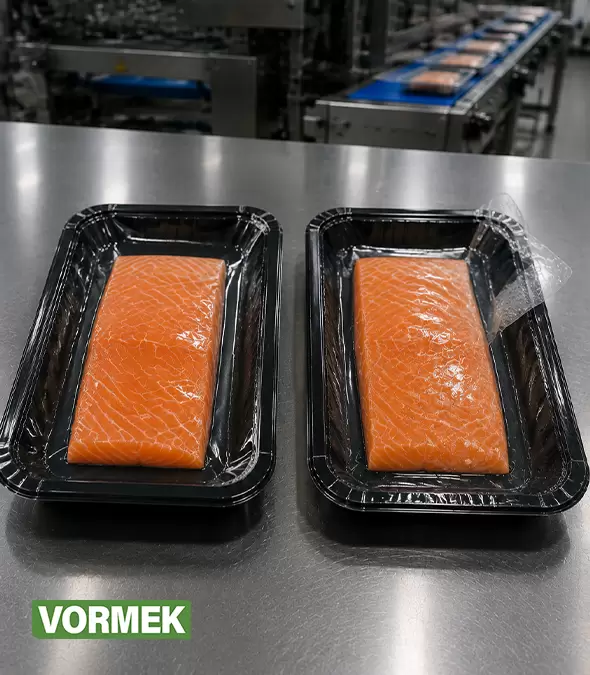
Seal failure is a critical problem in seafood and fish packaging. A package may look acceptable immediately after sealing but develop a leak during cold storage, handling or distribution. Other defects are visible at once, including open corners, wrinkles, film lifting from the tray flange and incomplete seals.
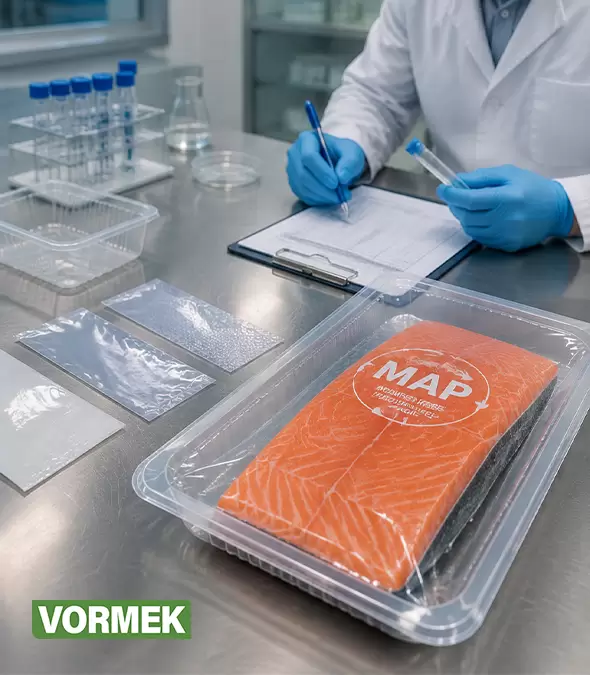
For seafood processors, poor seal integrity can increase product leakage, rejects and food waste. In modified atmosphere packaging (MAP), even a small leak can also allow the internal gas composition to change during storage, undermining the intended packaging conditions.
Seafood presents a demanding sealing environment. Water, fish oils, purge, marinades, ice and product fragments can contaminate tray flanges, while refrigerated trays and humid processing environments can encourage condensation. Seal performance also depends on the compatibility of the tray and film and on controlled temperature, dwell time and pressure.
Troubleshooting should therefore focus on the complete packaging process rather than treating every leak as a machine problem.
This guide explains how to identify common seafood packaging seal problems, diagnose product and film interference, optimise sealing parameters and prevent recurring failures.
Processors evaluating complete packaging solutions can also explore the Seafood & Fish industry landing page. For tray-sealing and MAP applications, the Smart Sealer product page provides further information on an appropriate equipment platform.
Common Causes of Weak or Leaking Seals in Seafood Packaging
Weak or leaking seals usually result from one or more problems involving the product, packaging materials, machine settings or sealing system.
Common causes include:
- moisture, oil or product on the tray flange;
- incorrect sealing temperature;
- insufficient or excessive dwell time;
- inadequate or uneven pressure;
- incompatible tray and lidding film;
- film wrinkles or poor tracking;
- worn or contaminated tooling;
- distorted trays;
- condensation;
- product extending into the sealing zone.
The first troubleshooting step should be to identify the pattern of failure.
How to Diagnose Different Seafood Seal Failures
The position and appearance of a defect often provide clues to its cause.
| Seal Problem | Likely Cause | First Check |
|---|---|---|
| Entire perimeter is weak | Temperature, dwell, pressure or materials | Verify validated recipe |
| Same corner leaks repeatedly | Tooling, alignment or local pressure | Inspect that tool area |
| Random leaks | Contamination or condensation | Inspect tray flanges |
| Film wrinkles | Tracking or tension | Check film feed |
| Film does not bond | Material incompatibility or low thermal input | Verify film/tray specification |
| Film sticks excessively | Excessive thermal input | Review temperature and dwell |
A defect repeatedly occurring in the same position often indicates a local mechanical or thermal problem. Random failures are more likely to involve changing conditions such as contamination, condensation, tray variation or film movement.
This distinction prevents unnecessary adjustments. Increasing the temperature of the entire sealing tool, for example, is unlikely to correct a leak caused by damaged tooling in one corner.
Why Seafood Packages Are Vulnerable to Seal Leaks
Seafood products can introduce contaminants directly into the sealing area.
Fresh fish may release purge, oily species can transfer lipids to the flange, and marinated products may introduce sauces or seasoning. Residual ice can melt during handling, while cold trays exposed to warmer humid air may develop condensation.
These contaminants can interrupt contact between the lidding film and tray, producing small leak channels that are not always visible.
The consequences are particularly important for MAP seafood packaging. Modified atmosphere packaging depends on maintaining a controlled atmosphere inside the package. If seal integrity is compromised, external gases can enter and internal gases can escape.
A good-looking package is therefore not necessarily a leak-free package.
Seal Strength vs Seal Integrity
Seal strength and seal integrity are related but different.
Seal strength describes the force required to separate the sealed materials under specified test conditions.
Seal integrity describes whether the package remains continuously closed without channels, pinholes or incomplete areas.
A strong seal can still contain a small channel leak. Conversely, maximum seal strength is not always desirable when the package requires controlled peelability.
The objective should be a seal that is continuous, repeatable and appropriate for the product, package and distribution conditions.
Why Increasing Sealing Temperature May Not Fix the Problem
A common reaction to a weak seal is to increase temperature. This may help when insufficient thermal input is genuinely the cause, but heat cannot solve every defect.
Seal formation depends on the interaction of:
Temperature × Dwell Time × Pressure × Material Compatibility × Surface Condition
If fish oil or moisture is trapped on the flange, additional heat may not create a reliable bond. If tooling is misaligned or a tray is distorted, the problem is mechanical.
Excessive heat can also cause film distortion, tray deformation, excessive bonding or poor peel behaviour.
Before changing temperature, determine whether the failure is thermal, mechanical, material-related or caused by contamination.
Film Contamination & Product Interference in Fish Packaging
Flange contamination is one of the most common causes of seafood tray seal failure.
During sealing, the lidding film must contact the tray’s sealing surface uniformly. Water, fish oil, purge, marinade, scales, seasoning or small product fragments between these surfaces can interrupt bond formation.
How Moisture and Fish Oil Cause Seal Failure
Moisture may reach the flange through wet seafood, melting ice, overfilling, condensation or product handling. Even a small contaminated area can create a leak pathway.
Fish oils and marinades can be particularly difficult because they may spread as a thin layer across the flange.
When clean trays seal correctly but packages containing seafood fail, product interference should therefore be investigated before machine settings are changed.
Use an Empty-Tray Test to Identify Product Interference
A simple controlled test can help isolate the problem.
Run several clean, empty trays using the normal lidding film and validated sealing recipe. Compare them with filled packages produced under normal conditions.
If empty trays consistently pass while filled trays leak, check:
- fill level and product position;
- moisture, purge or oil on the flange;
- condensation;
- operator handling;
- splash from filling equipment.
This test does not replace formal package-integrity testing, but it can quickly distinguish product-related interference from a basic machine or material problem.
Keep the Tray Flange Clear
The tray flange should be treated as a no-product zone.
During manual loading, wet seafood should not be dragged across the tray edge. Automated filling and transfer systems should minimise splash and position the product away from the sealing surface.
Tray dimensions should also match the product. If portions regularly extend onto the flange, changing the sealing parameters may only mask a packaging-design problem.
Condensation should also be investigated when failures are intermittent. If leak rates change with product temperature, room humidity or production interruptions, environmental conditions may be affecting flange cleanliness.
Controlling contamination at its source is usually more reliable than trying to compensate for it with additional sealing temperature.
Temperature & Dwell Time Settings for Seafood Packaging Seals
After contamination, tray positioning and material compatibility have been checked, the next step is to verify the sealing parameters. Temperature and dwell time are critical, but they must be evaluated together with pressure, product temperature and machine condition.
There is no universal sealing temperature for seafood packaging. PP, PET and other tray structures may require different conditions, while peelable, anti-fog and high-barrier MAP films can have different sealing windows.
The correct settings should therefore be based on packaging-material specifications and validated under actual production conditions.
What Is the Correct Sealing Temperature for Fish Packaging?
The correct temperature is not simply the highest setting at which the film bonds to the tray. The objective is to operate within a validated sealing window that consistently produces acceptable package integrity.
Insufficient temperature may cause:
- weak or incomplete seals;
- easy film separation;
- inconsistent peel strength;
- leakage during handling or storage.
Excessive temperature may cause:
- film distortion or shrinkage;
- tray flange deformation;
- excessive bonding;
- difficult or uneven peeling.
The target is repeatable seal performance, not maximum thermal input.
How Does Dwell Time Affect Seafood Tray Sealing?
Dwell time is the period during which sealing conditions are applied to form the bond.
If dwell time is too short, insufficient thermal energy may reach the sealing interface. This can become more noticeable with thicker films, cold trays or increased production speeds.
Excessive dwell, however, can reduce throughput and increase thermal exposure.
Temperature and dwell time should therefore be optimised together within a validated process window rather than adjusted randomly.
Why Sealing Pressure Matters
Heat and time alone cannot create a reliable seal if the film and tray do not make appropriate contact.
Uneven or insufficient pressure may result from:
- worn gaskets;
- tooling misalignment;
- pneumatic pressure variation;
- tray deformation;
- debris in the tooling;
- mechanical wear.
If the same section of consecutive packages remains weak, inspect the corresponding tooling area before increasing the overall sealing temperature.
Can Cold Seafood Affect Seal Quality?
Yes. Chilled seafood and cold trays can influence heat transfer at the sealing interface.
This does not mean the product should be warmed to improve sealing. Seafood must remain within its required temperature-control conditions. Instead, the packaging process should be validated using realistic product and tray temperatures.
A recipe developed with room-temperature empty trays may perform differently when used with chilled filled trays during commercial production.
Validation should therefore reflect actual conditions, including product temperature, tray temperature, film type, line speed and MAP cycle where applicable.
Why Seal Failures Can Increase at Higher Line Speeds
A package may seal correctly during slow trials but become inconsistent when production speed increases.
Higher throughput can affect effective dwell time, film movement, thermal recovery and tray positioning. This is why sealing performance should be verified at the intended commercial production rate.
If failures appear only at higher speed, identify which process variable becomes unstable rather than simply reducing speed or increasing temperature.
Use a Validated Recipe for Each Tray-Film Combination
Different seafood products and package formats may require different sealing conditions.
A controlled recipe should identify at least:
| Parameter | What to Verify |
|---|---|
| Tray | Material and specification |
| Film | Structure and sealant compatibility |
| Temperature | Validated setting or range |
| Dwell time | Validated setting or range |
| Pressure | Approved setting |
| Product temperature | Validated production condition |
| Packaging mode | Seal-only, vacuum or MAP |
| Line speed | Validated operating rate |
When a previously stable line develops problems immediately after a tray or film change, verify the new material specification before making extensive machine adjustments.
Troubleshooting MAP Seafood Seal Failures
Seal integrity is especially important in modified atmosphere packaging because the package must retain the intended atmosphere during storage.
When MAP seafood packages show seal failures or unexpected gas changes:
- Inspect the seal for contamination, wrinkles and incomplete areas.
- Compare filled packages with clean empty trays.
- Confirm tray-film compatibility.
- Verify temperature, dwell time and pressure.
- Inspect tooling if defects repeatedly occur in the same location.
- Perform the appropriate validated package-integrity test.
A correct initial gas composition cannot compensate for a leaking package.
Verify Seal Quality After Adjustments
Whenever a significant sealing parameter is changed, representative packages should be tested before normal production continues.
Depending on the packaging system and quality programme, verification may include visual inspection, seal-strength testing, leak testing, vacuum-based integrity testing or gas-composition monitoring for MAP packages.
Parameter changes and test results should also be documented. A controlled process history makes recurring seafood packaging seal problems much easier to diagnose and prevents operators from repeatedly relying on trial-and-error adjustments.
Preventive Steps for Consistent Seals in Seafood & Fish Packaging
Preventing seal failures is more efficient than correcting defective packages after production. Once the tray, film and sealing recipe have been validated, processors should focus on maintaining stable conditions throughout each shift.
A practical preventive programme should combine startup checks, sanitation, material control, equipment inspection and package-integrity verification.
How to Prevent Seafood Packaging Seal Leaks Before Startup
Before production begins, operators should confirm that:
- sealing surfaces are clean;
- tooling is correctly installed and aligned;
- gaskets show no visible damage;
- the correct tray and film are loaded;
- film tracking is stable;
- the correct recipe is selected;
- the machine has reached operating conditions;
- startup packages meet acceptance criteria.
These checks are particularly important after sanitation, maintenance, tooling changes or extended shutdowns.
Keep Sealing Tools Clean and Maintained
Fish proteins, oils, salt and marinades can accumulate around sealing components and affect heat transfer, pressure distribution or tray positioning.
Cleaning should follow the machine manufacturer’s instructions and the processor’s validated sanitation programme.
Maintenance teams should also inspect:
- gaskets for wear or deformation;
- sealing surfaces for damage;
- heaters and temperature sensors;
- tooling alignment;
- film guides and feed components;
- pneumatic and mechanical systems.
Recurring leaks in the same package position should trigger inspection of the corresponding tooling area.
Control Film Tracking and Tray Quality
Poor film tracking can create wrinkles or folds across the sealing flange. Operators should monitor film tension, lateral movement, roll unwinding and damaged film edges.
Tray quality is equally important. Warped trays or damaged flanges can prevent uniform sealing pressure.
If failures begin after changing a film roll or tray batch, verify the new material and setup before modifying the sealing recipe.
Prevent Overfilling and Flange Contamination
Product should remain clear of the sealing flange throughout loading and transport.
This is particularly important for irregular seafood portions, shellfish, marinated products and seafood in sauce. Automated filling systems should minimise splash, while manual-loading procedures should treat the flange as a no-product zone.
If the product repeatedly reaches the flange, tray geometry or portion configuration may need to be reconsidered.
Establish Routine Package Integrity Checks
Visual inspection alone may not identify small channels or microleaks.
Depending on the package and quality system, verification may include:
- seal-strength or peel testing;
- leak detection;
- pressure or vacuum-based integrity testing;
- gas-composition monitoring for MAP packages.
Additional checks should be considered after startup, material changes, maintenance, recipe adjustments or unexpected increases in rejects.
For MAP seafood, gas analysis and package-integrity testing should complement each other. Correct gas concentration immediately after packaging does not prove that the package will retain its atmosphere throughout storage.
Track Seal Failure Patterns
Recording where and when defects occur can reveal recurring problems.
| Defect Pattern | Priority Check |
|---|---|
| Same corner repeatedly leaks | Tooling, alignment and pressure |
| Random leaks | Contamination and condensation |
| Failures after film change | Film specification and tracking |
| Failures after tray change | Tray geometry and compatibility |
| More leaks with wet products | Flange cleanliness |
| Failures at higher speed | Process stability and dwell time |
This type of trend analysis can identify deterioration before reject rates become significant.
Daily and Planned Seal Prevention Checklist
A simple inspection schedule can improve process consistency:
Before production: verify tray, film, recipe, tooling cleanliness and startup seal quality.
During production: monitor contamination, film tracking and reject patterns.
After changeovers: confirm the new recipe and inspect representative packages.
Daily: clean relevant sealing areas and inspect accessible components.
Planned maintenance: inspect tooling, heaters, sensors, alignment, gaskets and mechanical or pneumatic systems according to the equipment manufacturer’s recommendations.
Seafood lines operating continuously in wet environments may require more frequent inspection.
Standardise Product Changeovers
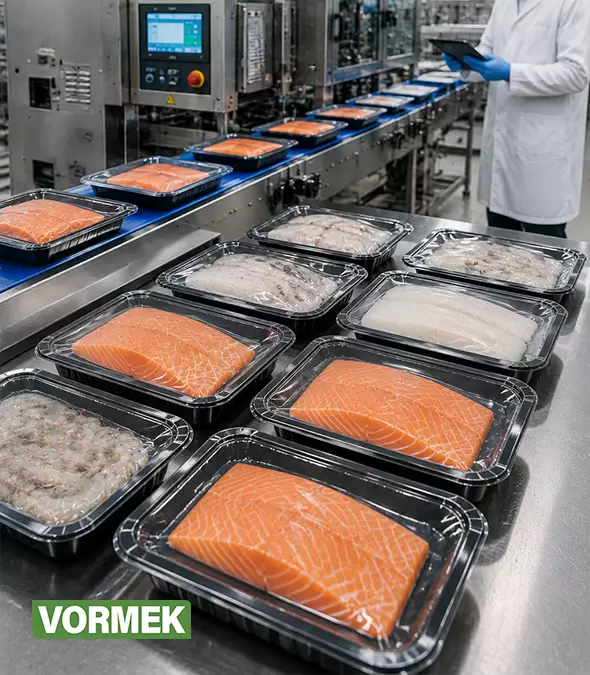
When several seafood SKUs run on one machine, changeovers should verify the correct tooling, tray, film, sealing recipe and MAP settings where applicable.
Startup packages should then be checked against defined acceptance criteria before full production resumes.
Processors evaluating packaging systems for multiple seafood applications can explore the Seafood & Fish industry landing page. The Smart Sealer product page can also provide additional information for controlled tray-sealing and MAP applications.
Train Operators to Diagnose Seal Problems
Operators should learn to interpret defect patterns rather than responding to every leak by increasing temperature.
A useful rule is:
Same-location defect → inspect tooling and pressure.
Random defect → inspect contamination, materials and film handling.
Weak entire perimeter → verify materials and sealing parameters.
This simple diagnostic discipline reduces uncontrolled machine adjustments and improves consistency between shifts.
Five Rules for Consistent Seafood Packaging Seals
A reliable preventive strategy can be summarised in five rules:
- Control materials: use validated tray-film combinations.
- Control contamination: keep seafood and moisture away from the flange.
- Control parameters: maintain validated temperature, dwell and pressure.
- Maintain equipment: inspect tooling and sealing components.
- Verify results: test package integrity and track recurring defects.
A successful seafood packaging line is not simply the fastest line. It is one that consistently produces packages meeting defined seal-integrity requirements at the required commercial throughput.
Conclusion: Solving Seafood & Fish Packaging Seal Problems
Seal failures in seafood packaging can result from contamination, incompatible materials, incorrect temperature or dwell time, uneven pressure, film-tracking problems, tray deformation or worn tooling.
The most effective troubleshooting method is systematic. Start with the location and pattern of the defect. Repeated leaks in one area often indicate a local tooling or pressure problem, while random leaks are more likely to involve contamination, condensation or material variation.
Next, verify tray-film compatibility and compare clean empty trays with filled packages. This helps separate machine and material problems from product interference. Only then should temperature, dwell time or pressure be adjusted within the validated process window.
For seafood processors, prevention is particularly important. Keeping tray flanges clean, controlling filling, maintaining tooling, using validated recipes and routinely checking package integrity can significantly reduce recurring failures.
The objective is not to produce the strongest possible seal. It is to create a consistent, validated and fit-for-purpose seal capable of maintaining package integrity throughout the intended storage and distribution period.
Frequently Asked Questions About Seafood Packaging Seal Problems
Why Do My Fish Packaging Trays Keep Leaking?
Common causes include moisture or product on the flange, incorrect sealing parameters, insufficient pressure, film wrinkles, damaged tooling, tray deformation and incompatible packaging materials.
If leaks repeatedly appear in the same location, inspect the corresponding tooling area. Random leaks are more likely to involve contamination or material variation.
What Is the Best Sealing Temperature for Seafood Trays?
There is no universal sealing temperature for seafood packaging. The correct setting depends on the tray material, film structure, sealant layer, dwell time and machine configuration.
The appropriate temperature should be established through a validated sealing window using the actual packaging materials and production conditions.
Can Moisture Cause Fish Packaging Seal Failure?
Yes. Water, purge and condensation on the tray flange can interfere with contact between the film and tray, potentially creating weak areas or leak channels.
Controlling flange contamination is therefore one of the most important preventive measures in seafood tray sealing.
Why Do Empty Trays Seal Correctly but Filled Trays Leak?
If clean empty trays seal consistently but filled packages fail, investigate product interference.
Possible causes include overfilling, seafood touching the flange, fish oil, marinade, purge or condensation. Cold filled trays may also behave differently from room-temperature empty trays.
Why Does a Seafood Tray Leak in the Same Corner?
Repeated leakage in one location often indicates a localised problem such as tooling misalignment, uneven pressure, damaged sealing components or tray deformation.
Inspect the corresponding area before changing the overall sealing temperature.
Why Do MAP Seafood Packages Lose Their Gas?
Unexpected gas changes can result from seal leakage, film damage or inadequate package barrier properties.
A correct initial MAP gas composition cannot compensate for poor package integrity. If gas levels change unexpectedly during storage, investigate both the seal and the complete packaging system.
Seafood Packaging Seal Troubleshooting Quick Reference
| Problem | Check First | Then Investigate |
|---|---|---|
| Entire seal is weak | Recipe and materials | Temperature, dwell and pressure |
| Same corner leaks | Tooling | Alignment and local pressure |
| Random leaks | Flange contamination | Condensation and materials |
| Film wrinkles | Film tracking | Tension and setup |
| Filled trays fail | Product interference | Moisture, oil and filling |
| MAP gas changes | Package integrity | Seal and material barrier |
For efficient troubleshooting, follow a controlled sequence:
Observe the defect → identify the probable cause → test one variable → make one corrective change → verify package integrity → document the result.
This approach reduces trial-and-error adjustments and helps seafood processors maintain consistent seal quality with fewer rejects and less unnecessary downtime.