Vacuum Packaging vs MAP for Seafood: Which Extends Freshness Longer?
Introduction
Choosing between vacuum packaging and modified atmosphere packaging (MAP) for seafood involves more than comparing two methods of reducing oxygen. Fresh fish and seafood are highly perishable, and packaging performance depends on microbial activity, oxidation, temperature, initial product quality, packaging materials and the atmosphere surrounding the food.
Vacuum packaging removes most of the air from the package before sealing, creating a reduced-oxygen environment. MAP deliberately modifies the atmosphere using gases such as carbon dioxide (CO₂) and nitrogen (N₂), with oxygen (O₂) used in specific applications where technically appropriate.
Both methods can support freshness and commercial shelf life, but neither is universally superior.
For seafood processors, the key question is:
Which packaging technology provides the best combination of shelf life, food quality, presentation, production efficiency and cost for a specific seafood product?
The answer differs between fresh fish fillets, fatty fish, shrimp, shellfish, smoked seafood and bulk products.
This guide compares vacuum packaging vs MAP for seafood, examining how each method works, their shelf-life potential, equipment and operating costs, and which technology may be more suitable for different seafood categories.
Food safety note: Vacuum and MAP are reduced-oxygen packaging technologies and must operate within a validated food-safety and cold-chain system. Neither packaging method replaces refrigeration, hygienic processing or appropriate regulatory controls.
How Vacuum Packaging Works
Vacuum packaging removes air from around the seafood before creating a hermetic seal. Since atmospheric air contains approximately 21% oxygen, this process substantially reduces the oxygen initially present inside the package.
A typical industrial vacuum cycle includes:
- Loading the seafood into the package
- Removing air
- Reaching the required vacuum level
- Sealing the package
- Returning the system to atmospheric pressure
The flexible packaging material then conforms closely to the product.
Why Is Vacuum Packaging Used for Seafood?
Vacuum packaging is widely used because reducing oxygen exposure can support both product preservation and packaging efficiency.
Depending on the seafood product, potential advantages include:
- Reduced oxygen exposure
- Slower selected oxidative reactions
- Lower moisture loss
- Protection from external contamination after sealing
- Compact storage and distribution
- Efficient packaging for bulk and foodservice formats
However, vacuum packaging does not sterilise seafood.
Reducing oxygen changes the microbial environment rather than eliminating microorganisms. Strict temperature control and a validated shelf-life programme therefore remain essential.
How Vacuum Packaging Affects Seafood Quality
The close contact between flexible film and seafood can be beneficial for compact packaging but may influence appearance and physical quality.
Potential considerations include:
- Product compression
- Changes in fillet shape
- Visible accumulation of drip
- Less conventional retail presentation
- Pressure on delicate seafood structures
For bulk seafood or products where compact packaging is desirable, these characteristics may be acceptable or advantageous.
For premium retail seafood, where shape and presentation are important, a rigid MAP tray may provide greater visual appeal.
Vacuum Packaging Film Requirements
Vacuum packaging requires flexible materials capable of maintaining a low-oxygen environment throughout the intended storage period.
Important properties include:
- Low oxygen transmission rate
- Appropriate water-vapour barrier
- Reliable heat sealing
- Mechanical strength
- Puncture resistance
- Compatibility with refrigerated storage
Puncture resistance is especially important for seafood containing bones, shells or hard edges.
Seal contamination from product liquids can also compromise vacuum retention. Film selection, seal-area cleanliness and sealing parameters should therefore be considered together.
How MAP Packaging Works
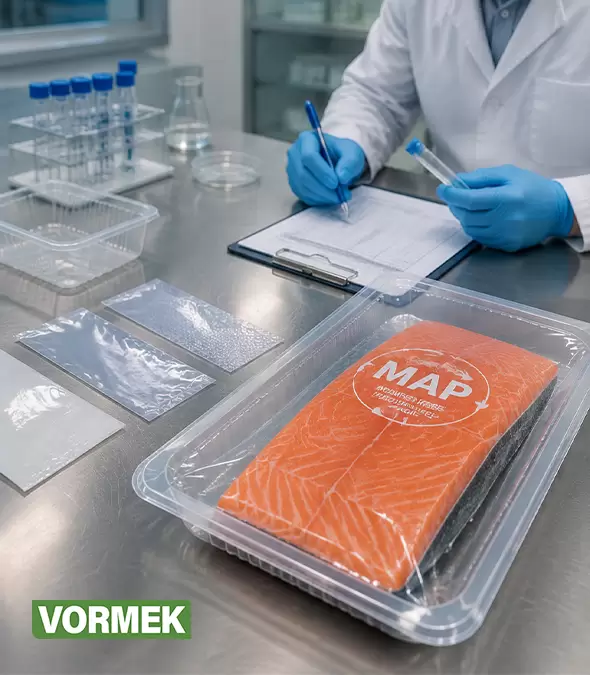
Modified atmosphere packaging changes the gas composition surrounding the seafood before the package is hermetically sealed.
Unlike conventional vacuum packaging, MAP usually maintains a headspace around the product. This allows seafood to be presented in rigid or semi-rigid trays without the packaging film compressing the product.
For many refrigerated seafood applications, MAP atmospheres are based primarily on controlled proportions of CO₂ and N₂.
What Does CO₂ Do in Seafood MAP?
Carbon dioxide is particularly valuable because it can inhibit several microorganisms associated with seafood spoilage.
Its effectiveness depends on:
- CO₂ concentration
- Seafood composition
- Storage temperature
- Initial microbial load
- Package headspace
- Gas-to-product ratio
- Packaging barrier properties
CO₂ can dissolve into the water and fat phases of seafood. This contributes to its antimicrobial action but can also reduce package headspace.
If atmosphere and headspace are poorly designed, excessive CO₂ absorption may contribute to pack collapse or changes in sensory quality.
For this reason, simply specifying a high CO₂ percentage does not guarantee better packaging performance.
What Is the Role of Nitrogen in Seafood MAP?
Nitrogen is relatively inert and is commonly used as a filler gas.
It can help:
- Displace oxygen
- Maintain package volume
- Balance CO₂ concentration
- Reduce excessive package collapse
The optimum balance between CO₂ and N₂ depends on the seafood product and required shelf life.
Is Oxygen Used in Seafood MAP?
Oxygen requirements are product-specific.
For many seafood applications, reducing oxygen is desirable, particularly where oxidative deterioration is a concern. However, the appropriate oxygen level depends on species, fat content, pigment chemistry, microbial considerations and the desired product characteristics.
Processors should therefore avoid applying one standard gas mixture to every fish and seafood product.
Packaging Materials for Seafood MAP
MAP performance depends on both the atmosphere and the packaging material.
| Packaging Property | Importance |
|---|---|
| Oxygen Barrier | Limits uncontrolled oxygen ingress |
| CO₂ Barrier | Helps maintain the designed atmosphere |
| Sealability | Supports hermetic package integrity |
| Water-Vapour Barrier | Assists moisture management |
| Anti-Fog Performance | Maintains retail visibility |
| Mechanical Strength | Protects packs during distribution |
A carefully selected gas mixture cannot perform effectively if the package leaks or the film allows excessive gas transmission.
The seafood, gas mixture, headspace, tray, film and sealing process should therefore be developed as one packaging system.
For processors evaluating retail-ready seafood packaging, Vormek Smart Sealer can support suitable flexible tray-sealing applications, while LuxPacker can be considered where greater automation and production capacity are required. Both should be configured according to product, tray format, atmosphere requirements and target throughput.
Shelf Life Comparison: Vacuum Packaging vs MAP for Seafood
For seafood processors, shelf life is often the decisive factor when comparing vacuum packaging vs MAP. Both technologies can slow quality deterioration compared with conventional aerobic packaging, but they achieve this through different mechanisms.
Vacuum packaging primarily reduces oxygen availability. MAP provides greater control over the internal atmosphere and can use elevated CO₂ concentrations to inhibit selected spoilage microorganisms.
For many fresh seafood applications, a properly designed MAP system can therefore provide greater shelf-life potential. However, MAP does not automatically outperform vacuum packaging for every species or product.
What Determines Seafood Shelf Life?
The commercial shelf life of packaged seafood depends on multiple interacting factors:
- Species and product type
- Freshness at packaging
- Initial microbial load
- Processing hygiene
- Fat content and composition
- Storage temperature
- Packaging atmosphere
- Residual oxygen
- Film barrier properties
- Seal integrity
Initial product quality is especially important. Packaging can slow deterioration, but it cannot restore freshness that has already been lost during harvesting, processing or handling.
This makes raw-material control and rapid refrigeration fundamental to both vacuum and MAP applications.
How Vacuum Packaging Affects Seafood Shelf Life
Vacuum packaging removes most of the initial air and creates a reduced-oxygen environment.
This can slow the growth of selected aerobic spoilage microorganisms and reduce oxygen-dependent deterioration. It can also help control oxidative changes in products sensitive to oxygen.
However, microorganisms capable of growing under reduced-oxygen conditions remain relevant. Vacuum packaging must therefore be combined with appropriate refrigeration and food-safety controls.
Shelf-life performance also depends on package integrity. A poor seal, punctured bag or unsuitable barrier film can allow oxygen to enter and reduce the expected preservation benefit.
How MAP Affects Seafood Shelf Life
MAP adds another preservation variable: the gas atmosphere can be designed specifically for the seafood product.
CO₂ is particularly important because it can inhibit several microorganisms associated with seafood spoilage. This can allow properly designed MAP systems to slow microbial deterioration more effectively than oxygen reduction alone.
However, increasing CO₂ concentration indefinitely does not produce proportional shelf-life gains.
Excessive CO₂ absorption may contribute to:
- Package-volume reduction
- Pack collapse
- Changes in drip behaviour
- Sensory changes in some products
The most effective atmosphere is therefore the one that provides sufficient microbial inhibition while maintaining acceptable product quality and package appearance.
Does MAP Keep Fish Fresh Longer Than Vacuum Packaging?
For many refrigerated fresh fish applications, MAP can provide greater shelf-life potential than conventional vacuum packaging, particularly where CO₂-sensitive spoilage microorganisms are an important limitation.
That does not mean MAP should automatically be selected.
A lean white-fish fillet, fatty fish, shrimp and smoked seafood have different preservation requirements. Vacuum packaging may remain the better choice where compact packaging, oxidation control, simpler operation or lower packaging costs are priorities.
The correct comparison should therefore be made using the actual seafood product under realistic storage conditions.
Why Fixed Shelf-Life Numbers Can Be Misleading
Statements such as “vacuum-packed fish lasts X days” or “MAP extends seafood shelf life to Y days” can be misleading without specifying the test conditions.
A product packaged immediately after processing and stored close to its optimum refrigeration temperature may perform very differently from the same species packaged later or exposed to temperature fluctuations.
Four variables are particularly important:
| Factor | Effect on Shelf-Life Performance |
|---|---|
| Initial Freshness | Determines the starting microbiological and sensory condition |
| Storage Temperature | Strongly influences microbial and biochemical deterioration |
| Packaging Atmosphere | Changes microbial and oxidative conditions |
| Package Integrity | Determines whether the designed environment is maintained |
For commercial production, shelf-life claims should therefore be based on validated product trials rather than generic industry figures.
Temperature Is Critical for Both Technologies
Neither vacuum packaging nor MAP replaces refrigeration.
Seafood remains highly temperature-sensitive after packaging. Temperature increases during processing, storage, transport or retail display can accelerate microbial growth and biochemical deterioration.
Cold-chain performance can therefore have as much practical importance as the packaging technology itself.
This is particularly relevant for export seafood, where the product may pass through several logistics stages before reaching retail.
Microbial Spoilage: Vacuum vs MAP
The main preservation difference between the technologies is how they modify the microbial environment.
Vacuum packaging primarily reduces oxygen and therefore restricts microorganisms that depend strongly on aerobic conditions.
MAP can combine reduced oxygen with elevated CO₂, providing an additional hurdle against selected spoilage organisms.
Neither process eliminates microorganisms.
A robust seafood preservation strategy still requires:
- High-quality raw material
- Hygienic processing
- Rapid temperature control
- Appropriate packaging
- Reliable sealing
- Controlled refrigerated distribution
This hurdle-based approach is more reliable than depending on packaging technology alone.
Lipid Oxidation in Fatty Fish
Shelf life is not determined exclusively by microbial growth.
Fatty fish can be particularly susceptible to lipid oxidation, which may produce undesirable odours and flavours even when microbial quality remains acceptable.
Low-oxygen vacuum packaging can provide strong oxidation control. MAP can also reduce oxidative deterioration when the atmosphere is appropriately designed.
This means that the MAP mixture providing the greatest microbial inhibition is not necessarily the atmosphere that delivers the best overall sensory shelf life for every fatty fish product.
Drip, Texture and Retail Appearance
Commercial shelf life also depends on whether the seafood remains attractive to the consumer.
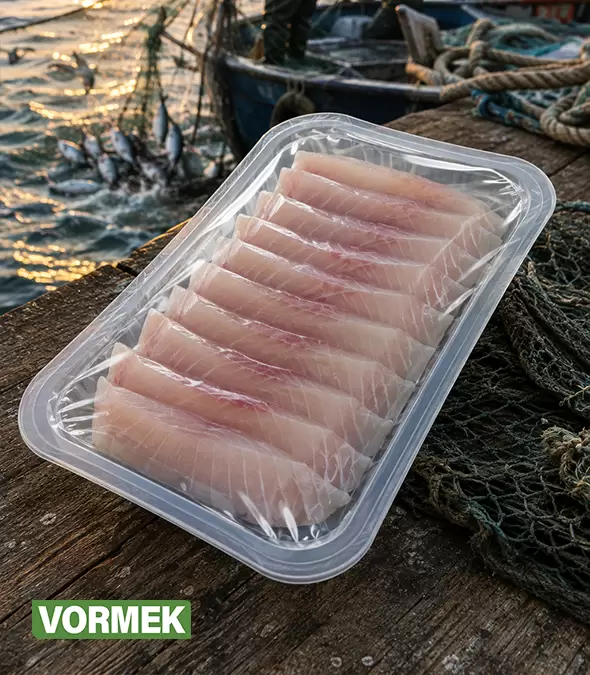
Vacuum film conforms closely to the product, which can influence fillet shape and make exudate more visible.
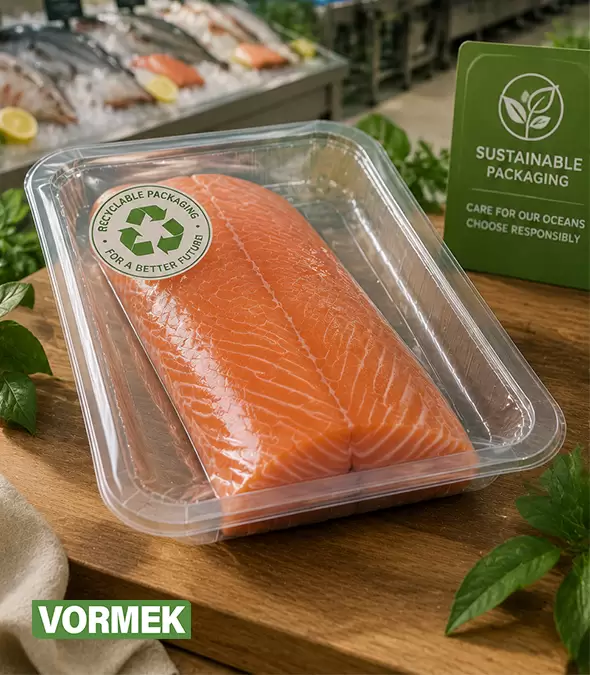
MAP tray packaging avoids direct film compression and can provide a cleaner retail presentation. Suitable tray systems may also incorporate absorbent materials to manage visible drip.
Processors evaluating shelf life should therefore assess more than microbiological results. Relevant quality parameters include:
- Odour and flavour
- Colour
- Texture
- Drip loss
- Product shape
- Package appearance
Vacuum vs MAP Shelf-Life Comparison
| Factor | Vacuum Packaging | MAP |
|---|---|---|
| Oxygen Reduction | High | Controllable |
| CO₂ Antimicrobial Effect | Limited | Deliberately controllable |
| Oxidation Control | Strong in low-oxygen packs | Strong when correctly formulated |
| Product Compression | Higher | Low in tray systems |
| Atmosphere Flexibility | Limited | High |
| Retail Presentation | Compact | Typically stronger |
| Shelf-Life Potential | Good for suitable products | Potentially higher for selected seafood |
| Cold Chain Required | Yes | Yes |
Overall, MAP often provides greater atmosphere control and can extend freshness longer for selected refrigerated seafood products, while vacuum packaging remains a highly effective option where simplicity, compact packaging and oxygen reduction are the main priorities.
The best method is the one that maintains microbiological, sensory and physical quality for the required commercial period under the processor’s actual cold-chain conditions.
Cost & Equipment Comparison: Vacuum Packaging vs MAP for Seafood
Comparing the cost of vacuum packaging and MAP requires more than looking at machine purchase price. Seafood processors should evaluate total cost of ownership (TCO), including equipment, packaging materials, protective gases, labour, energy, maintenance, throughput and potential product losses.
Vacuum packaging generally offers a simpler route to reduced-oxygen packaging, while MAP tray sealing requires additional atmosphere-control equipment and packaging components. MAP may therefore involve greater initial investment, but its potential advantages in shelf life, presentation and automation can justify the additional cost in suitable applications.
Vacuum Packaging Equipment for Seafood
A typical industrial vacuum-packaging system may include:
- Vacuum chamber or vacuum system
- Vacuum pump
- Sealing system
- Control system
- High-barrier vacuum bags or films
Seafood is loaded into a suitable package, air is removed and the package is hermetically sealed.
This relatively straightforward process can make vacuum packaging attractive for processors requiring flexible production, compact packs and efficient oxygen reduction.
Actual production capacity should nevertheless include loading, vacuum, sealing and unloading time rather than theoretical machine cycle speed alone.
MAP Packaging Equipment for Seafood
MAP tray sealing requires more components because the atmosphere surrounding the seafood must be controlled before sealing.
Depending on the line configuration, equipment may include:
- Tray-sealing machine
- Vacuum system for vacuum-gas applications
- Protective-gas supply
- Gas pressure and flow control
- MAP-compatible trays
- Barrier lidding film
- Sealing tooling
- PLC/HMI controls
Higher-capacity lines can also incorporate tray denesting, weighing, filling, coding, inspection and automatic discharge.
Vormek Smart Sealer can be considered for suitable seafood tray-sealing applications where flexibility is required. For processors seeking higher production capacity and greater automation, LuxPacker can be evaluated as part of an integrated packaging line.
Machine selection should be based on tray dimensions, atmosphere requirements, seafood characteristics and target throughput.
Initial Investment and Operating Costs
Vacuum packaging often requires a lower initial equipment investment than an automated MAP tray-sealing system.
However, machine price represents only one part of the cost.
MAP may involve recurring expenditure for:
- Protective gases
- Preformed trays
- Barrier lidding films
- Gas-control components
- Additional quality control
Vacuum packaging also has ongoing costs, including barrier bags or films, vacuum-pump operation, sealing components and labour.
The correct comparison therefore depends on the required production scale and value generated by the final package.
Packaging Material Costs
Vacuum systems commonly use flexible high-barrier bags or films, whereas MAP tray sealing generally requires a tray plus lidding film.
This can make the packaging-material cost of MAP higher per unit.
However, seafood processors should consider cost per saleable pack, not packaging-material cost alone.
A more expensive package may be commercially justified when it contributes to:
- Longer validated selling time
- Reduced product waste
- Improved physical protection
- Stronger retail presentation
- Access to premium market segments
- More consistent production
Because many seafood products have relatively high unit value, reducing avoidable product loss can have a substantial economic impact.
MAP Gas Consumption
Protective gas represents an additional operating cost for MAP.
Consumption depends on factors such as:
- Tray and headspace volume
- Gas composition
- Vacuum-gas or flushing method
- Production rate
- Machine configuration
Gas use should be optimised around the validated atmosphere rather than simply increasing flow.
An efficient MAP process achieves the required atmosphere consistently while avoiding unnecessary gas consumption.
Labour and Automation
Labour can significantly affect the economics of both packaging methods.
Conventional chamber vacuum systems may require operators to fill bags, position packages, run the cycle and remove finished packs.
MAP lines can support greater automation through integration of:
- Tray denesting
- Product loading
- Weighing
- Tray sealing
- Coding and inspection
- Automatic discharge
Automation can reduce manual handling, but its value extends beyond labour savings. It can also improve cycle consistency, throughput and process repeatability.
The appropriate automation level should reflect production volume and expected utilisation.
Throughput and Production Efficiency
Maximum machine speed should not be confused with effective line output.
A high-capacity tray sealer cannot achieve its potential if upstream weighing or loading cannot supply trays at the required rate.
When comparing equipment, seafood processors should evaluate:
- Packs per shift
- Product loading capacity
- Packaging cycle time
- Changeover requirements
- Cleaning time
- Labour availability
- Planned and unplanned downtime
This provides a more realistic basis for comparing vacuum and MAP production economics.
Maintenance and Downtime
Both systems require preventive maintenance.
Vacuum equipment requires attention to vacuum pumps, seals and sealing components. MAP tray sealers may add gas-control systems, tooling and automation that increase maintenance complexity.
For seafood processors, equipment reliability is particularly important because packaging downtime can leave highly perishable product waiting in production.
Serviceability, spare-parts availability and preventive-maintenance requirements should therefore be considered alongside purchase price.
Vacuum vs MAP Cost Comparison
| Cost Factor | Vacuum Packaging | MAP Tray Sealing |
|---|---|---|
| Initial Investment | Generally lower | Generally higher |
| Packaging Material | Barrier bag / flexible film | Tray + barrier lidding film |
| Protective Gas | Usually not required | Required |
| Automation Potential | Moderate to high | High |
| Maintenance Complexity | Generally lower | Higher |
| Retail Presentation | Functional and compact | Strong |
| Product Compression | Higher | Lower |
| Atmosphere Control | Limited | High |
| Scalability | Application-dependent | Strong for integrated lines |
Which Packaging Method Offers Better ROI?
There is no universal answer.
Vacuum packaging may provide better economics for processors prioritising lower initial investment, compact packages and operational simplicity.
MAP may generate greater value where longer validated shelf life, premium presentation, reduced product damage or higher automation improve the number and value of saleable packs.
A practical comparison can therefore use:
Packaging Cost per Saleable Pack = (Packaging Materials + Gas + Labour + Energy + Maintenance + Expected Product Loss) ÷ Saleable Packs Produced
This approach is more meaningful than comparing equipment prices alone.
Processors should also consider potential financial gains from reduced waste, increased production capacity, lower product giveaway, fewer rejected packages and access to higher-value retail channels.
For a broader evaluation of packaging options, the Vormek Seafood & Fish industry page can be used as an internal link to connect this comparison with seafood-specific tray sealing, MAP, vacuum and automation solutions.
Which to Choose Based on Product Type
The best choice between vacuum packaging and MAP for seafood depends on the product’s composition, physical characteristics, shelf-life target, distribution conditions and required presentation.
Fresh lean fish, fatty fish, shrimp, shellfish and smoked seafood should not automatically receive the same packaging specification. Each category presents different microbial, oxidative and physical challenges.
Fresh Fish Fillets: Vacuum or MAP?
Both technologies can be suitable for fresh fish fillets.
Vacuum packaging provides strong oxygen reduction and compact packs, making it useful where storage efficiency and close-contact packaging are acceptable.
MAP tray sealing may be preferred when processors require:
- Premium retail presentation
- Reduced product compression
- Controlled CO₂ exposure
- Clear product visibility
- Tray-based automated production
For premium fresh fillets, MAP often provides a presentation advantage because the product maintains its natural shape within the tray.
Where shelf-life extension is the main objective, both methods should be evaluated using the actual species under realistic refrigerated conditions.
Fatty Fish
Fatty fish require particular attention to lipid oxidation.
Reducing oxygen exposure can help limit oxidative deterioration, making both vacuum and appropriately designed low-oxygen MAP relevant options.
However, packaging decisions should balance microbial control with flavour, odour and oxidative stability. An atmosphere optimised exclusively for microbial inhibition may not necessarily provide the best overall sensory result.
Shrimp and Prawns
Packaging requirements for shrimp and prawns vary depending on whether the product is raw, cooked or otherwise processed.
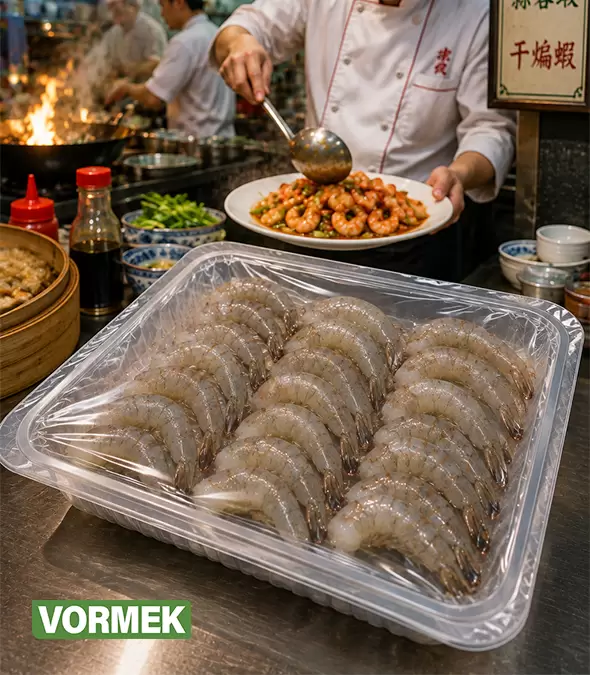
MAP tray sealing can provide strong retail presentation while avoiding excessive compression. Vacuum packaging may be suitable for bulk, foodservice and selected processing applications where compact packs are desirable.
For shell-on products, packaging materials must provide sufficient puncture resistance to maintain package integrity.
Shellfish
Shellfish packaging is highly product-specific because species, shell structure and processing conditions differ considerably.
Rigid trays can provide mechanical protection for products capable of puncturing flexible materials. MAP can also provide a controlled headspace where the process has been validated for the specific seafood.
A single gas mixture or shelf-life assumption should not be applied across all shellfish categories.
Smoked Seafood
Vacuum packaging is commonly used for smoked seafood because it provides compact packs and low oxygen exposure.
However, reduced-oxygen packaging of refrigerated smoked seafood requires rigorous food-safety controls. Product formulation, processing, refrigeration, shelf life and applicable regulations must all be considered.
MAP may also be suitable for selected smoked products where tray presentation or controlled atmosphere is required.
Vacuum vs MAP by Seafood Type
| Seafood Product | Vacuum | MAP | Main Decision Factor |
|---|---|---|---|
| Fresh Lean Fish | Suitable | Often highly suitable | Shelf life and presentation |
| Fatty Fish | Suitable | Suitable when validated | Oxidation and spoilage control |
| Shrimp / Prawns | Suitable | Strong retail option | Presentation and atmosphere |
| Shellfish | Product-dependent | Product-dependent | Species and package format |
| Smoked Seafood | Common | Possible | Food-safety validation |
| Bulk Seafood | Strong option | Less commonly required | Cost and packaging efficiency |
| Premium Retail Seafood | Possible | Strong option | Appearance and product protection |
Quick Decision: Vacuum or MAP?
Choose vacuum packaging when compact packaging, strong oxygen reduction, operational simplicity and lower packaging complexity are priorities, particularly when the seafood can tolerate close film contact.
Consider MAP when premium presentation, reduced compression, controlled CO₂ exposure, tray packaging or greater line automation are important.
Processors handling multiple seafood categories may benefit from using different technologies for different products rather than selecting one packaging method for the entire facility.
Vormek Smart Sealer can support suitable flexible tray-sealing applications, while LuxPacker can be considered where higher throughput and greater automation are required.
Frequently Asked Questions About Vacuum vs MAP Seafood Packaging
Is MAP better than vacuum packaging for seafood?
Not for every product. MAP provides greater control over the internal atmosphere and can offer stronger spoilage inhibition in selected refrigerated seafood applications. Vacuum packaging provides efficient oxygen reduction with a simpler, compact packaging format.
The better option depends on seafood type, shelf-life requirements, presentation and production economics.
Does MAP extend fish shelf life longer than vacuum packaging?
MAP can provide greater shelf-life potential for certain fresh seafood products, particularly when CO₂ effectively inhibits important spoilage microorganisms.
However, the result depends on initial freshness, storage temperature, gas composition, package integrity and seafood species. Commercial shelf-life claims should therefore be supported by product-specific testing.
What gases are used for MAP seafood packaging?
Carbon dioxide and nitrogen are commonly used. CO₂ can inhibit several spoilage microorganisms, while N₂ acts primarily as an inert filler gas and helps maintain package volume.
Oxygen may be used in specific applications where technically justified. There is no universal gas ratio suitable for all seafood.
Does MAP seafood still require refrigeration?
Yes. MAP does not replace refrigeration.
Seafood remains highly perishable after packaging, and maintaining the validated cold chain is essential for both safety and quality.
Is vacuum-packed fish safe?
It can be safely produced when the product, packaging process, refrigeration, shelf life and distribution conditions are properly controlled.
Because vacuum creates a reduced-oxygen environment, relevant microbiological hazards must be addressed through an appropriate food-safety system and applicable regulatory requirements.
Which is cheaper: vacuum packaging or MAP?
Vacuum packaging generally involves simpler equipment and can have lower initial packaging costs.
MAP requires protective gas, trays, barrier lidding films and additional atmosphere-control equipment. However, its higher cost may be justified when improved presentation, reduced waste or longer validated selling time increases the value of saleable product.
Can MAP stop seafood spoilage?
No. MAP can slow selected spoilage mechanisms but does not sterilise seafood.
Raw-material quality, processing hygiene, temperature control, package integrity and appropriate shelf-life management remain essential.
What is the best packaging method for fresh fish?
There is no universal best method.
Vacuum packaging can be effective where oxygen reduction and compact packaging are priorities. MAP tray sealing may be preferable for premium retail fish where controlled atmosphere, product protection and presentation are important.
The final choice should be based on product-specific shelf-life and quality testing.
Conclusion: Is Vacuum or MAP Better for Seafood?
There is no universal winner in vacuum packaging vs MAP for seafood.
Vacuum packaging provides strong oxygen reduction, relatively simple operation and compact packaging. It can be highly effective for bulk seafood, foodservice formats and products that tolerate close film contact.
MAP provides greater control over the atmosphere surrounding the seafood. In suitable refrigerated applications, controlled CO₂ can offer additional spoilage inhibition, while tray packaging protects product shape and provides strong retail presentation.
For many premium fresh seafood products, MAP may offer greater shelf-life and presentation potential. For other applications, vacuum packaging can provide the better balance of preservation, simplicity and cost.
The final decision should consider:
Seafood type + initial freshness + microbial risk + oxidation sensitivity + storage temperature + shelf-life target + packaging material + presentation + production volume + total cost per saleable pack.
Processors should therefore select packaging technology based on the complete product and supply chain rather than generic shelf-life claims.
For manufacturers developing or upgrading a seafood packaging line, Vormek Smart Sealer, LuxPacker and the Seafood & Fish packaging solutions can be internally linked from this guide to help users explore equipment according to production capacity, tray format and MAP requirements.
The most effective packaging system is ultimately the one that maintains safety, freshness, sensory quality and package integrity consistently throughout the real refrigerated supply chain.